Tuesday, November 15, 2022

I love this interview question


Tell me a time when you went around your manager to make a decision. Why did you do it, and what was the outcome?
The question is so good because the answer reveals so much. 
  • If you has never done this, does it mean that you are not very experienced, or that you are a corporate sheep, going along to get along. 
  • If you have done this, does it mean that you are following your own agenda rather than trying to implement your company's strategy.  
Using the idea of incentive alignment,(make sure employees have enough information to make good decisions and the incentive to do so), it becomes clear what a good answer might be:

I have gone, and would go, around my manager if I thought I had better information than she did. But if I thought she had considered my point of view, I would defer to her judgement, as she may be trying to achieve goals or have concerns that do not occur to me.   

From Amazon (link)

Friday, November 11, 2022

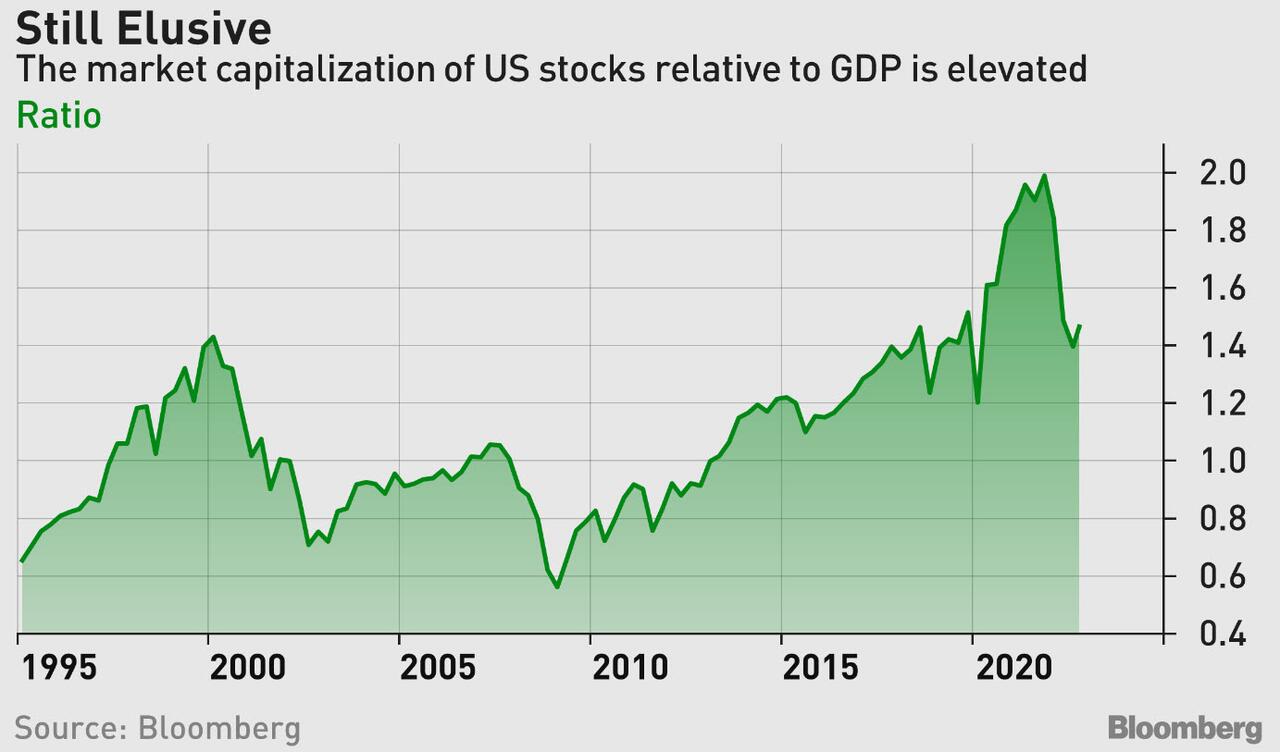
11/22: Is the stock market over-valued?

Price of a stock is supposed to go close to its value in the long run. But how does one determine value? We have talked about Shiller's P/E ratio. From your Finance class, you know that the "value" of a stock is its discounted future earnings. But cannot observe future earnings, so Shiller used a moving average of past earnings and found that stock prices seem to revert to about 17 times earnings.
The current Shiller P.E Ratio for the S&P 500 is 39.89. Last month the ratio was at 38.68, and a year ago was at 34.51. In fact, the ratio is now at its highest level in the last 20 years.
Another value metric is the total capitalization of the stock market relative to GDP (From Zerohedge).  

Wednesday, November 9, 2022

How higher interest rates bring down inflation.


The above graph shows a sharp drop in mortgage applications (to buy houses).  This is how the Federal Reserve is trying to reduce inflation:  by raising interest rates, they reduce demand for capital spending, e.g., equipment, cars, and houses, where you typically borrow to make the purchase. 

As demand for goods and services falls, their prices start falling as well.  From CalculatedRisk.com

Recently we've seen used car prices down over 10% and framing lumber prices down 33% 

Currently inflation is running close to 9%, and many expect the Fed to keep raising interest rates until the rate of annual price increases drops to around 2%. 

WSJ: EU Doubles Down on Big Government

WSJ reports:

Unlike during the financial crisis, the eurozone crisis and the pandemic, free-spending governments are on a collision course with the [European Central Bank], which has raised interest rates at its fastest-ever pace to cool inflation. The eurozone’s inflation rate rose to 10.7% in October, a fresh high, while price growth in the U.S. slowed to 8.2% in September.
...The IMF last month urged Europe to cut state spending to support central banks in the fight against inflation
As interest rates go up, firms' cost of capital increases, and fewer investments are made, e.g., in capital equipment, in houses, cars. As spending decreases, incomes also decrease because one person's spending is another's income (this is the "Keynesian Multiplier" in your Macroeconomics class).

Friday, November 4, 2022

Benefits of inflation?


The only other time in US history that our debt/GDP ratio was as high as it is today was after WWII (link).  High inflation in the following three years (8.5%, 14.4%, and 7.7%, link) reduced the real amount (in deflated dollars) that we had to pay back. Lenders (debt holders) lost, but borrowers (the US govt) won.

HT:  Cramer

Wednesday, November 2, 2022

Bidenomics: US turning into France

 You know the President's in trouble when the left-leaning Economist goes off on him:

Joe Biden’s colossal economic stimulus in early 2021 first set inflation on its feverish trajectory, before Russia’s invasion of Ukraine sent prices spiralling further. Voters may soon punish him for it, among other perceived excesses....
Mr Biden has signed three landmark bills, on infrastructure, semiconductors and the environment, which together contain plans to spend $1.7trn. With his executive actions, these amount to full-blown industrial policy. The result is unlike anything seen since Congress threw its weight behind America’s car- and chipmakers in the 1980s. The government will dole out $180bn in subsidies and tax credits to local firms over the next five years. At 0.7% of gdp, that is more than supposedly dirigiste France.
Dirigisme: an approach to economic development emphasizing the positive role of state intervention. The term dirigisme is derived from the French word diriger (“to direct”), which signifies the control of economic activity by the state.

Bank strategies are changing in response to Fed Policy

Wells Fargo, the bank most reliant on Home Mortgages is laying off employees:
The ranks of mortgage loan officers, who mainly earn commissions from closing deals, is expected to drop to under 2,000 from more than 4,000 at the start of the year, according to one of the people. Many salespeople haven’t closed a single loan in recent weeks, this person said. 

And changing strategy:

Among the six biggest U.S. banks, Wells Fargo has historically been the most reliant on mortgages. But that has begun to change under CEO Charlie Scharf, who has said that the bank is looking to shrink the business and focus primarily on serving existing customers.

What happens next in Russia?

From The Economist:
questions that weigh heavily these days on the minds of the Russian elite, its bureaucrats and businessmen, as they observe the Ukrainian army advancing, talented people fleeing Russia and the West refusing to back down in the face of Vladimir Putin’s energy and nuclear blackmail. “There is a lot of swearing and angry talk in Moscow restaurants and kitchens,” one member of the elite says. “Everyone has realised that Putin has blundered and is losing.”
To fill this power vacuum, those who provide support to President Putin's regime may soon re-focus their energies (and armies) on fighting for power in a post-Putin world. 

This is analogous to what happens in a prisoners' dilemma: self interest (struggling for power in a post-Putin world) trumps group interest (supporting Putin's regime).

Monday, October 31, 2022

Truth in Education: which majors go into which jobs?

Research from Conlon & Patel showing that "many more students expect to attain their major’s stereotypical career than actually work in that job: 

  • 65% of prospective art majors expect to be artists (only 17% are), 
  • 63% of biology majors expect to be doctors(23% are), 
  • 42% of communications/journalism majors expect to be writers or journalists (4% are), 
  • 62% of psychology majors expect to be counselors (21% are), 
BOTTOM LINE:
  • Majors more likely to end in disappointment:  "—e.g., fine arts, humanities, communications, psychology—have both rare stereotypical careers and low-paying alternatives." 
  • Majors less likely to end in disappointment: "STEM, business, education, and nursing, either because these majors’ stereotypical careers are objectively quite common or because wages are high even for those who end up in non-stereotypical careers."
Related Information on choice of majors (past blog posts)

Friday, October 28, 2022

What happens when you reduce a wealth tax?

 Evidence from Switzerland:

...1 percentage point drop in a canton's wealth tax rate raises reported taxable wealth by at least 43% after 6 years.  
Wealth reported to the government goes up because: 
  • Less tax evasion as the benefits of evading the wealth tax decrease (Ch03); 
  • Wealthy people migrate to lower-tax areas (Ch02); and 
  • House prices rise, increasing wealth, as the benefit of living in a lower-tax area increase housing demand (Ch09).
BOTTOM LINE:  markets discipline governments.