Showing posts with label 14. Indirect price discrimination. Show all posts

Tuesday, November 10, 2026

When Personalized Pricing is the Opens the Door to Bargaining


Online retailers often send discount offers to shoppers who abandon their carts without completing a purchase. Customers who buy immediately reveal a willingness to pay the posted price, while those who abandon their carts may need a discount to complete the sale. A recent Fortune article describes how retailers use these offers to recover lost sales. If buyers behave passively, the strategy makes sense. The retailer charges full price to customers with high willingness to pay and offers discounts to those who appear more price-sensitive.

But what happens when buyers figure out the strategy? A 2026 Omnisend survey found that as many as 60% of American respondents sometimes abandon shopping carts expecting a discount or reminder email. What began as price discrimination becomes bargaining: customers strategically withhold their purchases to induce a better offer. Even customers willing to pay full price now have an incentive to pretend otherwise. The retailer's attempt to identify low-willingness-to-pay customers can backfire by teaching high-willingness-to-pay customers how to get lower prices. Strategic behavior by buyers could blunt the price premiums sellers expect from personalized pricing.

Saturday, October 10, 2026

The Razor-and-Blades Strategy Comes Full Circle

The Oura Ring looks like an ordinary piece of jewelry, but it contains sensors that continuously monitor heart rate, body temperature, sleep, activity, and other health indicators. Unlike a smartwatch, it has no screen, doesn't display messages, and doesn't make calls. Instead, it sends information to a smartphone app that analyzes sleep quality, recovery, stress, and overall health. The newest Oura Ring starts at around $399, comparable to many smartwatches with similar capabilities. But while most smartwatches include their core health-monitoring features in the purchase price, Oura charges an additional $5.99 per month or $69.99 annually for access to detailed health information and personalized insights.

This resembles the familiar razor-and-blades pricing strategy: sell customers a durable product, then earn recurring revenue from the complementary products or services needed to get its full value. Oura's recent IPO filing suggests the strategy is working. Approximately 94% of ring activations convert to paid memberships, and about 85% of paying members remain subscribed after 12 months. Subscriptions account for roughly 20% of revenue but earn gross margins approaching 90%. By separating the price of the device from the price of the information it produces, Oura turns a one-time hardware purchase into a continuing stream of high-margin revenue.

Monday, May 25, 2026

Selling Mattresses on Memorial Day

A nagging thought kept creeping into my more somber thoughts this Memorial Day. Why did retailers turn a day of remembrance into an opportunity to sell large consumer goods?

Wikipedia provide a nice history of the holiday but a short piece by McNutt & Partners explains some retailing aspects. For generations after the Civil War, it was called "Decoration Day" during which acknowledgement for the sacrifices of the dead were paired with commemorations meant to instill pride for country. It was renamed "Memorial Day" after WWII but a more significant change occurred in 1971 when it was moved from May 30 to create a three-day weekend. This made possible quick vacations and more time to consider large irregular purchases. 

In economic terms, it concentrated demand for mattresses, and similar big-ticket items, into a single weekend (and then two weeks around the date). This is efficient if there are economies of scale so that retail costs fall with sales volume. This may also permit some price discrimination as those who are more demand elastic seek out these deals and schmucks like me pay higher prices the rest of the year.

Thursday, April 30, 2026

Saturday, March 7, 2026

How Vail changed the economics of skiing

WSJ:
Ski resorts used to be weather-dependent businesses — essentially farmers who grew snow. Bad snow year, bad revenue. In 2008, Vail CEO Rob Katz asked a different question: what if we could sell skiing in advance, before anyone knew how good the conditions would be? The Epic Pass was the answer.
The business model is textbook: bundle access to dozens of resorts onto a single pass, price it attractively, sell it in the offseason, and collect nearly $1 billion in revenue before a single lift spins. Weather risk transfers from the firm to the customer. Cash flow becomes predictable. Vail can now plan capital investments, acquire more resorts, and grow — all without watching the sky.
The tradeoff is equally textbook. To make the pass look cheap, you make day tickets look expensive — some now top $300. That's not accidental; it's price discrimination by design, nudging committed skiers toward the bundle. The side effect is crowded slopes and squeezed independent resorts that can't compete with a bundle their customers already bought.

Monday, October 27, 2025

Irony: quitters are making tobacco companies rich

   ANALYSIS from the Economist:
When lots of people smoked, there were many “price-elastic” consumers. In plain English, they were sensitive to increases in the cost of a cigarette. As more people have quit, however, only the most committed smokers are still puffing. Companies have responded by raising prices at an ever-quicker pace.

MY COMMENT:  In chapter Chapter 6, the simple linear demand curves get more price elastic as price increases. But for cigarettes, higher prices make the more-price-elastic consumers stop smoking. The remaining smokers have less elastic demand, so demand becomes less elastic as price increases. This allows tobacco firms to raise price more--and earn higher profit--than they other otherwise would.

You can also understand this using the language of Chapter 14 (indirect price discrimination), with two groups of consumers with different elasticities of demand. At lower prices, both groups consume, but at higher prices, only the less-price-elastic group consumes. Firms optimally raise price and earn higher profit by serving only the less price-elastic group.

An obvious question raised by this interpretation is why didn't firms simply raise price so that the less elastic consumers quit and then reap higher profit from the higher prices. One possible answer is that the tobacco companies didn't know. It was only when so many snokers quit that they realized the remaining ones had much less elastic demands.

Friday, September 26, 2025

McDonald's is Repricing Combo Meals

The WSJ recently reported that McDonald's is working with franchisees to keep combo meals, e.g., Big Mac, fries, and a drink, 15% lower than the sum of the individual item prices. They have been losing low-end customers who may be more receptive to a cheaper value menu. Bundling the different items entices me to buy fries when my waistline, and wife, say I really shouldn't. I just came for the sandwich and drink, but the price of the fries could be maybe 40% cheaper now.


Saturday, June 21, 2025

Anchor Shock Pricing: How Vail makes most of its money

In 2008, 65% of skiers at Vail Resorts bought single-day lift tickets. Today, 75% of their customers purchase season passes, committing thousands of dollars months before the first snowfall.
People are shocked by the $329 daily ticket price and then realize that “If I ski just 3-4 days this season, the annual pass pays for itself!” 

In other words, Vail "anchors" price expectations at $329, and then offers consumers dramatically lower average daily prices with the annual pass, and they switch. This is akin to bundling as a form of indirect price discrimination but includes a bit of psychology. 

CITE:  DemandCurve.com 

HT: Justin

Monday, June 3, 2024

Costco's Price Discrimination


There is a great episode of the Acquired podcast about the Costco business model. It is three hours long and full of history, anecdotes, and, importantly, lots of business insights. One is just how important two-part pricing is to their business model. Customer/members pay an annual membership fees to pay much lower prices. Costco limits product markups to 14% when the standard for traditional retailers is 100%. This means that 70% of the net income is from memberships and only 30% is from retailing. Another is how scale economies feature throughout their operations, from pallets on the floor to the Kirkland Signature brand. Their low margins and scale economies are meant to deliver huge consumer surpluses that they then extract with the membership fee.

Sunday, March 3, 2024

The Economics of Skiing

Vail's two-part pricing (Fixed Fee + Low Daily Price) from The Economist:  

With the Epic Pass, Vail has changed the offer. Skiers can now get unlimited skiing at a whole pack of resorts cheaply, but only by committing before the season starts. The result, says Stuart Winchester, who runs the Storm Skiing Journal, an industry blog and podcast, is that for the first time in decades skiing in America is reliably profitable. But it has come at a cost to competition. “Everyone else is swimming around. Vail is buying everything,” he says.
Vail now owns 41 resorts, including more than two dozen tiny hills on the East Coast and in the Midwest, which they consider “feeder” resorts that nurture new skiers who eventually may come west. In 2018 a competing pass, the Ikon, was launched by the Alterra Mountain Company, owned by the billionaire Crown family of Chicago, which shares revenue with independent resorts. Nowadays, most of America’s biggest ski areas are on one or the other pass.

Saturday, February 17, 2024

Four Myths about Price Discrimination

In an earlier post, Soda Prices are Too Low for the FTC, the Biden Administration seems to be trying to turn back the clock to a time when price discrimination was viewed as bad.  Lest we repeat the mistakes of the past, it is worthwhile to remember its lessons.   

 See this 2003 talk by some middling FTC economists. Here the conclusions:  


BOTTOM LINE:  Determining the role that price discrimination plays in antitrust enforcement typically requires the kind of difficult and time consuming economic analysis the Biden administration is trying to avoid.
Cooper, James C. and Froeb, Luke M. and O'Brien, Daniel P. and Tschantz, Steven T., Does Price Discrimination Intensify Competition? Implications for Antitrust (2005). Antitrust Law Journal, Vol. 72, No. 2, pp. 327-373, 2005, George Mason Law & Economics Research Paper No. 14-30, Available at SSRN: https://ssrn.com/abstract=2470135
Werden, Gregory J. and Froeb, Luke M., Can the FTC Turn Back the Clock? (August 15, 2021). Antitrust Magazine Online, Oct. 2021, Available at SSRN: https://ssrn.com/abstract=3909851

Friday, November 25, 2022

Tesla "Crimping?"

Alex Tabarrok over at Marginal Revolution thinks Tesla may have unwittingly committed a marketing faux pas. As Hurricane Irma bears down, they expedited an over-the-Internet update to the cars' software to extended battery life.
Tesla owners in Florida may be grateful for this mileage boost as they escape the ravages of Irma but I suspect that some of them will be upset when they have more time to reflect. How could Tesla increase the mileage at the flick of a switch? The answer is that owners of the Tesla 60kWh version of its Model S and Model X actually have the same battery as the 75kWh vehicles but the battery has been purposely limited or “damaged” to provide only 60KWh of mileage. But why would Tesla damage its own vehicles?

The idea of offering both premium and discount versions is common, as is purposely 'damaging' the product one so as to make the discount version perform more poorly than the premium version (i.e. "Crimping").

In this case though, there may have been no deception. There is a report that owners may have opted not to pay for the better battery life.

Friday, June 10, 2022

EVs and VGs are the new Razors and Blades


Sony is partnering with Honda to make a new EV automobile. What does Sony bring?

The car business “is shifting toward EVs, and at the same time they’ll be hooked up to a network, so they’re being turned into a tech product,” Mr. Yoshida said.

and

Currently, drivers’ ability to enjoy a Sony movie or videogame is limited by the need to keep their eyes on the road, but Mr. Yoshida expressed hope that full autonomous driving would spread in the next few years. 

Without having to watch the road, drivers, or rather riders, can enjoy some Sony entertainment. It looks like Sony will implement the common video gaming pricing model popularized by Gillette a century ago of "giving away the razor, to sell the blade." That is, set a low margin on the "system," in this case the autonomous EV, to charge more for the accessories, in this case, connected games and entertainment. This sort of metering price discrimination means that hardcore rider/gamers who consume more entertainment and receive more surplus will be paying larger margins. More casual rider/gamers who consume less will pay less.

Thursday, July 15, 2021

Price Changes by Product

Mark Perry has updated and discusses an important graphic. Follow the link to get further insights but I want to focus specifically on the prices for college textbooks below. It is the only one in which the trend has changed. Why?


There are more open source materials available, but I doubt they are widely used. I conjecture that this is due to reduced piracy. It is so easy to scan and post online a PDF version of a textbook that publishers had expected a >50% drop in sales in each successive year of a new edition. (This had also caused a reduction in the time between editions.)

However, a few years ago, textbook publishers adopted a new strategy of pushing online textbooks that came bundled with lots of other online material (my favorite textbook included). Among the online material were assignments, quizzes, and test materials whose scores can be embedded directly into an instructor's Learning Management System (LMS) like Canvas or Blackboard. This meant students needed to subscribe to the online material to complete these assignments needed for their courses. I suspect this caused the amount of piracy to plummet and this negated both the constant need for publishers to stamp out piracy and the rationale for constant price increases. These are testable implications with the right data.

Are market innovations at work with other pirated information goods? Subscribers to music streaming platforms like Spotify and Pandora that bundle huge libraries of songs have little need to search for a pirated song. In this case, each service has access to practically the entirety of recorded music. Video is different. Much of the content on Netflix is not available on Apple+ or Peacock. Each service is a bundle of non-overlapping content. Unless one subscribes to them all, there is still an incentive to pirate a highly-desired, but unavailable, movie.

Wednesday, April 14, 2021

The Disneyland Dilemma

Some vintage Disneyland ticket books reminded me of Walter Oi's famous paper "A Disneyland Dilemma: Two-Part Tariffs for a Mickey Mouse Monopoly." He highlighted the two-part tariffs as part of their price discrimination scheme.

  1. The simplest rides, appealing to the younger children, such as Sleeping Beauty Castle Walkthrough or the King Arthur Carousel, required only the cheaper A tickets. The best rides, such as the Matterhorn Bobsleds or Pirates of the Caribbean, required the most expensive E ticket. In between, rides could go for a B, C, or D ticket. Already Disneyland is price discriminating based on demand elasticity across rides.
  2. Disneyland made convenient ticket books with various numbers of each type available for a discount. There never were enough E tickets. This was an initial form of bundling.


  3. Next, Disneyland adopted Oi's two-part pricing. They set ride prices equal to marginal cost, essentially zero, but then required a high up front park admission fee.

  4. Next, they adopted multi-day and multi-park passes with a decreasing price for each additional day or park. They also offered season passes that were popular to locals who could visit parks on non-consecutive days. These are versions of quantity discounts.
  5. Finally, there exists a Disney Golden Pass that allows unlimited lifetime entrance to nine parks. However, it appears to be only given out to dignitaries and Disney officials.


Thursday, March 4, 2021

Really Complex Pricing


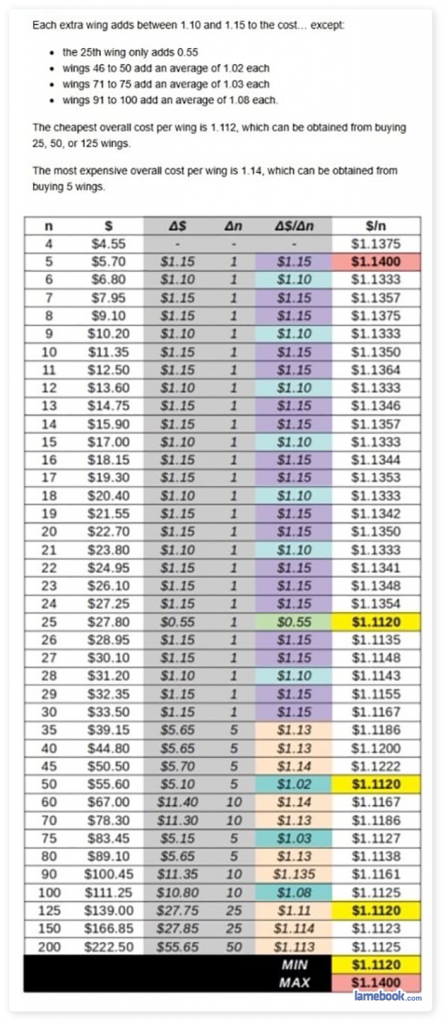
A Chinese restaurant in West Philly called Danny's Wok has the weirdest pricing structure for chicken wings. The price per additional wing may fall ever so slightly, but will rise every so often so that the average price per wing never falls much. It was so weird, it generated some buzz as many on twitter tried to make sense of it.


And at least a dozen people on twitter have tried to describe it. Some of my favorites are from math twitter:

Or from folks simply graphing the menu prices.


Perhaps, this was not  form of price discrimination after all but merely a clever ploy to get a bunch of free word-of-mouth marketing. Toward this end, it worked wonderfully.