Showing posts with label 05. Investment decisions: Look ahead and reason back. Show all posts

Wednesday, September 9, 2026

Save Early Kids

One of the most valuable decisions in retirement saving is when to start. Over the 50 years from 1976 through 2025, the S&P 500 delivered a compound annual return of about 11.82%, including reinvested dividends. Suppose a young worker had invested just $100 each month in an S&P 500 fund and earned that historical compound return until age 65. Starting at age 25 would produce about $922,000. Waiting until 30 reduces the ending balance to about $523,000, while waiting until 35 reduces it to about $295,000. Scraping together $100 when you are 25 is difficult, but if you can do it consistently, voila you will become a millionaire.

What makes the comparison striking is how little of the difference comes from the contributions themselves. Doubling your set-aside each month will merely double the ending balance. But by starting at 25 versus 30, you contribute only $6,000 more yet finish with roughly $399,000 more. Save 15% more and finish with 76% more. Compared with starting at 35, the early saver contributes just $12,000 more but finishes with about $627,000 more. The reason is compound growth: dollars contributed early earn returns, those returns earn returns, and the process repeats for decades. Of course, future stock returns may be lower than the past 50 years, and actual returns are anything but smooth. But the lesson does not depend on the return so much. The opportunity cost of waiting to save is not primarily the contributions you miss, it is the decades of compound returns those contributions could have earned.

You can use the SEC site to do your own “what if” scenarios.

Friday, June 19, 2026

Rethinking Strategy at Cracker Barrel

Julie Felss Masino was recruited to become the new CEO of Cracker Barrel in 2023 to reinvigorate the brand. Should strategy focus on growing demand by increasing attractiveness to new customers or should it focus on keeping existing customers comfortable? As the WSJ reports, it opted for the former:

The goal was to modernize its stores, menu and design to help bring new customers to the vintage chain. The company had seen some promising results from food updates and marketing tie-ins when, as part of a fall marketing campaign in 2025, it unveiled a new, simplified logo.

And then Cracker Barrel became an unexpected flashpoint in the culture wars. The new logo was described as "going woke" and the changes alienated many of its more traditional patrons. Visits plummeted and the company lost $100 million in market capitalization in a week.

Well that didn't work. To her credit, Masino quickly reversed course.

She cut ties with the marketing firm behind the chain’s rebranding campaign and revamped the company’s leadership structure, bringing back a former vice president for menu strategy and elevating a veteran field operator to oversee store operations. 

They doubled-down on the traditional experience. Even the old logo has returned. The pivot seems to be working. Customers are beginning to return and the share price is rebounding, though not to the $60-$70 range prior to these events.

A strategic decision is a sunk cost. Abandon it when new information indicates a mistake.

Tuesday, June 9, 2026

AI and the Shrinking Firm

The way that Artificial intelligence (AI) is changing worker productivity may also be changing the optimal scale of the firm itself. According to a recent Axios report, AI-powered tools are enabling entrepreneurs to launch and operate businesses with little or no staff. Tasks that once required specialists in coding, graphic design, marketing, customer support, and bookkeeping can increasingly be performed by a single entrepreneur assisted by AI. The result is a growing number of "one-person firms" capable of generating revenue levels that previously required a small team. This contrasts with the trend since the industrial revolution in which ever more mechanization generated ever greater economies of scale and ever larger enterprises.

Some aspects of AI fit nicely into theories of the firm.

  •          Transactions costs can be reduced by engaging with AI rather than an employee.
  • AIs eliminate employee principal/agent issues.
  • However, a more personalized AI may represent a relationship-specific sunk cost that can lead to holdup.

Tuesday, May 12, 2026

Lessons from Sweden's Capitalist Makeover

WSJ:
  • By 1990, center-left raised taxes/spending to 70% of GDP
THEN:
  • cuts to unemployment, housing subsidies, pensions
  • privatization of public services
  • cuts to taxes
  • Limit govt. debt to 36% of GDP (vs 129% U.S.)
  • govt. spending drops to 24% of GDP (vs. 30% for France, Italy)
  • Businesses invent new technologies.
  • GDP, house prices, and inequality soar
LESSONS:  
  • Incentives drive innovation and inequality
  • Innovation drives 2% growth: income doubles in 36 years
HT:  Justin

Friday, March 13, 2026

Elizabeth Warren's plan to keep poor people in apartments, and out of homes

...“Warren is deliberately trying to choke off investment in the construction of new single-family rental properties. This is profoundly regressive. Why is it OK for large investors to build and rent out apartments but not single-family homes?” He adds: “Warren’s policy effectively helps rich people keep working-class renters out of their towns.” ...
BOTTOM LINE: More investment increases supply which reduces price.

Saturday, March 7, 2026

What happens if we raise our capital gains tax?

Senate Democrats want to raise the top federal capital gains tax rate to 35.8% — which, combined with state taxes, would hit nearly 50% for investors in California or Maryland. That would be the highest rate since 1978. For comparison:
  • China has a 20% rate. 
  • The European average capital gains tax is 17.9%.
The higher rate will have two effects: 
  • Less investment: A higher tax on the returns to investment means that fewer US investments would have a positive NPV.
  • Lock-in: since the tax only triggers when assets are sold, investors would hold appreciated assets longer than they should, freezing capital in old uses instead of letting it flow to better ones. 
BOTTOM LINE: Investment and the resulting growth double our standard of living every 40 years.  This tax would change that.    

Thursday, March 5, 2026

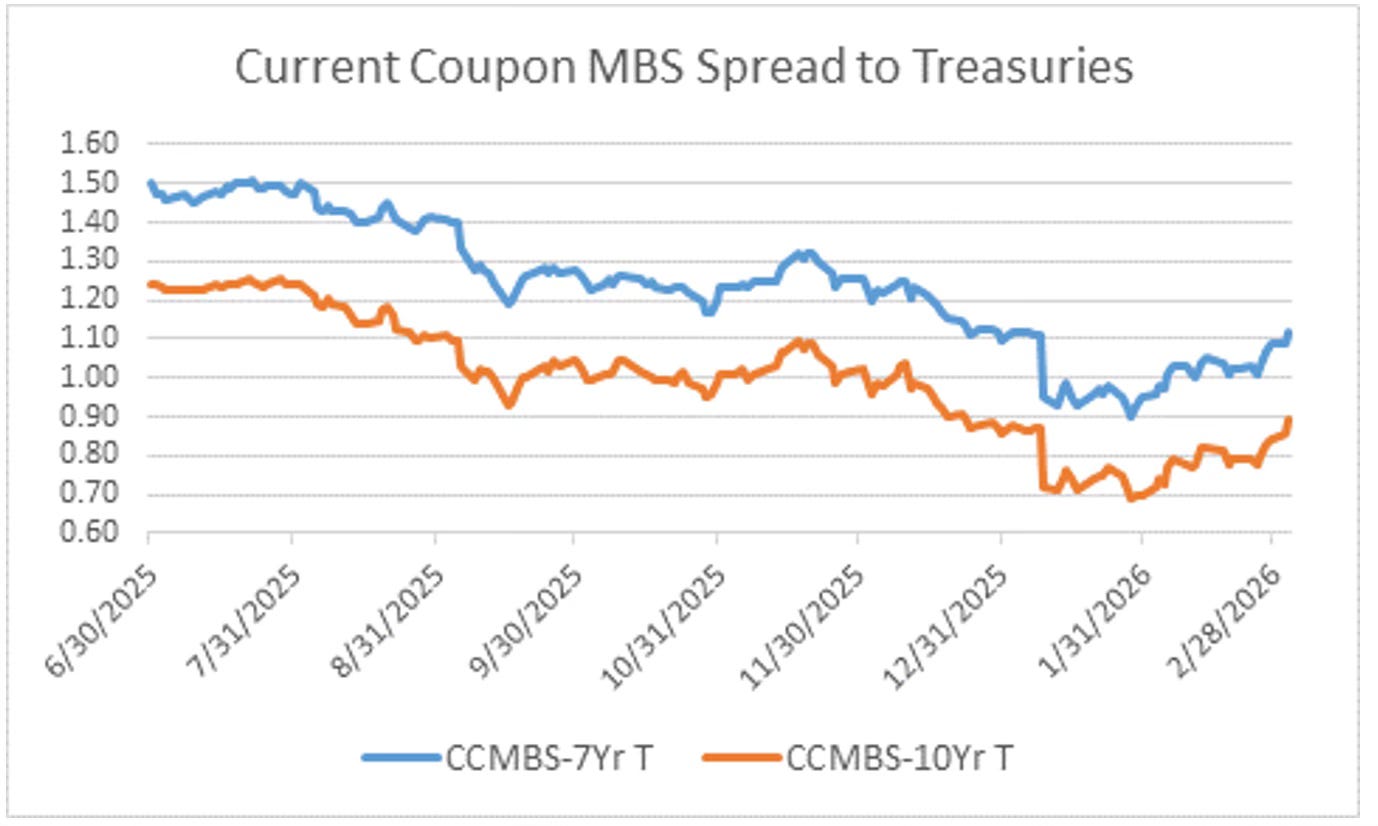
QUESTION: Why have mortgage interest rates gone up?

CalculatedRisk
CCMBS/Treasury spreads, in contrast, widened significantly last month
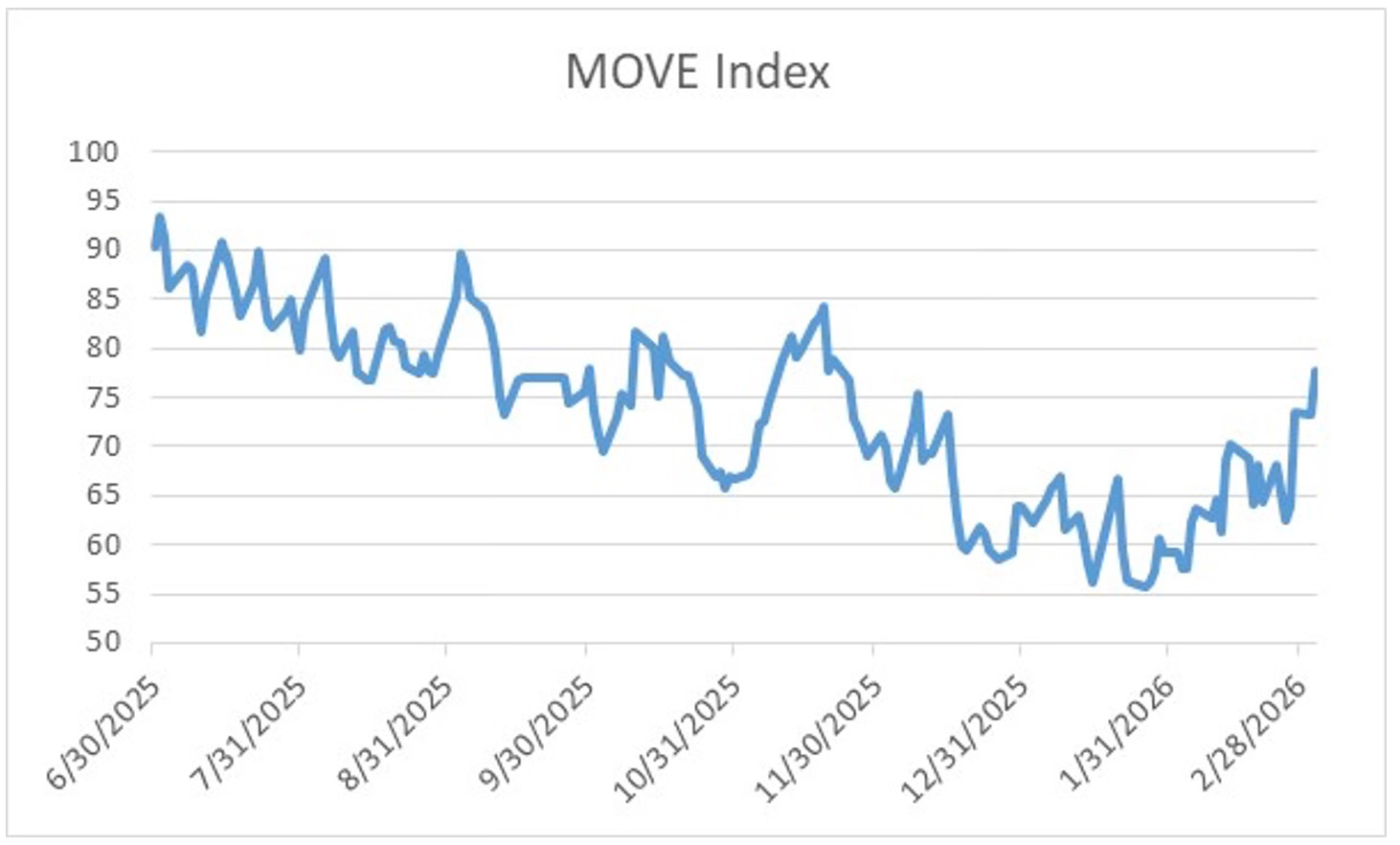
One reason CCMBS/Treasury spreads have widened since January is that implied and actual interest rate volatility [a measure of risk] has increased ... Below is a chart of the MOVE index, a measure of implied interest rate volatility from options on Treasury securities across the curve.

Monday, December 15, 2025

European Pensions are in bad shape

Europe’s fastest-ageing countries also already offer some of the most generous pensions and lowest retirement ages. The average French retiree now spends 23 years drawing a pension, longer than in any other OECD country (see chart below). In Denmark, by contrast, pensioners draw one for 19 years on average. Its government plans to raise the retirement age from 67 to 70 by 2040, which would be the highest in Europe.

Saturday, October 4, 2025

EU Labor Laws crush innovation.

Economist:
...the sheer difficulty of shedding staff en masse—a reality of corporate life—steers Europe’s biggest companies away from making risky bets in innovative fields.
BOTTOM LINE: Look ahead and reason back: if you cannot fire workers, no company wants to hire.

Saturday, May 17, 2025

Why the U.S. Produces More Unicorns than the EU

The United States has produced about twice as many unicorns (private startups valued at $1B+) as China and more than four times as many as the European Union. These numbers reflect institutional and cultural advantages in the U.S. startup ecosystem.

Table: Number of Unicorns Created Since ~1990

Region Cumulative Unicorns
United States ~1,950
China ~970
European Union ~450

Source: Estimates based on Hurun Global Unicorn Index 2024 and Strebulaev & Gornall, Stanford Venture Capital Initiative. Includes both active and exited unicorns created since ~1990.

Why the Disparity?
  • Tolerance for Inequality:  The US gap between rich and poor is bigger than in any other advanced country, but most Americans want to join the rich, not soak them. The EU taxes inquality.
  • Bankruptcy Laws Forgive Failure: U.S. founders can declare bankruptcy and get a clean slate in ~7 years. EU bankruptcy regimes are often punitive, with long-term credit restrictions. That discourages risky ventures. The U.S. treats failure as a résumé item, not a moral failing.
  • Unified market: A U.S. startup can scale across 330 million consumers under one legal system. EU startups must navigate 27. It's harder to grow when your “domestic market” includes multiple languages, tax codes, and regulations.
  • University spinouts: U.S. research universities are world leaders in tech transfer. Stanford alone has spun out over 200 unicorns. The Bayh-Dole Act helps universities commercialize IP. Europe is catching up, but still lags.
  • Easier exits (acquisitions) lead to more entryinvestors require an exit.  
  • Immigration to the US Nearly half of U.S. unicorn founders were born outside the U.S. If you have a good idea, you can more easily act on it in the US.
  • Lighter regulation: U.S. startups face less red tape. European data/privacy rules (e.g., GDPR), strict labor laws increase fixed costs and reduce flexibility.

Acknowlements:  This post based on research begun by Annie Cox, and Avi Goldberg, and Jack Underwood and finished by ChatGPT.  

Friday, May 16, 2025

How to raise kids in the age of AI

FreePress: AI Will Change What It Is to Be Human. Are We Ready?
...If you raise your children with the uncritical expectation that if they work hard they can be a top person in their field, they will be disappointed. The skill of getting good grades maps pretty closely to what the AIs are best at. You would do better to instill in your kids the quality of taking the initiative and the right kinds of intellectual humility. You should also, to the extent you can, teach them the value of charisma, making friends, and building out their networks.

... 

  • Don’t set up being the smartest person in the room as the goal. Encourage them to develop to their fullest, challenge themselves, and to be virtuous. 
  • Encourage them to find many sources of meaning and social connection. They should develop hobbies and learn how to do self-directed projects, and actively seek out friends. 
  • Make it clear that meaningful endeavors don’t necessarily have to be compensated. Work is one way to contribute, but volunteering, making art, and building a family are some of the many others. 
  • Familiarize them with AI. Teach them how to learn from it and how to let it augment them. 
  • But choose their AI carefully! Don’t let them fall prey to the attentional black holes that will be built and offered to them. 
  • Don’t teach them to expect stability. Make it clear the world will likely change a lot, but that this change brings opportunities for them.

Sunday, March 30, 2025

Remove barriers to progress!

Open Philanthropy's Progress and Growth Fund
  • ...scientific and technological progress that creates ideas is the main driver of long-run growth...But ideas don’t automatically raise living standards; economic growth requires turning them into technologies that can disseminate throughout society. 
  • Burdensome government regulations and institutional constraints are increasingly slowing the pace of this progress and creating artificial scarcity. 
    • Restrictive zoning and land use regulations have created housing shortages in many major cities, driving up rents and preventing people from [moving to] to centers of economic growth and innovation. 
    • Similar constraints hinder scientific and technological innovation — key institutional funders ...burden researchers with excessive paperwork and overly lengthy grant review processes, [leading to] low-risk, incremental research over higher-risk but potentially transformative ideas. 
    • ...environmental review laws slow a wide variety of infrastructure projects, including green energy. [Irony is my favorite kind of humor.]

Friday, March 7, 2025

Tariffs May Not Boost Domestic Investment

Alcoa would seem to benefit from an increase in demand for domestically produced aluminum from the imposition of 25% tariffs on steel and aluminum. All they have to do is ramp up existing US capacity. This quote from Alcoa CEO William Oplinger.in the WSJ suggests maybe not.

“We make decisions around aluminum production that have a horizon of 20 to 40 years,” he said. “We would not be making an investment in the United States based on a tariff structure that could be in place for a much shorter period of time.”

Who knows what tariffs would be under the next administration. Instead, he is bracing for a loss in 100,000 U.S. aluminum industry jobs due to tariffs targeting the metal. He is not explicit, but this would be the case if customers plan to cut back purchases due to their reduce operations or their ability to find cheaper substitutes. 

Sunday, February 9, 2025

Is your master's degree worthless?

Economist:
In America returns are especially large in computer science and in engineering. They are slightly smaller in other science subjects, in part because an undergraduate degree in these already bumps up salaries by quite a lot. Teachers who bag graduate degrees in education tend to earn more, even if wages for the profession as a whole are fairly low, because many American school districts automatically raise the pay of those who have them.

Friday, January 10, 2025

Is ESG investing illegal? In TX it is.

Breaking:
...US District Judge Reed O’Connor found that the airline breached its fiduciary duty ... by prioritizing ESG considerations over the financial interests of participants.  ... The court criticized American Airlines for allowing its asset manager, BlackRock, to advance goals unrelated to maximizing returns for plan participants.
“ERISA does not permit a fiduciary to pursue a non-pecuniary interest no matter how noble it might view the aim,” O’Connor said, according to separate reporting by Bloomberg Law. He went on to maintain that ESG investments “often underperform traditional investments by approximately 10%
See related posts:

Saturday, December 14, 2024

Advice for the new administration: Reform Social Security

 CATO:  Social Security ... operates like a Ponzi scheme: Paying benefits promised to earlier generations depends on new revenues from current and future workers. With an aging population, the worker-to-beneficiary ratio has been decreasing, making Social Security’s finances increasingly unsustainable ...

...Since 2010, the OASI program has added $1.08 trillion to the federal debt and is projected to add $4.1 trillion more by 2033, when the program runs out of borrowing authority and confronts a 21 percent shortfall.

  • Slow the growth in future benefits. Under the current system, initial benefits are adjusted based on wage growth, which typically outpaces inflation. [This would eliminate] 85 percent of the program’s long-term funding shortfall.
  • Modernize and reduce cost-of-living adjustments (COLAs). 
  • Social Security should return to its intended mission of alleviating old-age poverty. [limit benefits to the poor]

Friday, December 6, 2024

Advice to the New FTC Leadership

Here is the most important part (link): 

 II. Promote Innovation 
Since 2010, the U.S. economy has grown at a real rate of 1.74% per capita. At this rate, per capita income doubles every 40 years.4 When our kids turn 40, they will earn twice as much as we did.
Public policy—especially antitrust policy—should recognize that innovation drives growth, much of which comes from Big Tech and startups. Big Tech has provided consumers with more everyday value than any other small group of firms in history. And most startups “exit” via acquisition, not by going public. If the FTC prevents these exits due to concerns about lost potential competition, funding becomes harder to come by, which deters startups. The FTC should recognize these innovation incentives when setting enforcement priorities.
Here is press on the new Antitrust chief on "Taking on Big Tech and Beyond"
Slater will inherit a docket packed with blockbuster cases that aim to challenge the dominance of some of the world’s largest companies. These cases, many initiated during Trump’s first term, focus on allegations of monopolistic practices that harm consumers and stifle innovation.
Trump emphasized that Slater’s leadership will prioritize fair and vigorous enforcement of competition laws. “She will ensure that our competition laws are enforced, both vigorously and FAIRLY, with clear rules that facilitate, rather than stifle, the ingenuity of our greatest companies,” he stated.
The decision to place Slater in charge signals a continuation of the administration’s efforts to curb corporate concentration and promote competition across key sectors of the economy. With both Trump and Vance championing a tough stance on monopolistic practices, Slater’s tenure is expected to mark a pivotal chapter in the U.S. government’s approach to antitrust enforcement.