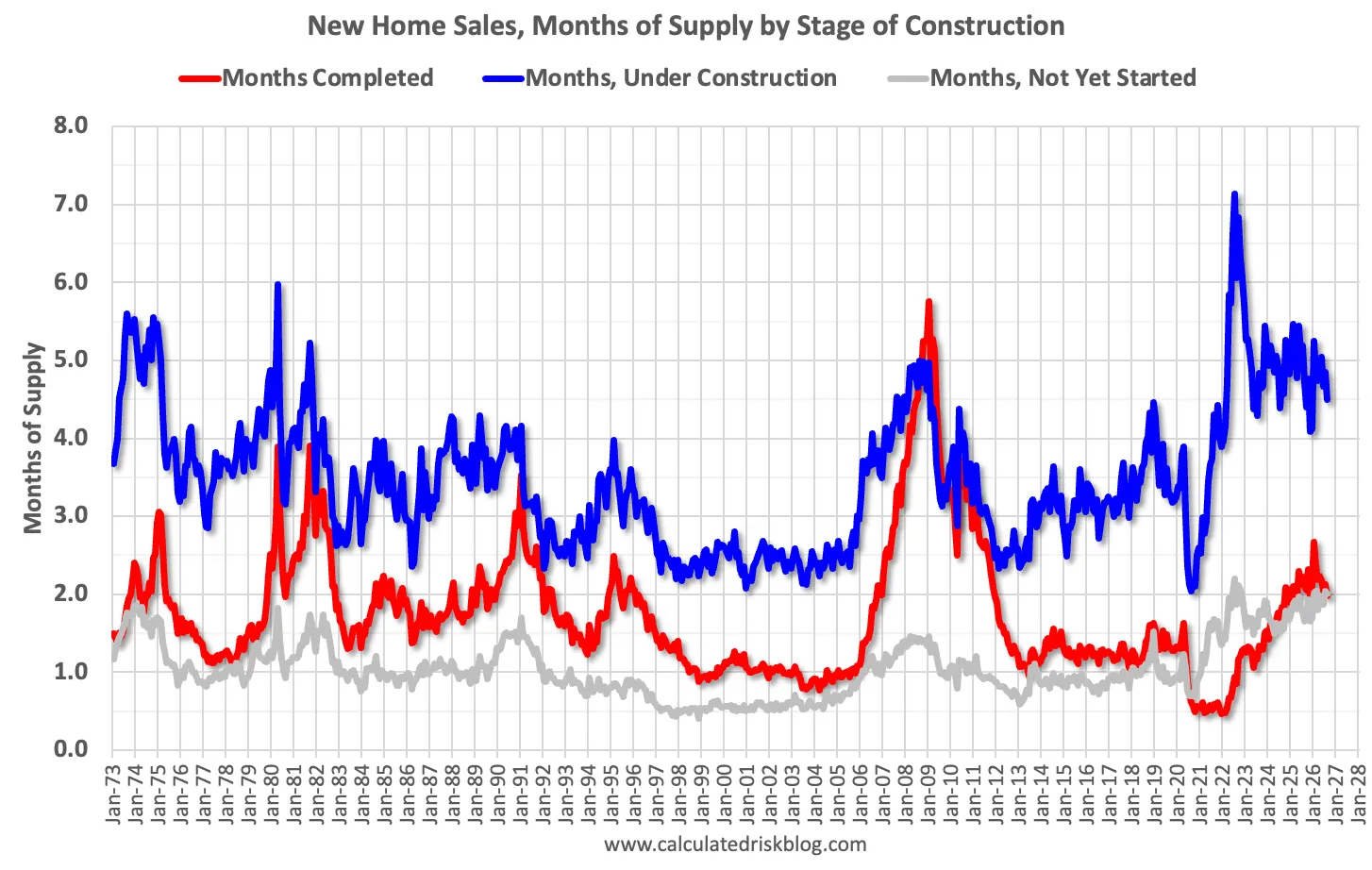
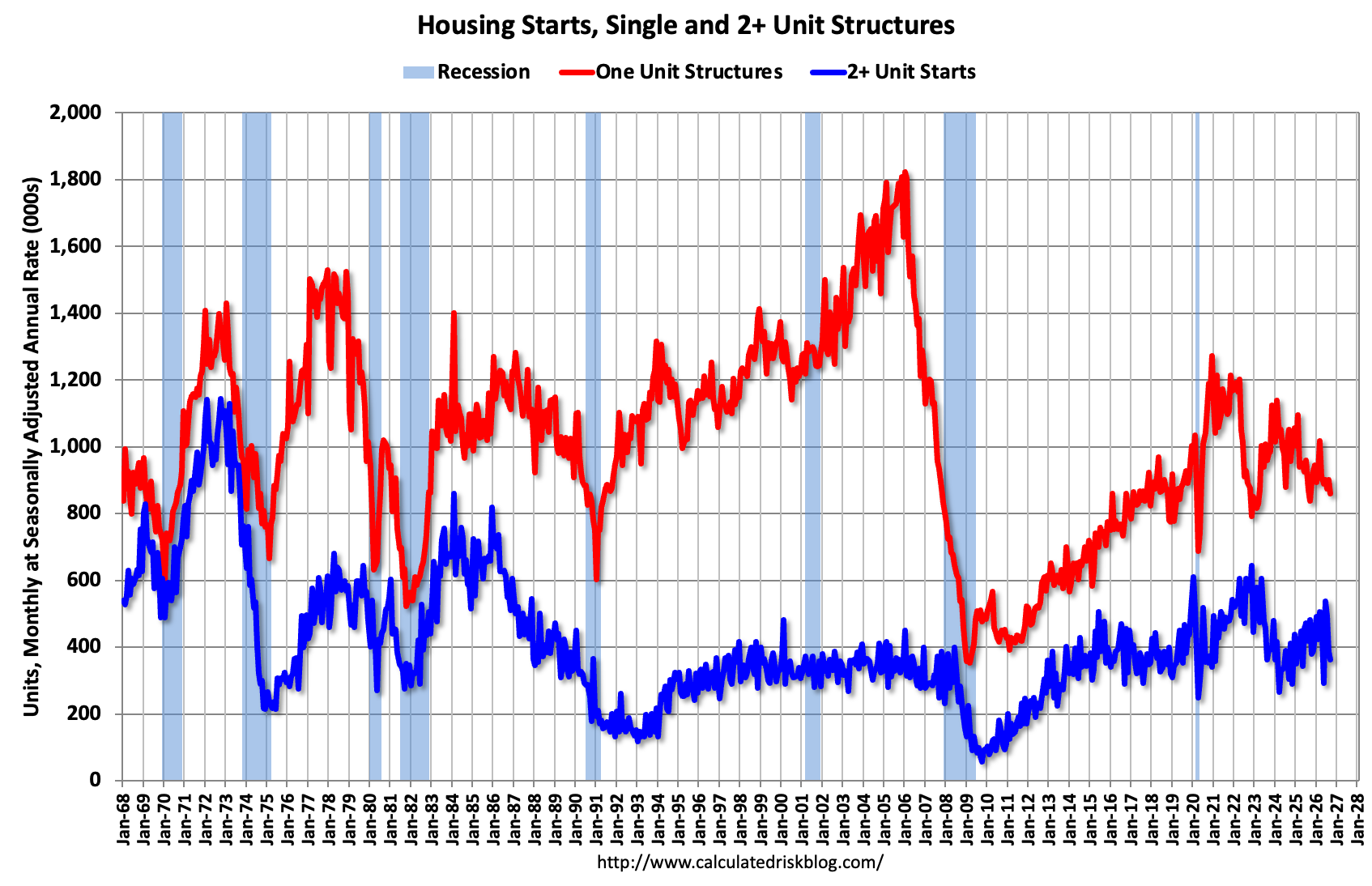
Since national house prices increased very quickly during the pandemic - up over 40% - it seems likely that some of the usual “stickiness” will not apply. I think the most likely scenario now is nominal house prices declining 10% or more from the peak, and real house prices declining 25% or so over the next 5 to 7 years.
Friday, October 16, 2026
CalculatedRisk Prediction: real housing prices will decline 25% over next 5-7 years
Friday, October 9, 2026
War Provides Arbitrage Opportunities
Arbitrageurs profit by buying where prices are low and selling where prices are high. But what happens when transporting the product is dangerous? According to The Wall Street Journal, oil producers in the Persian Gulf are paying $30–$40 million for tankers to make dangerous trips through the Strait of Hormuz. The tankers carry oil out of the Gulf and transfer it to other vessels for delivery to customers. Some sailors are being offered bonuses of up to $25,000 per trip. While buyers are reluctant to send their own tankers into the Gulf, producers are willing to pay extraordinary sums to get their oil to market.
The disruption has also affected oil shipments far from the Persian Gulf. Reuters reports that shipping two million barrels of U.S. crude from the Gulf of Mexico to China now costs approximately $80 million, or $40 per barrel, compared with just $8.60 per barrel before the war. The elaborate shuttle operations in the Persian Gulf have tied up tankers, reducing their availability elsewhere. Freight rates have risen so much that traders say the arbitrage opportunity for shipping U.S. oil to Asia has disappeared. Asian refiners are consequently considering alternative suppliers in the Middle East and Latin America.
The arbitrage cost is comparable in magnitude to the increase in Brent crude prices since the war began. The ability to exploit this form of arbitrage essentially put a cap on how much the price rose between between the well and the refinery.
Friday, August 7, 2026
Compensating differentials outlawed in Birmingham
From MarginalRevolution:
In 2010 an employment tribunal ruled that Birmingham City Council had discriminated against thousands (6,000) of female workers — cooks, cleaners, care assistants, caretakers — who were denied bonuses paid to the mostly male binmen, gardeners, and gravediggers (400). Why were the binmen given bonuses? Well, refuse collection is filthy, heavy, outdoor work and not many people want to be gravediggers.
Birmingham went bankrupt when they had to pay the bonuses to the 6,000 women and they went bankrupt. Then they eliminated the bonuses paid to the men, who then went on strike. Then:
The council hired an outside contractor to take over its rubbish collection and it now pays roughly triple its pre-strike outsourcing bill..
Thursday, June 4, 2026
Has the risk premium for owning stocks disappeared?
HOWEVER: That 3.7% is based on what companies earn today. Stock prices are high because investors expect much bigger earnings in the future, driven by AI. If those bigger earnings actually arrive, then the price you pay today is reasonable, and stocks aren't really overpriced after all.
BOTTOM LINE: The risk premium you calculate depends on which earnings you use — today's or the future's. The historical rule assumes today's earnings are a good guide to the future. If AI changes how much companies earn, that assumption breaks, and the real risk premium is unknowable until we see whether the growth shows up.
Monday, March 16, 2026
Changes in top income tax rates over last 20 years
WSJ:
Democrats warn that tax cuts will slash state revenue and services to the bone, ... Republicans caution that higher taxes will risk an exodus by wealthy residents who create jobs.
Thursday, March 5, 2026
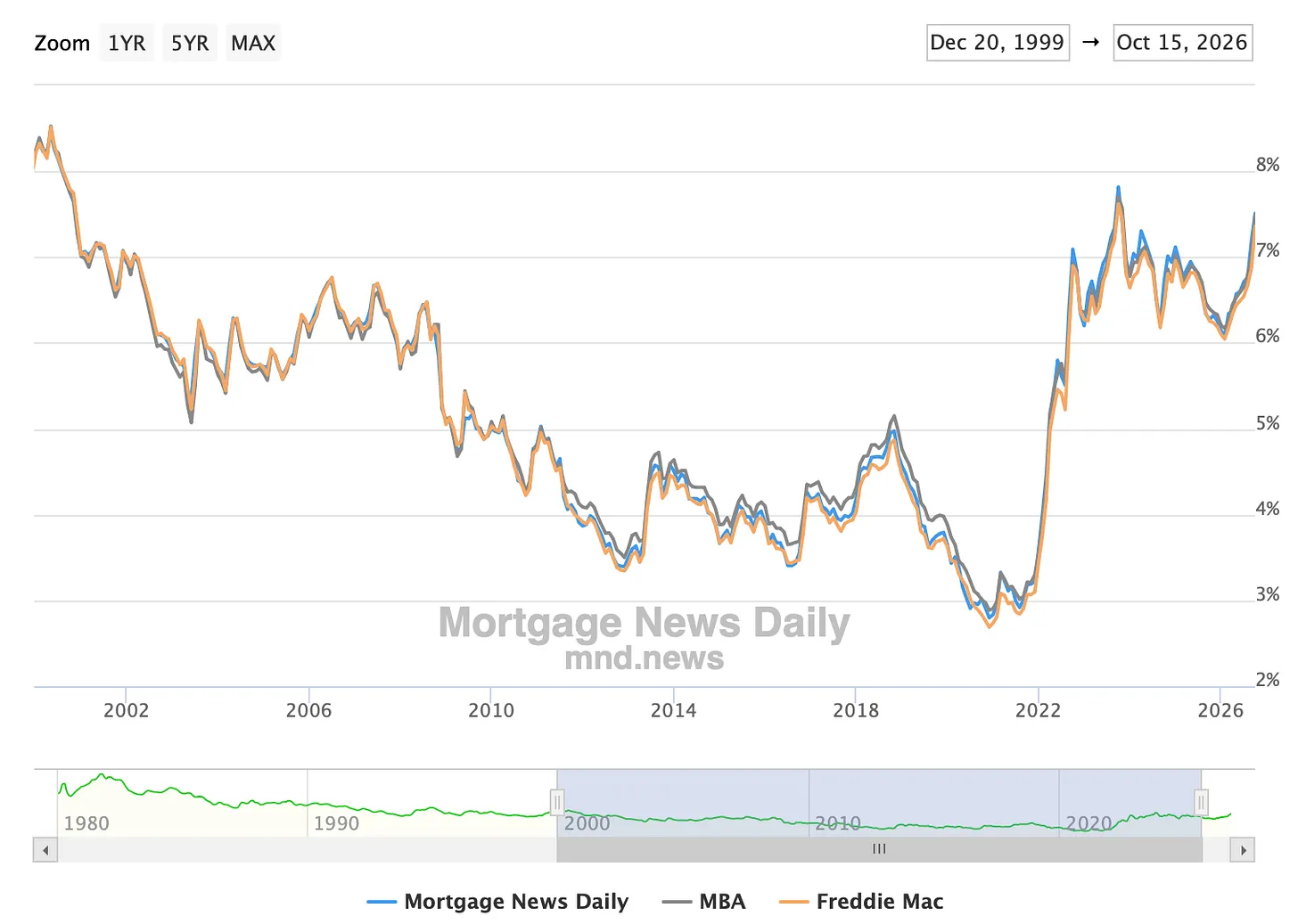
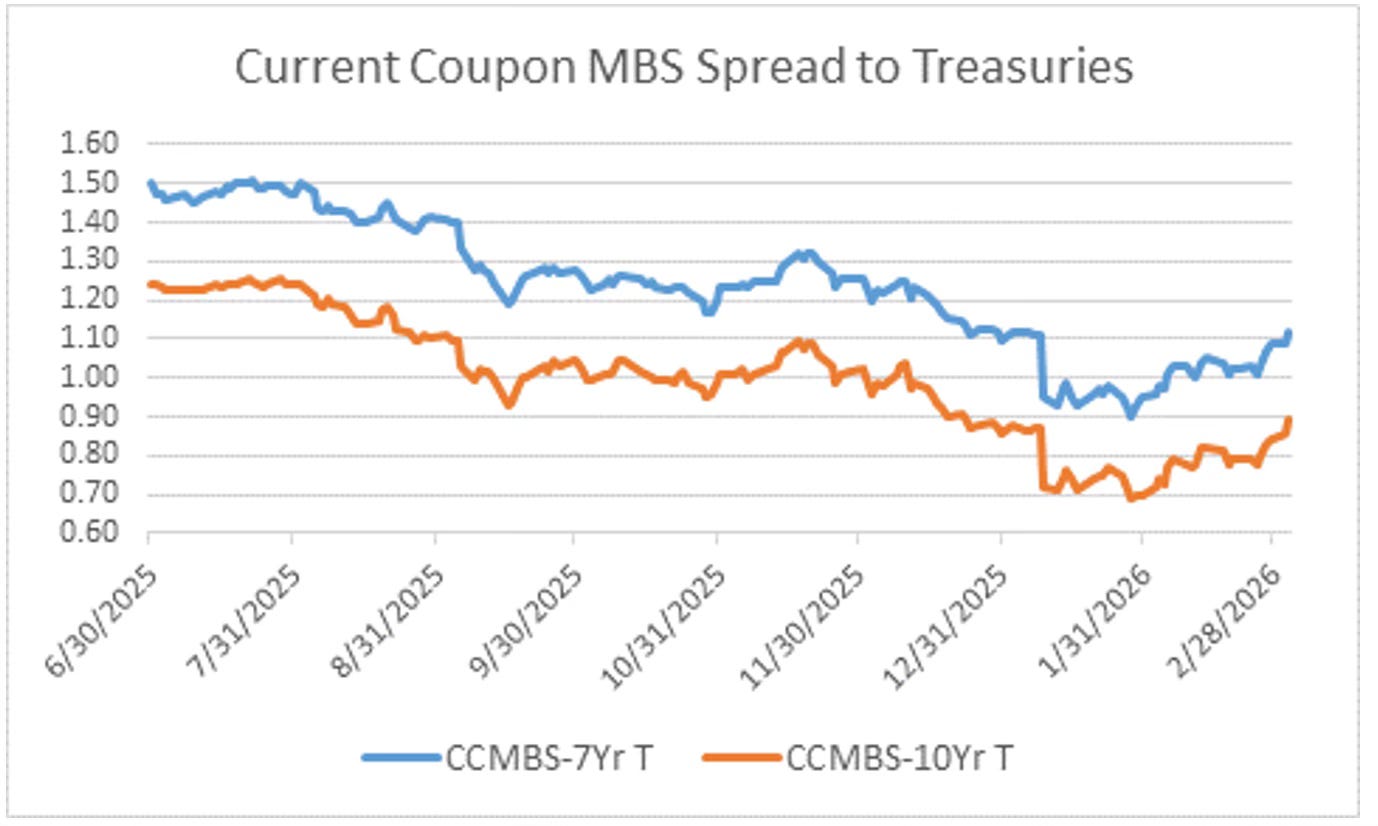
QUESTION: Why have mortgage interest rates gone up?
CCMBS/Treasury spreads, in contrast, widened significantly last month
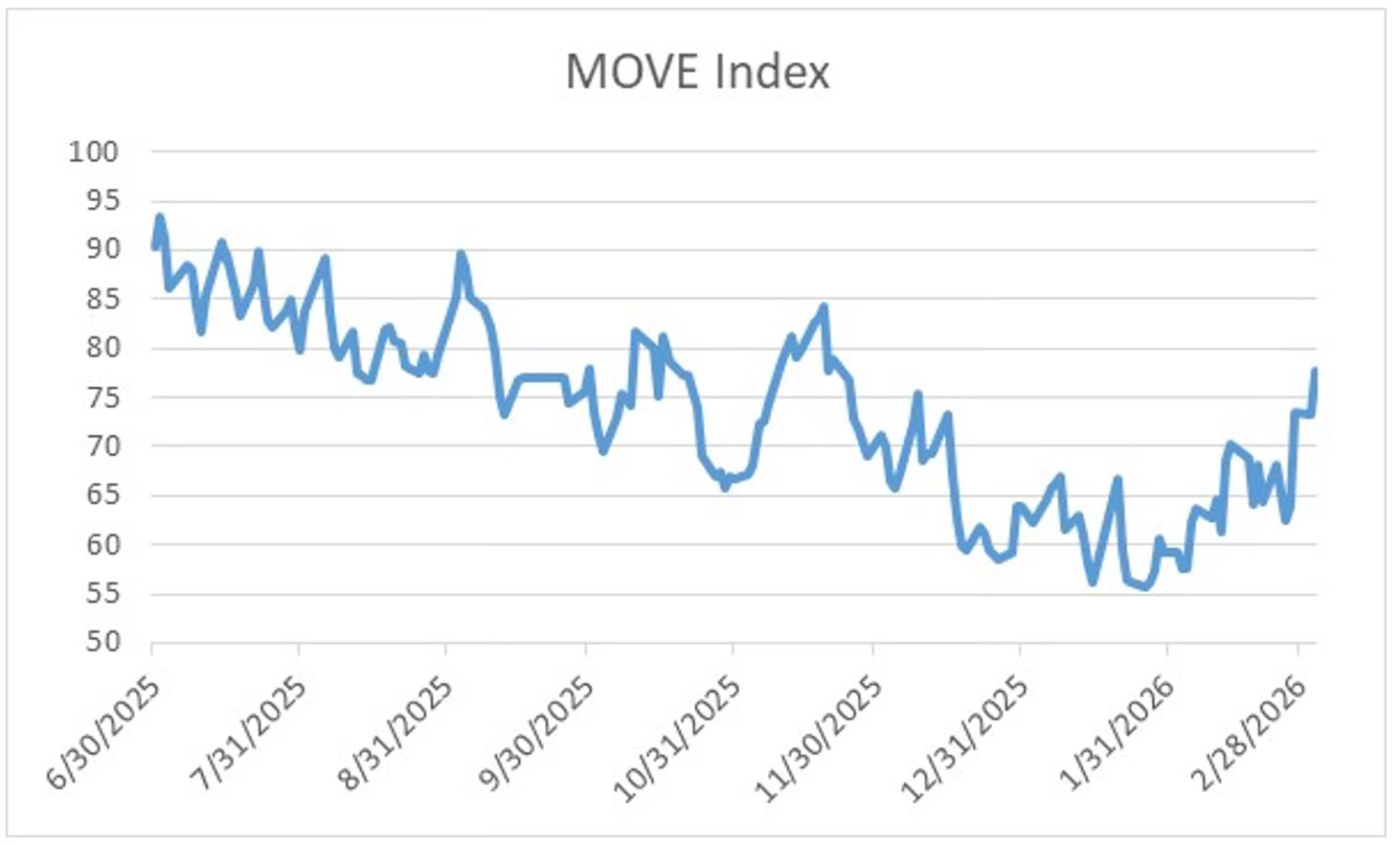
One reason CCMBS/Treasury spreads have widened since January is that implied and actual interest rate volatility [a measure of risk] has increased ... Below is a chart of the MOVE index, a measure of implied interest rate volatility from options on Treasury securities across the curve.
Tuesday, February 10, 2026
Where is it cheaper to rent vs. buy?
Monday, December 15, 2025
A tale of two cities and rent control
WSJ: What the Twin Cities Tell Us About Fixing the Housing Crisis
The Natural Experiment:
- In 2022, St. Paul enacted one of the strictest rent-control regimes in the country. The ordinance capped annual rent increases at 3% for most apartments, even empty ones. It didn’t adjust for inflation. ...
- Across the Mississippi River, Minneapolis steered clear of rent control. Instead, city officials strictly focused on creating new housing.
Results:
- [In St Paul]: Real-estate investment activity nearly froze. Developers halted new projects as lenders pulled back....Property values declined as investment cooled.
- In Minneapolis: ...developers kept building. Housing permits surged nearly fourfold in early 2022 from the year before. Downtown hubs blossomed as new apartments hit the market and attracted young professionals.
Monday, October 13, 2025
Nobel Prize: How to Grow
Economic growth is not just about new ideas but about how well an economy can reallocate production to the firms using the new ideas
...growth requires that some firms fail and that labor be displaced so resources can flow to new, more productive uses. ... Business dynamism has declined in Europe relative to the United States, a worrying fact given that business dynamism has also declined in the United States. Nevertheless, the US has a more flexible labor market and appears more open to both the birth of new firms (venture capital) and the deaths of older firms.
...Yet, in both the United States and around the the world the differences between high productivity and low productivity firms appears to be growing, ... which means that the good ideas are not spreading as quickly as they once did.Previous posts on Dynamism
Friday, May 30, 2025
Trade with China created US jobs
The jobs harm was largely local and temporary, while overall jobs and consumer welfare increased. ...
There is growing evidence that, while Chinese imports did hammer certain regions, they didn’t cause large net job losses across the entire U.S. Recent research from the National Bureau of Economic Research finds that job losses locally were mostly balanced by job gains in other regions. Manufacturing-heavy areas in the Midwest and South saw employment declines, but services jobs sprouted in coastal and high-tech hubs like the West Coast and Northeast. Import competition shifted jobs rather than eliminated them. ...
While tariffs on Chinese goods might bring back a few factory jobs, they will raise prices for everyone and hurt U.S. businesses that rely on imports. Current attempts to turn back the clock by introducing tariffs are a costly remedy for a poorly understood ailment.
Friday, May 16, 2025
How to raise kids in the age of AI
...If you raise your children with the uncritical expectation that if they work hard they can be a top person in their field, they will be disappointed. The skill of getting good grades maps pretty closely to what the AIs are best at. You would do better to instill in your kids the quality of taking the initiative and the right kinds of intellectual humility. You should also, to the extent you can, teach them the value of charisma, making friends, and building out their networks.
...
- Don’t set up being the smartest person in the room as the goal. Encourage them to develop to their fullest, challenge themselves, and to be virtuous.
- Encourage them to find many sources of meaning and social connection. They should develop hobbies and learn how to do self-directed projects, and actively seek out friends.
- Make it clear that meaningful endeavors don’t necessarily have to be compensated. Work is one way to contribute, but volunteering, making art, and building a family are some of the many others.
- Familiarize them with AI. Teach them how to learn from it and how to let it augment them.
- But choose their AI carefully! Don’t let them fall prey to the attentional black holes that will be built and offered to them.
- Don’t teach them to expect stability. Make it clear the world will likely change a lot, but that this change brings opportunities for them.
Saturday, May 3, 2025
The price of "free" healthcare is the wait
While healthcare in Canada's single-payer health care system is technically free, its real price is measured in wait times. In 2023, the median wait time from a general practitioner's referral to treatment reached 27.7 weeks—the longest ever and nearly triple the 9.3 weeks reported in 1993. (MuskegonPundit)
To see this, think of "free" as a price ceiling of zero.
- In the short run (Chapter 8), quantity demanded exceeds quantity supplied. So who gets this care? Those willing to wait. In other words, wait times act as prices to ration available supply (AIER).
- Even patients whose mortality depends on prompt care--and don't want to pay for care in the US--wait before receiving essential treatments . (Fraser Institute).
- This inefficiency could be lessened by allowing patients to sell their place in line to others.
- In the long run (Chapter 9), fewer providers (physicians, nurses, hospitals, clinics) are drawn into the industry, leading to decreases in supply and even longer wait times, or "prices."
HT, ZeroHedge: The Wait Is The Price: Quiet Rationing Plagues Canadian Health Care (AIER).
Tuesday, April 22, 2025
Earth Day Question: Will the world run out of resources?
"We are using 50% more resources than the Earth can sustainably produce, and unless we change course, that number will grow fast—by 2030, even two planets will not be enough," says Jim Leape, director general of the World Wide Fund for Nature International (formerly the World Wildlife Fund).To get the right answer, ask an economist. They will point out that when a good gets scarce, its price increases, which gives consumers an incentive to conserve or find substitutes, and producers an incentive to find more of it.
But thanks to fracking and the shale revolution, ... [we will find] cheap substitutes for fossil fuels long before they run out.
Tuesday, April 15, 2025
The Egg Market Rebounds
To prevent the spread of bird flu, 166 million birds were culled, most toward the end of 2024. Since the US typically has about 400 million egg-laying hens at any time, this was significant. With fewer hens, the supply of eggs also fell causing egg prices to more than double. Thankfully, this market disruption already appears to be behind us. A recent USDA report shows that production and egg prices have mostly recovered to where they were a year ago.
Damn that's fast. And just in time for Easter egg hunts. Not even the Ag sector expected the recovery of the egg industry so quickly. Just last month, Farm Progress forecasted, "The U.S. poultry industry could take a year or so to recover from the recent HPAI outbreak." They were only off by 11 months.
The speed of this adjustment is a testament to market forces. With prices doubled, egg producers saw a huge opportunity for short-run profits. Hens that might have been "retired" a year ago would be kept in service a bit longer. Chicks that might otherwise have been deemed unacceptable would be allowed to mature. Had the policy response instead been to impose egg price ceilings to prevent price gouging, the blunted profit motive would have weakened the supply response. Allowing the market to operate alleviated the shortage in short order.
Monday, April 14, 2025
S&P 500 Largest Ten Firm Transitions
The Visual Capitalist produces many wonderful visualizations. This one displays how fast firms rise into and fall out of the the top US 10 firms.
Tuesday, March 25, 2025
Revealed Preference: people like inequality
From Bryan Caplan's Bet On It:
“In their recent article,‘Why People Prefer Unequal Societies,’the psychologists Christina Starmans, Mark Sheskin, and Paul Bloom found that people prefer unequal distributions, both among fellow participants in the lab and among citizens in their country, as long as they sense that the allocation is fair: that the bonuses go to harder workers, more generous helpers, or even the lucky winners of an impartial lottery (Pinker 2019).“And they move into neighborhoods with more inequality. From research by Prof Douglas Coate (Rutgers):
...I find that two-bedroom home sale prices are not adversely impacted by income inequality in favor of the well off in the community. In fact, the results show these prices may be slightly higher in communities where high quintile households receive a greater share of community income
Saturday, March 22, 2025
Compensating differentials: wind turbines
From MarginalRevolution: Danish houses near wind turbines have 12% lower prices.
Wednesday, January 22, 2025
Gig Work as Entrprenerial Training
There can be many hurdles to becoming an entrepreneur, particularly for those without a background in business startups. New findings from Denes, Lagaras, and Tsoutsoura indicate that Gig work can help budding entrepreneurs overcome these hurdles. Using data from U.S. Tax Returns, they can track individual's sources of income.
We find that gig workers are more likely to become entrepreneurs, particularly those who are lower income, younger, and benefit from flexibility. We track all newly created firms and show that gig workers start firms in similar industries as their gig experience, which are less likely to survive and demonstrate higher performance. Overall, our findings suggest on-the-job learning promotes entrepreneurial entry and shifts the types of firms started by entrepreneurs.Of course the obvious benefit from Gig work is that we consumers have more choices to acquire goods and services. This is a static benefit. But a dynamic benefit is that Gig work becomes a stepping stone for workers to realize their potential. They will create new goods and services or they provide competitive pressure on existing suppliers. Policies that limit Gig work could undermine an economy's growth potential.
Wednesday, November 20, 2024
Business Dynamism
Visual Capitalist has a nice graphic that indicates the level of dynamism across industries in the US economy. An industry is not competitive if no firms ever fail.
Friday, August 23, 2024
Algorimthic Rental Collusion
Today, the DOJ accused RealPage of facilitating collusion. Among its services, RealPage has developed an algorithm that culls through rental information on 3 million units to make rental rate recommendations.The government alleges this stifles competition because, through its illegal monopoly over rent-setting software, RealPage allows landlords to illegally coordinate price increases. This is the latest in allegations that IT allowing sellers to see each others' prices in a market will reduce competition in that market. Earlier this Summer, I saw a presentation about a similar information sharing platform alleged to facilitate gasoline collusion in Australia.
What has changed with IT is better communication of the market conditions. What has not changed is the underlying market conditions in these industries. The apartment rental business is extremely unconcentrated. For example, there are close to a million units for rent in the DFW metroplex owned by perhaps 10,000 separate entities. As many as 30% could be using RealPage's service and, for the sake of argument, are in lockstep trying to elevate prices above competitive levels. But that means there may be as many as 7,000 apartment owners who could undercut these prices. We know OPEC has trouble maintaining prices with a dozen members, because there are two dozen other oil exporters that can potentially undercut them. When the number of sellers gets much past double digits, there is a huge temptation for any one of them to undercut the others.
Technology that improves information sharing can make markets more efficient. Until about six years ago, even I owned rental property. I wasn't very good at it. One reason was that I did not know how much to charge. Had I been aware of RealPage, I might have been able to increase occupancy rates. In fact, in financial markets, research often finds that quick and transparent information through advances in IT improves market efficiency by making prices better reflect the underlying values of assets.