Greenpeace and its activists allies have blocked for more than two decades the adoption of Golden Rice, which is genetically enhanced to produce the vitamin A precursor beta-carotene. The result, according to new calculations by DC Abundance founder and research director at the Golden Gate Institute for AI Abi Olvera, is that "delay has killed about 106,000 children and left another 210,000 to 425,000 blind."
Showing posts with label 03. Benefits; costs and decisions. Show all posts
Showing posts with label 03. Benefits; costs and decisions. Show all posts
Thursday, June 18, 2026
Hidden Cost of Environmental Protection

Sunday, April 5, 2026
The effect of California's $20 minimum wage
From MarginalRevolution:
...prices [of Food Away From Home or FAFH] rose, quantity demanded fell, and that’s what killed the jobs—not robots replacing workers.
In terms of welfare, the bulk of employed workers get an 8% wage increase, a small minority get disemployed. The big transfer was from consumers to workers. California has roughly 39 million residents, all of whom face 3.3–3.6% higher FAFH prices. The transfer is likely regressive — lower-income households spend a larger budget share on fast food specifically. So the policy effectively taxes low-income consumers generally to raise wages for a subset of low-income workers, while eliminating jobs for another subset. Your mileage may vary but I don’t see this as a big win for workers. ...
Thursday, March 5, 2026
Benefit-Cost Analysis of California's electric only mandate
Ted Stroll: The Bay Area Air Quality Management District wants to mandate electric water heaters and says it “will avoid an estimated 37 to 85 premature deaths per year.”
The Santa Clara County Association of Realtors surveyed contractors who estimated costs per home at $43,950 to $224,000. Its figures rely on replacing stoves and dryers as well as water heaters and furnaces.
Let’s pick a random lower figure and assume the Bay Area Air Quality Management District ban will cost each home $12,000. If 120,000 homes need a new water heater annually, the cost will be about $1.5 billion every year. That is a lot of money to “avoid an estimated 37 to 85 premature deaths,” assuming there’s a basis for that claim.
What could we do instead with that amount of money?
One answer would be to spend $1.5 billion annually to remediate homeless encampments. Encampment fires are ubiquitous in Santa Clara County. San José Spotlight reported in February that “over the past year thousands of non-structural fires have been sparked by homeless camps, causing toxic fumes and safety problems for people and property.”Stroll correctly points out that the opportunity cost of the mandates is whether there are better uses for the money.
Sunday, March 1, 2026
Why are cancer patients more likely to commit crime?

Friday, January 16, 2026
What caused the jump in US residential energy prices?
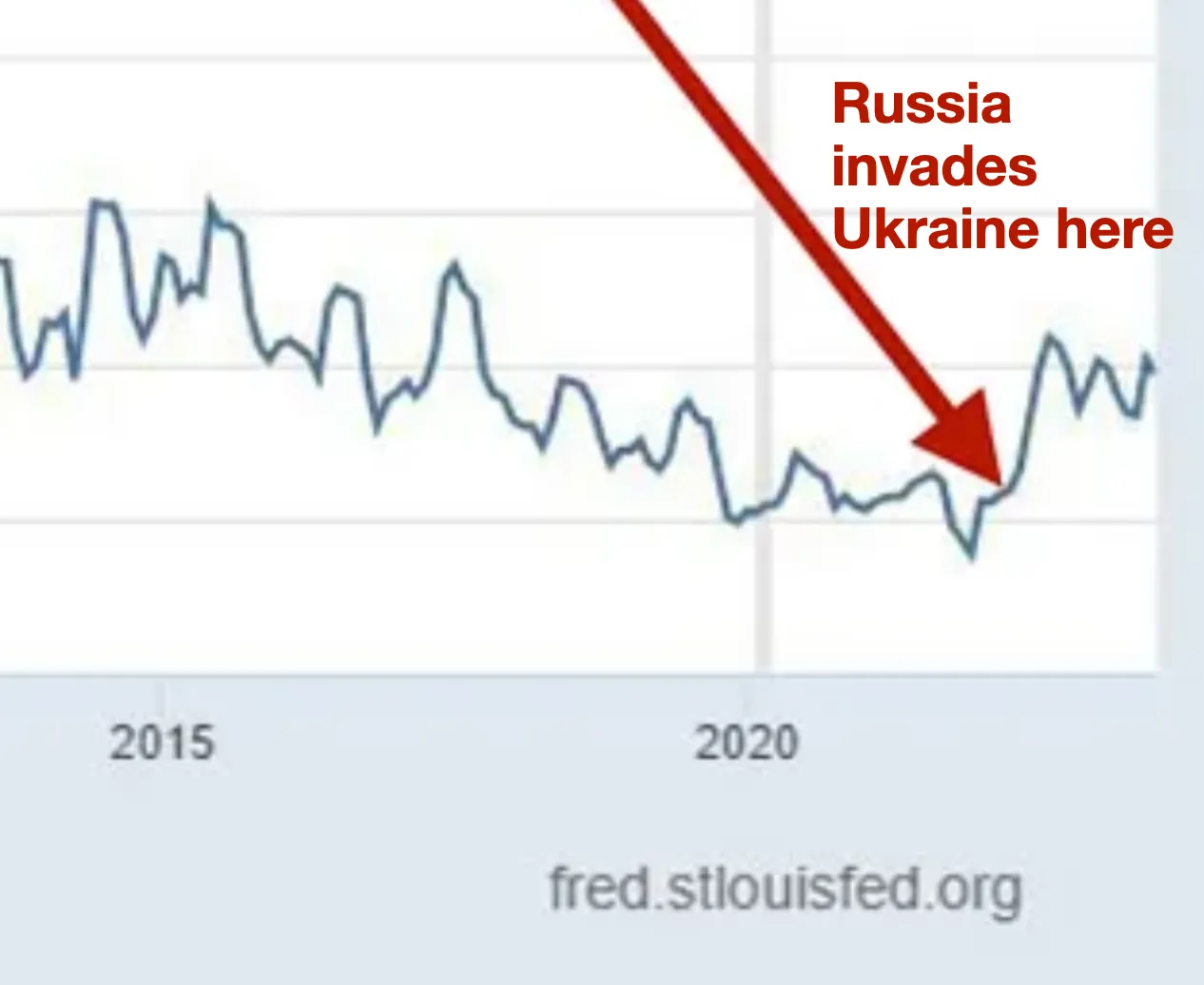
The opportunity cost of US natural gas rose.
Andy Masley Substack:
...Russia invaded Ukraine, Europe stopped buying Russian gas, America was suddenly competing with European countries more for natural gas from other places, and natural gas prices spiked for a bit. Here’s a graph of natural gas prices:
Wednesday, November 5, 2025
How not to grow: lessons from India's poorest and youngest state
Economist:
Lately Bihar’s leading parties have been talking about expanding the system of “reservations”, which provides preferential access to jobs to members of castes that are deemed to need a leg-up. ...
Only about one-third of 15-to-29-year-olds are in the labour force, among the lowest rates in the country. ... Growth would transform lives in Bihar, more than anywhere else in India. If only politicians would spend more time debating how to make the pie bigger—and less time fighting over how to slice it up.
Friday, August 22, 2025
Best Teaching Video ever! (comparative advantage)
From MRU via
The excellent Don Boudreaux on comparative advantage, one of the deepest and most important ideas in economics.
As a new semester begins this is a good reminder that MRU has great videos for learning and teaching economics, all entirely free and open. (Of course, these videos pair delightfully with Modern Principles of Economics).
Timely topic.
Wednesday, August 6, 2025
Sunk Costs while Playing Tennis
Roger Federer's 2024 commencement address at Dartmouth has received some attention on social media partly because of his admirable humility. In one part, he notes that, while he won almost 80% of his matches, he lost 46% of his points. Why relate this statistic?
Here’s why I am telling you this.
When you’re playing a point, it is the most important thing in the world.
But when it’s behind you, it’s behind you... This mindset is really crucial, because it frees you to fully commit to the next point… and the next one after that… with intensity, clarity and focus.
Sunk costs don't matter.
Friday, July 25, 2025
CA min wage goes up ==> CA employment declines
The classic book, Economics in One Lesson reduces all of economics to a similar lesson:
The art of economics consists in looking not merely at the immediate but at the longer effects of any act or policy; it consists in tracing the consequences of that policy not merely for one group but for all groups.
- Consider all costs and benefits that vary with the consequences of a decision:
- If you miss some, that is the "hidden cost fallacy"
- If you take account of irrelevant ones, that is the "sunk-cost fallacy"
This hidden-cost fallacy comes from California, via Instapundit.com:
California raised the minimum wage statewide for “fast food restaurant employees” to $20 per hour last April following the passage of a ballot proposition in September the year before.
Analysis of unadjusted data from the Quarterly Census of Employment and Wages, the NBER found “that employment in California’s fast food sector declined by 2.7 percent relative to employment in the fast food sector elsewhere in the United States from September 2023 through September 2024 … Our median estimate translates into a loss of 18,000 jobs in California’s fast food sector relative to the counterfactual.”
The fast food sector has also cut workers’ hour and increased automation to avoid paying rising employment costs.
Any econ student could have predicted this using a shift in the supply curve, but someone at UC Berkeley predicted the opposite:
A new study published by UC Berkeley’s Institute for Research and Labor Employment confirmed that California’s $20 minimum wage for fast-food workers has led to significant benefits for workers, without the devastating consequences that critics predicted.
Fortunately for us, we have an adversarial system, so that mistakes by one side are usually brought to light by the other.
FOOTNOTE: a middling economists' take on weighing the benefits of our adversarial system. (link)
Friday, July 18, 2025
Mowing Your Own Lawn
Roland Fryer has a nice opinion piece in the WSJ about "The Economics of DIY." He points out that even wealthy people tend to do household chores that they could affordably outsource. He relates an incident:
When a friend invited me to play golf and I declined because the yard needed mowing, he didn’t hide his disbelief. “You can pay someone to cut your lawn,” he said, “but you can’t pay someone to have fun for you.”
At first blush, it seems as though the tenured Harvard economics professor mowing his own grass needs a refresher in cost-benefit analysis. But he points out that many of the benefits of DIY are often hidden and ill-defined while the costs are fixed and precise. Three economic concepts help to better understand some hidden benefits.
Diminishing Marginal Utility - The value of an activity falls as you do more. In his example, when time with his kids is short, he frees up time by outsourcing more - cooking, cleaning, ride-sharing, etc. The cost of the meal, the maid, or the ride is fully observable. The value of the time shared is less amenable to an accounting ledger.
Experiential Utility - There is often pride in doing. We value our ability to do things and we recognize these talents in others.We admire the craftsmanship in DIY car restoration, woodworking, quilting, or calligraphy. Hobbies can be fun. Moreover, there can be joy in seeing yourself improve. And the nostalgia of learning from an elder can bring back fond memories.
Signaling - Cutting the lawn sends a signal to your neighbors and yourself. You are the kind of person who takes care of things, who others can look on with admiration for the care you take. You provide positive externalities.
Tuesday, May 20, 2025
WSJ: Why EU lags US in tech.
Someone at the WSJ read Why the U.S. Produces More Unicorns than the EU
- Limited Presence of Major Tech Firms:
- Apple's market cap > entire German stock market,
- Structural Barriers to Innovation:
- risk-averse business culture,
- stringent labor laws,
- heavy regulation
- smaller venture capital pool
- Talent and Incentive Challenges:
- lack of stock options makes it harder to align incentives--and retain--innovators.
- Underinvestment in Emerging Technologies: no quantum computing and artificial intelligence.
- Dominance of Legacy Industries/lack of dynamism: EU firms founded in 1911, US in 1985
Saturday, December 14, 2024
Acquired Podcast: Costco
Listening to the Aquired podcast about Costco. Lots of interesting history and economics in it.
- The start of discount retailing by figuring out how to skirt manufacturer RPM's (resale price minimums) with the "club format," Fed-co (nonprofit) to Fed-mart (
- The first US Hypermarket, idea imported from France
- How Costco evolved from retail to wholesale warehousing, where manufacturers take care of all the logistics: once a pallet is dropped off, it is immediately available for sale.
- To Price club, which opened up to credit union members as a benefit, which had a huge word-of-mouth advertising.
- Limiting # SKU's (#products=3800) to increase volume and get lower prices from manufacturers.
- To adding hot dogs from Hebrew National, $1.50 for hotdog and a drink, Costco's only loss leader
- Costco turns inventory 12x/year, where vendors finance Costo's inventory because it sells faster than the payment terms (pay manufacturers within 30 days).
- To two-part pricing (selling at MC and making money on the membership fees).
- Costco clones: Wal-mart, Home Depot, Starbucks
HT: Charles
Monday, October 21, 2024
The hidden cost of regulatory uncertainty
Innovation drives growth and at our current growth rate of 2%, US income doubles in 36 years. In contrast, EU income doubles in 108 years.
There are many reasons for the US/EU difference regulation, income taxes, subsidies and "regulatory uncertainty." President Biden’s appointees have createdted huge regulatory uncertainty in antitrust (see earlier post) which deters acquisitions which are the proverbial “exits” that drive startups.
Thursday, October 17, 2024
Failures ==> Learning ==> Success
Economist:
...SpaceX’s existing Falcon 9 rockets had a similar string of spectacular failures (it even released a blooper reel). But there was a method behind all the explosions. The idea is that flying lots of hardware, and failing rapidly, lets you learn from reality, which is the best teacher of all. That sort of mindset, best-known in Silicon Valley, is not how the rocket business has traditionally worked. But it is hard to argue with the results: SpaceX’s Falcon rockets have now made more than 350 successful landings. That has helped the firm cut the cost of getting a tonne of payload into space by perhaps a factor of ten. It now dominates the launch industry.
Wednesday, October 16, 2024
Why has US left other rich economies in the dust?
Economist:
On a per-person basis, American economic output is now about 40% higher than in western Europe and Canada, and 60% higher than in Japan—roughly twice as large as the gaps between them in 1990. Average wages in America’s poorest state, Mississippi, are higher than the averages in Britain, Canada and Germany.
WHY?
- Economies of Scale: a good idea hatched in California or product built in Michigan can, in short order, spread to 49 other states.
- Flexible Labor Market : ...allowing people to move to better-paying jobs and drawing workers to more productive sectors.
- Immigration: A long, porous southern border [allows] the labour force to steadily grow ... to fill the hard, dirty jobs that many native-born Americans have no interest in doing.
- Oil & Gas:...the improvements in techniques for extracting hydrocarbons from once-unpliant shale rocks have turned America into the world’s biggest producer of oil and gas.
- Light touch Regulation: ...has given high-tech companies room to play and grow. It also enabled the experimentation which led to the shale revolution.
- Better regulation: After the global financial crisis of 2007-09, [regulators] clean up bank balance-sheets, and making aggressive use of monetary policy to support growth.
- Good Macro policy: government’s willingness to step on the accelerator pedal when [the economy] has sputtered, ...[response to the] covid slowdown ... with...fiscal stimulus packages that left other countries in the dust.
Friday, August 2, 2024
Hidden costs of the Chernobyl accident: US deaths from air pollution
Namely, Chernobyl caused many more deaths by reducing nuclear power plant construction and increasing air pollution...
Sunday, June 2, 2024
Migrants Bear Costs of Biden's Changing Immigration Policy

PHOTO May 23, 2024: Migrants in Salina Cruz, MX, heading to US
NY Times: Migrants from all over Central and South America's are exhausting their savings to come to the US,
But instead of landing closer to the U.S. border, they are being hauled roughly 1,000 miles in the opposite direction — deep into southern Mexico in a shadowy program meant to appease the Biden administration and ship migrants far from the United States.
Mexican authorities rarely publicly acknowledge the busing program, making it much less contentious than the efforts by Republican governors to transport migrants to blue states that have become political theater in the United States.BOTTOM LINE:
In the first four months of 2024, U.S. border apprehensions plunged in one of the steepest declines in decades, giving the Biden administration some relief as immigration persists as a top voter concern in this year’s election.HT: Chris
Sunday, February 25, 2024
Thursday, February 22, 2024
Which undergrad majors lead to under-employement?

Tuesday, February 20, 2024
Is ESG investing illegal?
For fund managers, it may violate their fiduciary responsibility (to maximize returns) to their shareholders.
Apparently, the legal risk is too big for JP Morgan, State Street, and BlackRock:
Asset managers have been walking a fine legal line. GOP Attorneys General in 2022 warned that they might be violating their fiduciary obligations and antitrust laws. House Judiciary Committee Chairman Jim Jordan in December subpoenaed BlackRock and State Street Global Advisors for documents and communications related to their involvement in “collusive” agreements.
The climate alliance’s new rules would compound the legal and political jeopardy. In its withdrawal announcement, State Street said its rules “are not consistent with our independent approach to proxy voting and portfolio company engagement.” BlackRock said the rules “would raise legal considerations.”
Subscribe to:
Posts (Atom)