Showing posts sorted by relevance for query unicorns. Sort by date Show all posts

Tuesday, June 22, 2021

New Unicorns suggest fast pace of innovation!

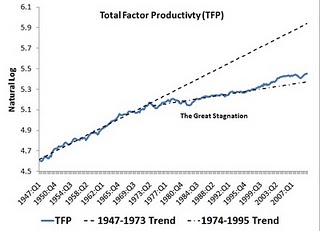
Two popular innovation metrics are total factor productivity the difference between output (like GDP) and the inputs (like capital and labor) used to produce it, or the number of unicorns, startups that reach a $1B valuation.  While total factor productivity seems rather flat, 


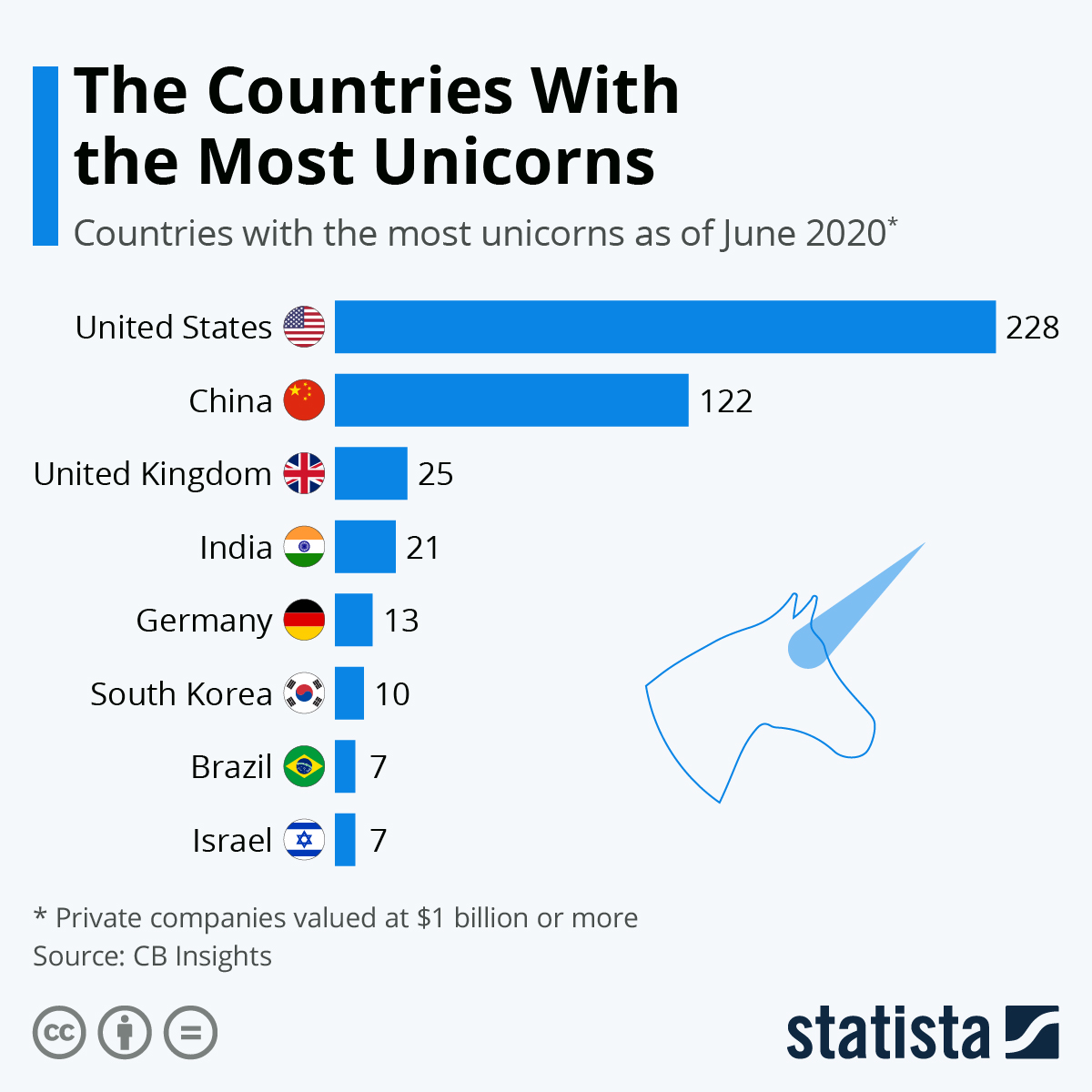
the number of unicorns seems to be accelerating.


The US seems to account for about half of them, maybe due to its tolerance for inequality, and light-handed regulation.  


Unicorns are concentrating in several US cities, sometimes called "innovation clusters."


 More posts about unicorns and innovation

HT:  Elad Blog

Sunday, July 12, 2020

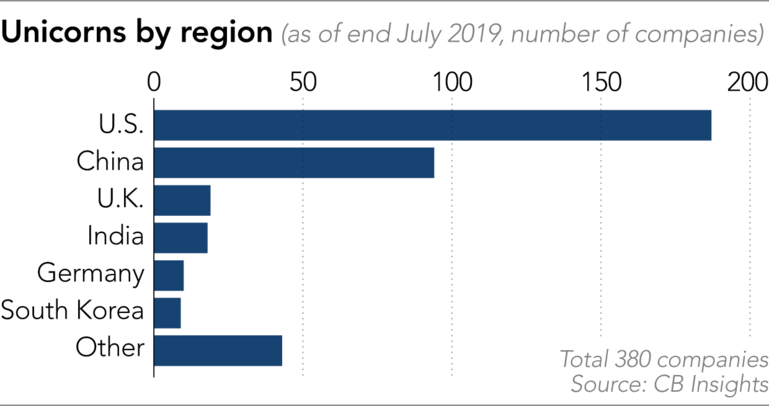
Unicorns by Region


Innovation leads to growth, and growth really matters:  

In the late 1950s, Nobel Laureate Robert Solow attributed about seven-eighths of the growth in U.S. GDP to technical progress. As Solow later commented: “Adding a couple of tenths of a percentage point to the growth rate is an achievement that eventually dwarfs in welfare significance any of the standard goals of economic policy.” 

Although the number of unicorns is a noisy measure of innovation, the relative number of unicorns in the EU may be a harbinger of future low growth, and is perhaps due to the burden of the EU regulation.  In my field of antitrust, there are big differences in how similar laws are enforced, e.g., CPI article or SSRN:

  • EC is run by politicians; US agencies by antitrust professionals 
  • EU skepticism of markets vs. US skepticism of regulation (since 1980) 
  • EU regulation vs. US law enforcement (adversarial) 
  • EU weak due process: remedies w/out adversarial hearing, 3rd party discovery, or cross examination 
  • EU harm to competitors vs. US harm to competition 
  • EU does not screen out bad theories (not supported by evidence) vs. US Daubert rules 

Friday, May 31, 2019

Why are there so few unicorns in Europe?

Despite a GDP that is about the same size as the US, but with about twice the population, the EU produces relatively few unicorns (billion dollar startups) because the regulatory burden is so heavy.  A recent example is the GDPR,

Controllers of personal data must put in place appropriate technical and organisational measures to implement the data protection principles. Business processes that handle personal data must be designed and built with consideration of the principles and provide safeguards to protect data (for example, using pseudonymization or full anonymization where appropriate), and use the highest-possible privacy settings by default, so that the data is not available publicly without explicit, informed consent, and cannot be used to identify a subject without additional information stored separately.

MarginalRevolution has another great post  that documents the compliance costs, especially for would-be unicorns :

  • Startups: One study estimated that venture capital invested in EU startups fell by as much as 50 percent due to GDPR implementation. (NBER)
  • Mergers and acquisitions: “55% of respondents said they had worked on deals that fell apart because of concerns about a target company’s data protection policies and compliance with GDPR” (WSJ)
  • Scientific research: “[B]iomedical researchers fear that the EU’s new General Data Protection Regulation (GDPR) will make it harder to share information across borders or outside their original research context.” (POLITICO)
  • Microsoft had 1,600 engineers working on compliance. (Microsoft)
  • During a Senate hearing, Keith Enright, Google’s chief privacy officer, estimated that the company spent “hundreds of years of human time” to comply with the new privacy rules. (Quartz)
    • However, French authorities ultimately decided Google’s compliance efforts were insufficient: “France fines Google nearly $57 million for first major violation of new European privacy regime” (The Washington Post)

Sunday, March 7, 2021

Which governments can get out of the way of growth?

John Cochrane reminds us to keep our eyes on the prize:
In the long run, nothing else matters. GDP buys you health, advancement of the disadvantaged, social programs, international security, and climate if you are so inclined. Without GDP, you get less of all.  Economic policy should have one central goal -- get productivity growing again, or (in my view) get out of the way of its growth. This is the one little hope that has not been let out of the policy Pandora's box, focused on everything else right now.

Macroeconomists classify two basic types of growth:  

  • More inputs (labor, capital) lead to more output (GDP)
  • Technological progress (Total Factor Productivity) increases output for the same level of input.


And here is the change in Total Factor Productivity across countries.  


We have blogged about the dearth of unicorns in the EU,
  Infographic: The Countries With the Most Unicorns | Statista 
Total Factor Productivity seems to be telling the same story.


Saturday, April 10, 2021

Does venture capital still contribute to growth?

The New Yorker has a harsh critique of some Venture Capital firms, like the ones that funded WeWork: 
 A widely read summary by a Harvard Business School professor, Nori Gerardo Lietz ... exposed WeWork’s “byzantine corporate structure, the continuing projected losses, the plethora of conflicts, the complete absence of any substantive corporate governance, and the uncommon ‘New Age’ parlance.” At the same time, she wrote, the S-1 (Disclosures to the regulators about the company's financial health ) failed to provide many conventional financial details. ...S-1 laid bare a basic truth: WeWork’s dominant position in the co-working industry wasn’t a result of operational prowess or a superior product. Instead, WeWork had beaten its rivals because it had access to a near-limitless supply of funds, much of which it had squandered on expensive furniture, flamboyant perks, and promotions luring customers with below-market rents.

Anyone who reads this blog knows three things:

1.  Innovation drives growth, and growth is almost everything.  

As Novel laureate Robert Solow said, “Adding a couple of tenths of a percentage point to the growth rate is an achievement that eventually dwarfs in welfare significance any of the standard goals of economic policy.

2.  Total Factor Productivity (the output measured relative to the inputs required to produce it) has grown much faster in the US than elsewhere.  This is one of the best aggregate measures of innovation.  


3.  The US has birthed more Unicorns (startups with a $1B valuation) than any other country else:


BOTTOM LINE:  Innovation is hard to measure, but it looks like the US has it, so the Venture Capitalists who fund it must be doing something right.  One cannot condemn an entire industry using a few anecdotes about how some startups fail--no matter how spectacularly.

Thursday, October 1, 2020

The costs of fighting inequality


Following up on an earlier post, Why are there so few unicorns in Europe?Bloomberg suggests an answer straight out of Chapter 1:  the EU limits on incentive pay, particularly on stock options, make it difficult for innovators to align the incentives of employees with the profitability goals of the company:

"...when you’re not highly profitable, you have to incentivize employees on the promise of the upside.”  

Onerous rules and taxation make this difficult to do.  Examples of EU limits on incentive pay:
  • The Dutch capped bonuses for bankers, money managers, and other financial professionals at 20% of base salaries. 
  •  Entrepreneurs must navigate onerous tax rates and restrictions that often make equity sharing and options more trouble than they’re worth. 
  • When employees in Germany exercise options, they have to pay income tax on the difference between the fair market value and the strike price, that runs from 14% to 47.5%. They also pay a 25% capital-gains tax on additional profits when they sell their shares.
In contrast, American employees typically pay a 0% to 20% rate on capital gains when options are redeemed, ...

Chatterbug's COO, sums it up: “I wish we had the same system as the U.S.,” she says. “But they don’t want us to get rich in Germany.”

HT:  Gus B.

ADDENDUM:  when I ask my EU colleagues about the disparity, they point to other factors as well, like bankruptcy codes that discourage risk-taking.