Showing posts sorted by relevance for query innovation. Sort by date Show all posts

Tuesday, June 22, 2021

New Unicorns suggest fast pace of innovation!

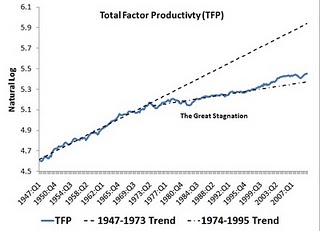
Two popular innovation metrics are total factor productivity the difference between output (like GDP) and the inputs (like capital and labor) used to produce it, or the number of unicorns, startups that reach a $1B valuation.  While total factor productivity seems rather flat, 


the number of unicorns seems to be accelerating.


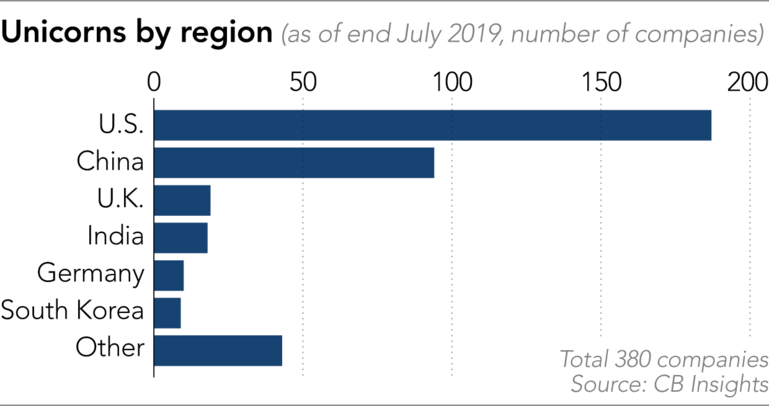
The US seems to account for about half of them, maybe due to its tolerance for inequality, and light-handed regulation.  


Unicorns are concentrating in several US cities, sometimes called "innovation clusters."


 More posts about unicorns and innovation

HT:  Elad Blog

Saturday, April 10, 2021

Does venture capital still contribute to growth?

The New Yorker has a harsh critique of some Venture Capital firms, like the ones that funded WeWork: 
 A widely read summary by a Harvard Business School professor, Nori Gerardo Lietz ... exposed WeWork’s “byzantine corporate structure, the continuing projected losses, the plethora of conflicts, the complete absence of any substantive corporate governance, and the uncommon ‘New Age’ parlance.” At the same time, she wrote, the S-1 (Disclosures to the regulators about the company's financial health ) failed to provide many conventional financial details. ...S-1 laid bare a basic truth: WeWork’s dominant position in the co-working industry wasn’t a result of operational prowess or a superior product. Instead, WeWork had beaten its rivals because it had access to a near-limitless supply of funds, much of which it had squandered on expensive furniture, flamboyant perks, and promotions luring customers with below-market rents.

Anyone who reads this blog knows three things:

1.  Innovation drives growth, and growth is almost everything.  

As Novel laureate Robert Solow said, “Adding a couple of tenths of a percentage point to the growth rate is an achievement that eventually dwarfs in welfare significance any of the standard goals of economic policy.

2.  Total Factor Productivity (the output measured relative to the inputs required to produce it) has grown much faster in the US than elsewhere.  This is one of the best aggregate measures of innovation.  


3.  The US has birthed more Unicorns (startups with a $1B valuation) than any other country else:


BOTTOM LINE:  Innovation is hard to measure, but it looks like the US has it, so the Venture Capitalists who fund it must be doing something right.  One cannot condemn an entire industry using a few anecdotes about how some startups fail--no matter how spectacularly.

Thursday, July 18, 2019

Why do innovative "clusters" form?

Interview with Economist Enrico Moretti suggest three factors that lead to manufacturing agglomeration are much stronger for firms engaged in innovation:

The first one is the existence of knowledge spillovers, also known as human capital spillovers: the fact that our human capital depends not only on where we go to school and how much schooling we get, but also on the people who surround us and from whom we learn. 
The second one is the matching advantage offered by thick labor markets. ... For example, if you are a biotech engineer specialized in, say, biofuel and you work in Silicon Valley, where at any moment in time there are a thousand biotech firms looking for biotech engineers, you are more likely to find the one that studies biofuels ... A better match ... results in higher productivity. 
The third channel is the thickness of the market for specialized services. Again, if you are in an area where there are many other firms like yours and they all need a very specialized type of vendor, you are more likely to find it in an area where there's a big agglomeration of firms in the same sector. 
All three factors exist in manufacturing, of course. But they are much stronger for firms and workers that engage in innovation.
...
In computer science, the top 10 cities account for 70 percent of all the innovation, as measured by patents. For semiconductors, it's 79 percent. For biology and chemistry, it's 59 percent.
HT:  MarginalRevolution.com

Monday, August 14, 2017

The Dark Side of Incentive Pay?

The Financial Times recently published a thoughtful commentary by Jonathan Ford arguing that performance pay in the financial sector has been bad for financial market consumers. He extolls the virtues of the post-war, pre-liberalization banking system where a particularly industrious bank manager might get rewarded with a letter of commendation from the bank president. Ford notes that there were flaws.
The system was not perfect: it could entrench snooty managers and make credit hard to come by.

In contrast to these halcyon days, today's financial managers face constant competitive pressure and are constantly rewarded for increasing profits. We hope that profits are generated by delivering ever increasing value to customers. But, especially during the financial crisis, there were many examples of bankers fleecing customers. He notes that the bad acts are a result of bad incentives and suggests a remedy for these bad acts.
But there is of course a simpler way to avoid offering bad incentives. That is simply to pay employees a salary based on what the job is worth.

On net, was the move to market liberalization, and incentive pay as a consequence, worth it?

I will note that, over the past four decades, the financial sector has seen nearly as much innovation as the IT sector. Spreads between interest rates to borrowers and savers and in stock market transactions have shrunk dramatically. More consumers have access to more financial instruments than ever before in part because more financial instruments are available at cheaper rates than ever before. Ask your grandparents if they diversified their retirement fund into international equity funds when they were your age and you will probably get a blank stare. This innovation is also a result of market liberalization. Would de-liberalization and a reduction in banker incentive pay also put a halt to further financial market innovation?

Wednesday, December 9, 2009

Volcker Disses Financial Innovation

Paul Volcker, former chairman of the Federal Reserve and current chairman of the President's Economic Recovery Advisory Board, took a shot at the banking and finance industry yesterday during the Future of Finance Initiative sponsored by the Wall Street Journal: “I wish someone would give me one shred of neutral evidence that financial innovation has led to economic growth — one shred of evidence.”

He wasn't totally critical of the industry, however: "The most important financial innovation I've seen in the last 25 years is the automatic teller machine." Ouch!

----------------------------
Euro dollars, dollar-denominated savings accounts from European banks not subject to US regulation, have allowed lenders and borrowers to by pass usury ceilings on interest rates.   Surely that counts as an unambiguous contributor to economic well being.  --Luke

Thursday, October 1, 2020

Which organizational forms can best adapt to change?

One of the themes in this blog is that it is not necessarily the strongest firms that survive, but the most adaptable.  Kodak once dominated the film industry but now it is bankrupt.  How did this happen?

Part of the fault lies with Kodak's centralized structure which was slow to react to the expiration of its patents, and the advent of digital photography.  Colby Chandler, former CEO of Kodak, admitted as much at the 1984 annual meeting:
Like many companies, we are not used to working in an environment where there is rapid technological transfer from laboratory to the marketplace. But we know that will be important in our future.
In 1984, in the hopes of encouraging innovation, Kodak decentralized decision making to 17 different business units with profit and loss responsibility.  However, the decentralized decision making was not accompanied by incentive pay.  Instead, small bonuses were doled out by officious bureaucrats, according to office politics. 

As a result, Kodak continued its slow decline, and in 1993 the board of directors fired its CEO for not holding its managers accountable for failure.  This year, Kodak entered bankruptcy.

The moral of the story seems clear to me:   decentralized decision making is better for adapting to technological change, but only if accompanied by strong incentive pay.  This may be the reason that much of certain types of innovation is done by small firms:  owner/operators have the strongest incentives to perform. 

Sunday, July 12, 2020

Unicorns by Region


Innovation leads to growth, and growth really matters:  

In the late 1950s, Nobel Laureate Robert Solow attributed about seven-eighths of the growth in U.S. GDP to technical progress. As Solow later commented: “Adding a couple of tenths of a percentage point to the growth rate is an achievement that eventually dwarfs in welfare significance any of the standard goals of economic policy.” 

Although the number of unicorns is a noisy measure of innovation, the relative number of unicorns in the EU may be a harbinger of future low growth, and is perhaps due to the burden of the EU regulation.  In my field of antitrust, there are big differences in how similar laws are enforced, e.g., CPI article or SSRN:

  • EC is run by politicians; US agencies by antitrust professionals 
  • EU skepticism of markets vs. US skepticism of regulation (since 1980) 
  • EU regulation vs. US law enforcement (adversarial) 
  • EU weak due process: remedies w/out adversarial hearing, 3rd party discovery, or cross examination 
  • EU harm to competitors vs. US harm to competition 
  • EU does not screen out bad theories (not supported by evidence) vs. US Daubert rules 

Wednesday, October 3, 2018

Economies of scope created AWS

Amazon Web Services is one of the biggest success stories around.
Less than a decade old, ... Cloud computing — remote computing, or web services, as cloud computing is sometimes called — has been so wildly successful that it’s increased the pace of technology innovation, the rate of technology adoption, and the volume of data in the world by many fold. Today mobile startups can go global in a snap, ...

Like many innovations, it's began with a problem, that it took too long and too much effort to plug "merchants" (sellers who use their own supply chain to fill orders) into the Amazon platform.
Providing a solution for Target, for example, one of Amazon’s early merchant.com deals, was “far more painful than we thought it would be,” .... 

According to the book Machine, Platform, Crowd, Amazon stopped customizing solutions for each new merchant on its platform by "hardening" its API's, developing a standardized and well documented set of protocols that essentially decoupled parts of the web platform. For example, they separated back-end data from the presentation layer so that their merchant associates could control the consumer interface without creating more work for Amazon on the backend. Customers who used the new API increased conversion rates on their web properties by 30%.
 
Initially, hardening the API's created more work for Amazon, but when they had finished, they realized that they had a reliable, world-wide, web infrastructure that would enable developers to build their tech infrastructure on top of Amazon's cloud computing platform.  It turns out that there was a huge demand for the service:
First one, then two, then three CEOs declared infrastructure services a top priority and asked Amazon to take a hard look at helping them with data warehousing. It was too expensive, hard to manage, required too much commitment and was riddled with pricey upgrades. It seems in these early days of widespread Internet adoption, a collective grumbling emerged over how much hardware was required to operate at “web scale” — interact globally in real-time with huge user bases. No one had the stomach for the banks of servers they’d have to swallow in order to operate a global online presence.

Amazon continues to "spin off" ideas developed to solve internal problems, like "API Gateway, ... a tool for creating, publishing, scaling and securing APIs. The idea is to let enterprises get the same advantages from using APIs as Amazon does, thereby paving the way for faster development and innovation...":
"Inside your company, if you're able to offer your different services via hardened APIs that are well documented, it frees up all the other teams that want to consume your services, to use those just as building blocks, as if they're external services," Jassy said. "Once we got into that mode inside Amazon, it dramatically changed the speed with which we were able to innovate."

References:

Monday, August 3, 2015

Two-sided hold-up

In the investment's chapter, we talk about the problem of post-investment hold-up.  After a firm makes sunk-cost investments, it becomes vulnerable to post-investment hold up by its trading partners.  A variety of solutions are available to address the problem of hold-up, including litigation.

The antitrust laws have been moving recently to address the problem of hold-up by adopting rules that shift bargaining power from innovators (who develop intellectual property that is implemented in a standard, like 4G LTE) to implementors (who license patents necessary to use the standard).

In this paper, two economists point out that the problem is really two-sided,
Concerns expressed regarding the potential for patent hold-up are generally one-sided, focusing on the incentives of the implementers of the technology while generally ignoring the incentives of innovators to create the technology in the first place. 7 Such analysis takes the level of innovation as given, so that the only possible harm to competition is through the implementer’s decision to invest. The underlying incentive problem, however, is two-sided because an innovator’s incentives to engage in significant R&D may also be distorted by well-intentioned actions taken to correct the potential hold-up problem.
But one of the hold-up problems--the innovator's--is relatively easy to solve, via negotiations that occur prior to the implementer’s investment in the standard.  In contrast, negotiations always occur after the innovator’s investment in R&D is sunk.  Consequently, shifting bargaining power to the implementor exacerbates the risk of under-investment:

The reason is that innovators and implementers can and do bargain prior to the implementer’s adoption of and investment in a standard and courts impose such “hypothetical” bargaining when determining royalties. Therefore, the implementer’s efficient investment, which benefits both parties, is an essential part of these deliberations. However, bargaining does not occur prior to the innovator’s investment in R&D. In fact, all such “ex ante” bargaining occurs after these investments are sunk. Curtailing injunctive relief and basing royalties on the smallest salable component both pose the risk of under-rewarding innovators for their investments. This is likely to retard innovation, reduce incentives to participate in standards, and reduce economic welfare


Wednesday, March 20, 2013

Innovation in sailboat racing driven by contest


This is such a cool video that I needed to find a link to managerial economics so I could post it.  Here it is:  a "prize" is a better way of encouraging innovation than subsidies.  See our earlier post, Prizes (McCain, battery) vs. subsidies (Obama, ethanol)

Wednesday, January 5, 2011

We need more loan sharks

In 2010, new financial regulations passed by Congress reduce the fees that banks can charge for credit cards.  This caused lenders to cut off credit to low income consumers:
Jamie Dimon of J.P. Morgan Chase reported that, "In the future, we no longer will be offering credit cards to approximately 15% of the customers to whom we currently offer them. This is mostly because we deem them too risky in light of new regulations restricting our ability to make adjustments over time as the client's risk profile changes."

Todd Zywicki predicts that these consumers will turn to other sources of credit, like loan sharks.
The least surprising event of 2010 was that, in the wake of new federal limits on how credit-card issuers can price risk and adjust interest rates, more Americans had to go to payday lenders, pawn shops and local loan sharks in order to get credit. It's simply the latest installment in the old story of regulators thinking they can wish away the unintended consequences of consumer credit regulation.

This seems like a nice example of Merton Miller's hypothesis that most financial innovation (although it is hard to think of loan sharking as an innovation) is driven by ill-conceived regulation.

In our textbook, the main theme of chapter 2 is that "inefficiency implies opportunity."  Every wealth creating transaction deterred by regulation also represents opportunity for someone resourceful enough to figure out how to circumvent the regulation.

Thursday, September 25, 2008

Financial innovation circumvents short-selling ban

Merton Miller, Nobel Laureate in economics, and thesis advisor to my colleague Bill Christie, once wrote that every important financial innovation was designed to circumvent regulation. An example from our textbook is that Euro dollars (dollar denominated savings accounts offered by European banks) were designed to circumvent Regulation Q, the 5.25% price ceiling on what US banks were allowed to pay depositors.

Now we see money flowing into betting markets to circumvent the ban on short-selling financial stocks.
BetsForTraders.com, a financial bookmaker, has reported volumes up by more than 400 per cent since last Thursday's ban, with almost all the increase in activity in bets against banking stocks.

Wednesday, December 5, 2007

PowerPoint Gone Wild

Peter Klein at Organizations and Markets discusses the University of Chicago's requirement that all business school applicants submit four PowerPoint slides as part of their application (Washington Post story here).

Supposedly, this will give students a chance to show their creativity and innovation. I guess we can all now confidently set aside any concerns that business schools don't know how to properly educate managers. PowerPoint=outlet for creativity and innovation.

Monday, December 3, 2007

Business Week's Best Business Books

The latest issue of Business Week includes one view of the best business books of the year. The list includes
  • In Spite of the Gods: The Strange Rise of Modern India (by Edward Luce)
  • Asian Godfathers: Money and Power in Hong Kong and Southeast Asia (by Joe Studwell)
  • The Age of Turbulence: Adventures in a New World (by Alan Greenspan)
  • The Black Swan: The Impact of the Highly Improbable (by Nassim Nicholas Taleb)
  • The Strategy Paradox: Why Committing to Success Leads to Failure (And What to Do About It) (by Michael E. Raynor)
  • Boeing Versus Airbus: The Inside Story of the Greatest International Competition in Business (by John Newhouse)
  • The Oil and the Glory: The Pursuit of Empire and Fortune on the Caspian Sea (by Steve LeVine)
  • The House of Mondavi: The Rise and Fall of an American Wine Dynasty (by Julia Flynn Siler)
  • The Billionaire Who Wasn't: How Chuck Feeney Secretly Made and Gave Away a Fortune (by Conor O'Clery)
  • Innovation Nation: How America Is Losing Its Innovation Edge, Why It Matters, and What We Can Do to Get It Back (by John Kao)
How about you? What's the best business book you've read this year? Count one vote for The Halo Effect, discussed in this post.

Thursday, August 26, 2021

"Them Geezers is Bleedin' us Dry"

... or so claims a colleague of mine. He was referring specifically to their staunch defense of increased medicare spending. He might have been a bit untactful. I argued that it is likely appropriate to increase transfer payments for the medical care of senior citizens for at least two reasons. First, medical care has increasingly become effective. We have developed more treatments for more conditions and the pace of medical innovation is quite impressive. Or the marginal benefits of a dollar spent here has increased. Second, we are wealthier. We can better afford to subsidize others. Or the marginal cost has fallen. He grudgingly agreed but claimed this is not enough to account for the increase. When he told me expenditures per medicare enrollee increased tenfold, I was incredulous ... until I looked at the numbers. Sure enough, the number of enrollees increased somewhat, but expenditures per enrollee per year increased from ~$1,000 in 1980 to ~$10,000 in 2009. Folks, the automatic increases at this pace just aren't sustainable. I sure wish we could have an honest debate about it.

Friday, August 6, 2021

Training Artificial Intelligence to not discriminate

The top book review on Amazon reduced Prediction Machines to three propositions: 
  • Artificial Intelligence (AI) is mostly about prediction 
  • The cost and price of prediction is falling, 
  • This will increase demand for complementary skills, like judgement and decision making.
As the cost of developing predictions has fallen, tremendous innovation has followed.  For example, AI can identify tumors with much greater accuracy than humans.  

Whatever the algorithms were seeing, they saw it clearly. The software could still predict patient race with high accuracy when x-rays were degraded so that they were unreadable to even a trained eye, or blurred to remove fine detail.

To see how this could create problems, imagine training AI to diagnose and treat patients.  And imagine that the training set reflected the racial disparities sometimes associated with healthcare, i.e., minorities are under-treated or under-diagnosed relative to non-minorities.  With such a training set, the AI would "learn" to continue the disparate treatment.  

The director of medical imaging research at Royal Adelaide Hospital, calls AI's ability to recognize race “the worst superpower.”

Wednesday, January 6, 2021

Are the FDA's incentives aligned with the goals of the people?

The FDA is resisting pressure from academics to vaccinate more people with single doses:
"At this time, suggesting changes to the FDA-authorized dosing or schedules of these vaccines is premature and not rooted solidly in the available evidence," Dr. Stephen Hahn, FDA commissioner, and Dr. Peter Marks, director of the FDA's Center for Biologics Evaluation and Research, said in a statement. "Without appropriate data supporting such changes in vaccine administration, we run a significant risk of placing public health at risk."

Apparently, these FDA bureaucrats want more information before making a decision. 

However, we know how to make decisions under uncertainty: minimize expected error costs or maximize expected value. The expected benefit of one-dose regime (vaccinating twice as many people with a half dose) is millions of lives.
The simplest argument for First Doses First (FDF) is that 2*0.8>.95, i.e. two vaccinated people confers more immunity than one double vaccinated person. But there is more to it than that. Perhaps more important is that with FDF we will lower R more quickly and reach herd immunity sooner. 
Here’s an extreme but telling example. Suppose you have a pop of 300 million, need 2/3 to get to herd immunity and you have 100m doses and can vaccinate 100m a month. Then with FDF you vaccinate 100m in first month and a new 100m in the second month and then you are “done.” i.e. you can then do 2nd doses more or less at leisure since you are at herd immunity (yes, I know about overshooting, this is a simple example). If instead you do second doses you vaccinate 100m in first month and the same 100m in the second month which leaves 100 million at risk for another month. Under second doses you don’t reach herd immunity until the third month. Thus, under FDF you save a 100m infection-month which is a big deal.

The FDA has a long and sorry history of delaying medical innovation because type I errors (doing something that turns out to be wrong) are visible and type II errors are not (not doing something that turns out to be right). These bureaucrats seem to be putting their own interests ahead of those of the people they are supposed to protect.

This is a well-known incentive problem:  unless we evaluate bureaucrats based on expected value, not on whether they commit Type I errors, they will respond accordingly.

Sunday, August 23, 2020

Deterring partying

 Syracuse University suspended students who attended a party where social distancing was not practiced.

...Vice Chancellor for Strategic Initiatives and Innovation J. Michael Haynie said the gathering of first-year students "may have done damage enough to shut down campus, including residence halls and in-person learning, before the academic semester even begins."

Because the individual expected costs of partying (the probability of suffering harm from infection times the cost of harm) are much lower than benefits for young people, it is easy to predict that young people are more likely to party.   And, because the costs of partying fall on the University, while the benefits of partying accrue to the students, it is easy to understand why the University wants to deter partying.  

Deterrence works best if the punishment is swift and sure, and linked closely to the crime.  Publicizing the policy ahead of time (I don't know whether Syracuse did this), and making it very clear that the expected costs of punishment are big, may raise the costs of partying above its benefits.  However, since only 23 out of what looks like a very large gathering were suspended, the expected costs of punishment (the probability of getting caught times the cost of suspension) seem too low to deter partying.

Mug maxim:  Anticipate self-interested behavior, lest you be victimized by it. 

HT:  Danny S.

Saturday, May 23, 2020

Marriott's changed strategy when it realized it was competing on the wrong dimension

New paper identifies a strategy mistake by Marriott:
Early in the 1980s, Marriott operated a chain of large, higher-end full-service hotels that typically had 300-500 rooms.

While attractive to higher-income tourists, these hotels were not attractive to business travelers who wanted lower-prices and larger rooms.  Marriott surveyed its business customers and learned exactly what these customers valued, and what they didn't:
...many business travelers did not value out-of-room amenities such as full service restaurants, lobbies, or meeting space as much as firms believed, and valued in-room amenities such as larger and better-appointed rooms more than they thought.
The results of this analysis were a surprise to Marriott executives ... The results indicated that some out-of-room amenities that many hotels offered were not valued by business travelers and as a result certain features, which were “often provided based on traditional hotel management beliefs were not retained [in the new chain], for example, an ‘action’ lounge, a more upscale restaurant and room service, and more meeting space.”

So they launched a new brand aimed at business travelers. 
Based on this survey, Marriott also decided that the new chain would not offer several typical out-of-room services such as bellmen or concierges.  Instead, hotels in the new chain (Courtyard by Marriott) emphasized features of the room itself. The rooms were somewhat larger than standard rooms, with room for a large desk and sofa, and had nicer décor and larger bathtubs than mid-range competitors’ rooms had. These hotels did have pools and restaurants, but the pools were mainly functional and did not have slides or diving boards, and the restaurants were small and offered only a limited menu – in part because Marriott’s customer survey indicated that the business travelers they were targeting valued having a good restaurant nearby, but not necessarily in the hotel itself.

And, of course, you can guess the rest of the story.  Competitors copied Marriott's innovation:
... “limited service” chains such as Holiday Inn Express, Hampton Inn, and Fairfield Inn, among others. 

This story illustrates several themes from the book:
  • Chapter 17 (Uncertainty): gather information to make better decisions; 
  • Chapter 10 (Strategy): do something with the information to develop a "sustainable competitive advantage;"
  • Chapter 14 (Indirect Price Discrimination):  they introduced a lower-priced brand that appeals to business travelers but does not cannibalize vacation demand for their other brand; and
  • Chapter 9 (Long-run Competition): keep innovating because imitation erodes competitive advantage.  
UPDATE FROM ONE OF THE AUTHORS:

Not sure this gives Marriott enough credit, though.  After all, all of Marriott's competitors were competing inefficiently as well, and Marriott was the first to figure it out.

There is a fun backstory to the series of events that your students might like.  It turns out that this series of events was catalyzed by an executive, Lee Pillsbury, who was a student in one of Kellogg's executive degree programs.  He took some marketing classes and saw what academics were doing in terms of conjoint analyses and surveys -- stuff that was innovative at the time.  He went back to Marriott and got others to agree to studies that utilized these methods, and what they found surprised them and changed the direction of the company.  So what you see in the paper has its roots in the MBA classroom -- what you learn there can end up changing an industry.

Jerry Wind --- one of the Wharton guys that was involved in the study -- told us that at the time, the design and attributes of hotels were largely determined by engineers and property development people -- individuals who had little contact with hotels' customers.  These individuals had very strong believes on what hotels "had to have," but did not realize that tastes were changing as how business travelers used hotels (more as a workplace, less as a place to entertain or be entertained) were changing.  Marriott's study was probably the first application of advanced marketing techniques to the industry, and Marriott's success with Courtyard ended up being proof in concept.

Thursday, April 18, 2019

Amazon fulfillment center tours

Went on a tour of an older sixth generation (no robots) Amazon fulfillment center in Chattanooga.   The infrastructure necessary to support Fulfillment by Amazon and Prime (two-day shipping, or two-hour in select areas) is impressive.  Here is what you see:

1. Where products enter the warehouse 
At the inbound dock, products get taken off trailers by forklift or manually built into pallets. Freight is separated between that coming from another Amazon facility and directly from a vendor, such as a seller using Fulfillment by Amazon (FBA). With FBA, small businesses store their products at fulfillment centers, and Amazon picks, packs, ships, and provides customer service, helping these businesses reach more customers. Half the items sold on Amazon.com are from small businesses and entrepreneurs
2. The stow process 
Instead of storing items as a retail store would—electronics on one aisle, books on another—all of the inventory at Amazon fulfillment centers is stowed randomly. Yellow, tiered "pods" stack bins full of unrelated items, all of them tracked by computers. This counterintuitive method actually makes it easier for associates to quickly pick and pack a wide variety of products. 
Robots ferry these pods to associates at stow stations based on product size, navigating 2D barcodes on the floor and yielding way to one another depending on which has more pressing business. The stower looks for suitable space for each item and stows it into the pod, making it available for purchase on Amazon.com. 
3. Picking orders 
Pickers are like personal shoppers, plucking from hundreds of items a day to fulfill customer orders. When the order comes in, a robot brings pods full of items to associates working at pick stations. The picker reads the screen, retrieves the correct item from the bin, and places it into a yellow plastic box called a tote. 
The robots are incredibly smart, but they aren't competing for jobs—they're creating them at Amazon fulfillment centers. Transporting thousands of pods per floor with millions of products stowed inside, the robots enable more inventory to pass through a fulfillment center, which means more associates are needed for handling that inventory. Since 2012, Amazon has added tens of thousands of robots to its fulfillment centers, while also adding more than 300,000 full-time jobs globally. 
4. Quality assurance 
Different teams along the way ensure the fulfillment process runs smoothly. The Inventory Control and Quality Assurance team makes sure an item's physical location actually matches what's in the computer, tracking millions of units of inventory. The robots need support too, so Amnesty Floor Monitors make sure the floors are clear and reset the units when needed. Many other checks along the way verify the right product goes to the right place. 
Touring an Amazon fulfillment center, you witness firsthand a process that is constantly being fine-tuned. While associates once needed to hand-scan a bin location after stowing each item, for example, machine learning now enables the system to know automatically the location where the associate has placed the item. It's impossible to predict today what technological innovation you might witness in six months. 
5. Packing orders 
First, items that belong to different shipments are organized and scanned for accuracy. Then they're sent to the pack station, where the computer system recommends box sizes to associates, and a machine measures out the exact amount of tape needed. Many items are shipped in their original boxes, and Amazon works with vendors to reduce packaging. At this stage, there's no shipping label—machines handle that down the line, protecting the customer's privacy and keeping the process efficient. 
6. Shipping orders out 
Packed envelopes and boxes then race underneath the SLAM (Scan, Label, Apply, Manifest) machines, which deposit shipping labels with astonishing speed and, contrary to the name, a light touch. For quality control, the package is weighed to make sure the contents match the order. A shipping sorter reads package labels to determine where and how fast customer orders should be sent, serving as a kind of traffic conductor. 
Ready to roll, the packages are nudged from the conveyor down slides into the correct trailer based on shipping method, speed of delivery, and location. Each door at the shipping dock accommodates trailers from a variety of different carriers and locations.