Thursday, July 15, 2021

Price Changes by Product

Mark Perry has updated and discusses an important graphic. Follow the link to get further insights but I want to focus specifically on the prices for college textbooks below. It is the only one in which the trend has changed. Why?


There are more open source materials available, but I doubt they are widely used. I conjecture that this is due to reduced piracy. It is so easy to scan and post online a PDF version of a textbook that publishers had expected a >50% drop in sales in each successive year of a new edition. (This had also caused a reduction in the time between editions.)

However, a few years ago, textbook publishers adopted a new strategy of pushing online textbooks that came bundled with lots of other online material (my favorite textbook included). Among the online material were assignments, quizzes, and test materials whose scores can be embedded directly into an instructor's Learning Management System (LMS) like Canvas or Blackboard. This meant students needed to subscribe to the online material to complete these assignments needed for their courses. I suspect this caused the amount of piracy to plummet and this negated both the constant need for publishers to stamp out piracy and the rationale for constant price increases. These are testable implications with the right data.

Are market innovations at work with other pirated information goods? Subscribers to music streaming platforms like Spotify and Pandora that bundle huge libraries of songs have little need to search for a pirated song. In this case, each service has access to practically the entirety of recorded music. Video is different. Much of the content on Netflix is not available on Apple+ or Peacock. Each service is a bundle of non-overlapping content. Unless one subscribes to them all, there is still an incentive to pirate a highly-desired, but unavailable, movie.

Saturday, July 10, 2021

NIMBY zoning is hurting our kids

Housing prices now consume 40% of the income of new home buyers. Baby Boomers paid only 30%. The difference is NIMBY zoning. Plus density is green. Fabulous essay by Ken Glaeser:
Americans who settle in leafy, low-density suburbs will leave a significantly deeper carbon footprint, it turns out, than Americans who live cheek by jowl in urban towers. And a second paradox follows from the first. When environmentalists resist new construction in their dense but environmentally friendly cities, they inadvertently ensure that it will take place somewhere else—somewhere with higher carbon emissions. Much local environmentalism, in short, is bad for the environment.
...
Thoreau was wrong. Living in the country is not the right way to care for the Earth. The best thing that we can do for the planet is build more skyscrapers.
Link to Chapter 8: restrictions on housing supply (zoning) prevent supply from expanding and raise price.

Sunday, July 4, 2021

Compensating differentials for government jobs

In India, government jobs pay 81% less than equivalent jobs in the private sector because of their amenities, like "lifetime tenure, access to bribes and prestige."

HT:  MarginalRevolution.com


Thursday, July 1, 2021

I am not sure this is how I would characterize my work, but ...

Why the US is so friendly to monopolies

What they're saying: "Numerous hard-wired differences between the European and American enforcement regimes make it very difficult for U.S. antitrust enforcement agencies to emulate their EU counterparts," wrote antitrust experts Gregory Werden and Luke Froeb in an article in 2019. 

In 10 different areas, they found it much easier to crack down on large monopolies in Europe than in the U.S.

The big picture: European antitrust measures are decided by politicians; in the U.S. it's up to judges.

Tuesday, June 29, 2021

Rent prices are rising fast, catching up to house prices


Except for in SF Bay area, NY, SF, Seattle, DC, and New Orleans, rents are increasing dramatically, to catch up with rising property prices.  

From Chapter 9, we know that in equilibrium, you have to be indifferent between renting and owning because renters can buy and become owners, while owners can sell and become renters.  In an earlier post we showed that the price-to-rent ratio was getting really big: 50 in SF, 30 in SD, 19 in Nashville.  Rising rents will help bring this down, and could suggest a movement towards long-run equilibrium.   

Tuesday, June 22, 2021

New Unicorns suggest fast pace of innovation!

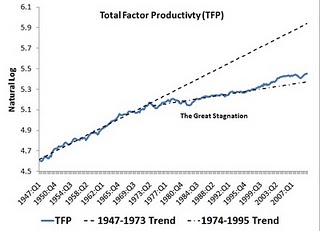
Two popular innovation metrics are total factor productivity the difference between output (like GDP) and the inputs (like capital and labor) used to produce it, or the number of unicorns, startups that reach a $1B valuation.  While total factor productivity seems rather flat, 


the number of unicorns seems to be accelerating.


The US seems to account for about half of them, maybe due to its tolerance for inequality, and light-handed regulation.  


Unicorns are concentrating in several US cities, sometimes called "innovation clusters."


 More posts about unicorns and innovation

HT:  Elad Blog

Saturday, June 12, 2021

G-7 countries collude to eliminate competition among themselves

 Countries compete for residents by offering to do more for less (lower taxes), in the hopes of attracting people and firms, e.g.,

Ireland’s low [12.5% corporate tax] rate has helped attract many of the new breed of footloose digital giants that don’t need to be close to consumers to sell to them, and can register their intellectual property—from which their profits derive—just about anywhere.
Like any cartel, the G-7 can make itself better off by fixing prices (corporate tax rates at 15%), thus eliminating competition among its members for residents and firms.

 Without competition to motivate them, I predict that:
  1. these countries will become less responsive to those they are supposed to serve; and/or
  2. they will "cheat" on the collusive agreement by competing in other dimensions, e.g., reducing property taxes, cutting red tape, giving away land, subsidizing wages.

Friday, June 11, 2021

Should Dropbox make or buy cloud services?


 By in-sourcing IT services, Dropbox saved $115 M over two years, doubling its gross profit margin.  

Actual spend as a percentage of COR is typically even higher than committed spend: A billion dollar private software company told us that their public cloud spend amounted to 81% of COR, and that “cloud spend ranging from 75 to 80% of cost of revenue was common among software companies”. 

Tuesday, June 8, 2021

Inflation and the weak dollar

 Good post about inflation, here is one part related to chapter 11


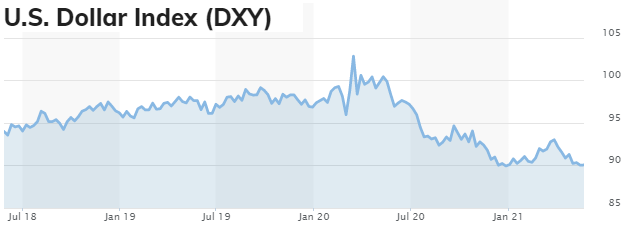
6) The USD is at a 3-year low. The way I look at it — and this is a vast oversimplification — is that a weak USD buys less in foreign goods, which increases the price of imports, contributing to inflationary pressures.

In other words, the falling dollar increases demand for domestic good because it raises the price of substitute imported goods.  

HT:   MarginalRevolution.com