Showing posts sorted by relevance for query eu and innovation. Sort by date Show all posts

Sunday, May 12, 2024

Why the US leads China, EU in economic dynamism

QUESTION TO CLAUDE 3:  The EU and China lag behind the US in economic dynamism, measured by start-up activity, number of unicorns, age of unicorns (younger indicates more rapid innovation), and in productivity growth. Can you document this and tell me why?

ANSWER:  Here is the data to document the economic dynamism gap between the US, EU, and China, along with some key reasons behind it:

Start-up Activity:

  • The US had over 63,000 startups in 2020, compared to around 37,000 in the EU and 25,000 in China. The US accounted for over 50% of global venture capital investment.

Unicorns (private companies valued at $1B+):

  • As of 2023, the US has 704 unicorns, China has 258, and the EU has 139. The total value of US unicorns is $2.4 trillion vs. $862 billion for China and $449 billion for the EU.
  • The US represents 51% of the world's unicorns by number and 65% by valuation. China and the EU lag significantly behind.

Age of Unicorns:

  • The median age of US unicorns is 7 years vs. 9 years for Chinese unicorns, indicating more recent startup success in the US. [Claude 3 unable to find data on EU unicorns]

Productivity Growth (average annual labor productivity growth 2010-2019):

  • US: 1.0%
  • EU: 0.7%
  • China: 7.1% (but from a much lower base)

Key Reasons for the US Lead:

  1. Larger, more developed venture capital and private equity industry in the US fueling more startup investment. US VC deal value was 5-7X higher than China and the EU in recent years.
  2. US equity markets provide better exit opportunities for startups via IPOs. US represented over 60% of global IPO proceeds in 2021.
  3. Huge US domestic market enables startups to scale quickly. EU is fragmented across countries and China's market is difficult for foreign firms.
  4. Top US universities and companies attract global talent. Over 50% of US unicorn founders are immigrants.
  5. Historically strong intellectual property protections, rule of law, and business-friendly regulations in the US encourage innovation and risk-taking.
  6. Deeply rooted culture of entrepreneurship and risk-taking in the US compared to more risk-averse cultures in the EU and China's state-led system.

While China leads on productivity growth, this is largely due to catch-up growth from a low base. On most measures of economic dynamism, especially in the innovation economy, the US maintains a substantial lead over the EU and China as of 2023. But the gap has been narrowing over time.

Economist: America is in the midst of an extraordinary startup boom

Monday, October 30, 2023

EU vs. US: which will discourage innovation more?

EU: (Thibault Schrepel):
If you read the #AIAct carefully and read between the lines, you quickly realize that it greatly expands the investigative powers of antitrust agencies.
Here is an example: the EU regulates high and low risk activities similarly, but...
Only those AI systems that are used in high-risk sectors (seethe list in Article 2 and Annex III of the European Commission’s AI Act) and that are nondeterministic should be burdened to the highest compliance requirements. The systems that are used in high-risk sectors but whose output is highly predictable (e.g., AI systems that rely on expert systems) should be subject to lower compliancerequirements because they present a lower degree of actual risk.
US (Politico):
The White House is poised to make an all-hands effort to impose national rules on a fast-moving technology, according to a draft executive order.
...
At the same time, the Oct. 23 draft order calls for extensive new checks on the technology, directing agencies to set standards to ensure data privacy and cybersecurity, prevent discrimination, enforce fairness and also closely monitor the competitive landscape of a fast-growing industry. The draft order was verified by multiple people who have seen or been consulted on draft copies of the document.
Based on history (see previous blog posts here), i.e., the EU doesn't seem to care as much about mistakenly deterring innovation, though that may be changing under the Biden Administration.

Friday, August 22, 2025

Why is Europe Falling Behind?

 WSJ: Europe is Losing

Europeans live longer, have more leisure time and less income inequality, and often live in stunning cities and towns built over the centuries. But increasingly, Americans enjoy a higher standard of living. They have over 50% more living space on average per person. More than four in five Americans have air conditioners and clothes dryers at home, compared with between one-fifth and one-third of Europeans. Executive assistants in New York City earn around the same as specialist doctors in London.

The reason: no innovation 

But Europe’s lack of economic dynamism has deeper roots, too. Taxes and regulations have risen inexorably; the volume of EU regulations has doubled since 2010. Sprawling rules protect old buildings, incumbent firms and aging consumers, limiting the creation of new infrastructure and industries. As Italy’s prime minister Giorgia Meloni puts it, “America innovates, China imitates, Europe regulates.”

Sweden is the exception: 

Sweden has quietly spurred economic growth by cutting back its welfare state—tightening government spending, revamping the pension system and slashing corporate and personal tax rates. Per capita incomes are now climbing, and the country has seen a burst of entrepreneurship. Sweden even moved ahead of the U.S. in the number of billionaires per capita, thanks to a thriving tech startup scene and a video-game industry that has produced hits such as Minecraft and Candy Crush.

Europeans dont want change: 

One reason change is difficult is that most Europeans will continue to enjoy a comfortable lifestyle for decades to come. “In global terms, relative decline is inevitable, but it may still be a very nice place, right?” says Sander Tordoir, an economist at the Center for European Reform.
Many European voters might consider the relative decline in economic power to be a price worth paying for spending less time at work than Americans and living with less inequality, a more generous social safety net and higher environmental standards.

Sunday, July 12, 2020

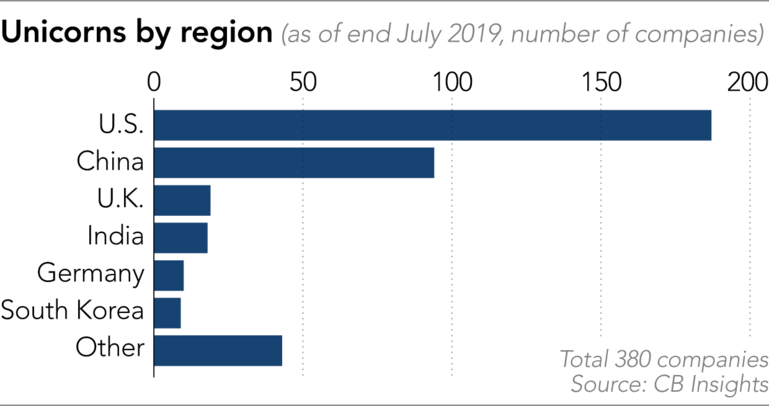
Unicorns by Region


Innovation leads to growth, and growth really matters:  

In the late 1950s, Nobel Laureate Robert Solow attributed about seven-eighths of the growth in U.S. GDP to technical progress. As Solow later commented: “Adding a couple of tenths of a percentage point to the growth rate is an achievement that eventually dwarfs in welfare significance any of the standard goals of economic policy.” 

Although the number of unicorns is a noisy measure of innovation, the relative number of unicorns in the EU may be a harbinger of future low growth, and is perhaps due to the burden of the EU regulation.  In my field of antitrust, there are big differences in how similar laws are enforced, e.g., CPI article or SSRN:

  • EC is run by politicians; US agencies by antitrust professionals 
  • EU skepticism of markets vs. US skepticism of regulation (since 1980) 
  • EU regulation vs. US law enforcement (adversarial) 
  • EU weak due process: remedies w/out adversarial hearing, 3rd party discovery, or cross examination 
  • EU harm to competitors vs. US harm to competition 
  • EU does not screen out bad theories (not supported by evidence) vs. US Daubert rules 

Sunday, December 19, 2021

Why is Europe lagging the US and China?

Since 2000, the EU's share of world income has fallen has fallen from 33% to 25%; and the its companies share of world value has fallen from 31% to 16%.

The Economist mistakenly attributes the difference to several factors:

  • Europe's firms seem to have been out-managed 
  • Its biggest firms are in the wrong industries
  • Entrepreneurial deficiency

All of these seem like symptoms of the EU's decline, not causes. My best guesses about what caused EU's decline are:
This shows up in the graph below, showing that "...in the past decade venture capitalists have backed 661 companies that went on to be worth over $1bn. Only 78 of these “unicorns” are in Europe, worth 8% of the 661 firms’ over-$2.5trn total."

Thursday, April 28, 2022

Can EU governments pick unicorns to close gap with US and China?

New report from the EC focusses on the number of unicorns which are thought to be a metric of innovation, the primary driver of growth.  The chart above shows that US (red) and China (pink) way ahead and growing faster than EU (blue), which updates the chart below (2013-2017).
  • To catch up, the EC suggests that "governments should play a role in the supply of venture capital, establishing funds to invest in larger deals ... that private sector VCs avoid." 
  • Interestingly, much of the private VC funding in the EU comes from the US and China
BOTTOM LINE:  
  • Hubris:  Why do EU bureaucrats think they can pick winners more accurately than venture capitalists?  
  • Selection bias:  Don't they realize that investments that VC's avoid are more likely to lose money?
  • However, I do like the humility of one caveat in the EC report.  
    • "... our analysis recognises that simply increasing the supply of finance will not be effective unless there will be also an effort to increase entrepreneurial activity, both technology start-ups and growth businesses."

Tuesday, April 14, 2015

Can more regulation help European companies?

From The Wall St. Journal

BRUSSELS—The European Union should regulate Internet platforms in a way that allows a new generation of European operators to overtake the dominant U.S. players, the bloc’s digital czar said, in an unusually blunt assessment of the risks that U.S. Web giants are viewed as posing to the continent’s industrial heartland.

If you have trouble spotting the irony, read the comments:

... here go the clowns, er, the EU regulators again. if you can't compete, then regulate, subsidize and then raise all kinds of protectionist barriers. That might have worked for Airbus, but the digital world has low barriers to entry and is fast moving. Add to it worker protection regulations, limit foreign workers and well...no wonder Herr Oettinger is sounding so frustrated.
... The EU has never stopped to seriously consider why their economic system fails to promote the innovation that leads to Google, Facebook, and Apple. Yet, their very response shows why they fail: their answer is more government regulation and market manipulation. I predict that in 10 years the EU will STILL be lagging since they're focused on today's technology and not innovating for tomorrow.
.... Step 1: Tie legs together before entering race against everyone else. 
Step 2: Insist that everyone ahead of you tie their legs together until you catch up. 
Step 3: ? 
Imagine these guys running the Olympics.

Tuesday, May 20, 2025

WSJ: Why EU lags US in tech.

Someone at the WSJ read Why the U.S. Produces More Unicorns than the EU
  • Limited Presence of Major Tech Firms: 
    • Apple's market cap > entire German stock market, 
  • Structural Barriers to Innovation: 
    • risk-averse business culture, 
    • stringent labor laws, 
    • heavy regulation
    • smaller venture capital pool
  • Talent and Incentive Challenges: 
    • lack of stock options makes it harder to align incentives--and retain--innovators.  
  • Underinvestment in Emerging Technologies: no quantum computing and artificial intelligence. 
  • Dominance of Legacy Industries/lack of dynamism:  EU firms founded in 1911, US in 1985

Thursday, December 5, 2024

More on Business Dynamism

Over at the Geek Way, Andrew McAfee has created a startling visualization related to entrepreneurship in the US and EU. The Draghi Report on EU competitiveness is generating a small buzz among economists. One startling claim is that

there is no EU company with a market capitalisation over EUR 100 billion that has been set up from scratch in the last fifty years, while all six US companies with a valuation above EUR 1 trillion have been created in this period.

But the visualization makes the contrast even more stark. US entrepreneurs have has dominated.


US institutions have made it the primary source for innovation. Coste and Coatanlem suggest a cause has to do with greater labor market regulation inflating the costs of failure in the EU. Other causes?

Monday, October 21, 2024

The hidden cost of regulatory uncertainty

Innovation drives growth and at our current growth rate of 2%, US income doubles in 36 years. In contrast, EU income doubles in 108 years. There are many reasons for the US/EU difference regulation, income taxes, subsidies and "regulatory uncertainty." President Biden’s appointees have createdted huge regulatory uncertainty in antitrust (see earlier post) which deters acquisitions which are the proverbial “exits” that drive startups.

Thursday, March 14, 2024

Would that the EU were as fast at innovating as they are at regulating

 Link:  The European Parliament approved the AI Act, which raises the cost of European innovation.

➵ High-risk AI systems will be assessed before being put on the market and also throughout their lifecycle. People will have the right to file complaints about AI systems to designated national authorities. ➵ Generative AI, like ChatGPT, will not be classified as high-risk but will have to comply with transparency requirements and EU copyright law.

➵ Fines for non-compliance can be up to 35 million Euros or 7% of worldwide annual turnover.


Saturday, October 4, 2025

EU Labor Laws crush innovation.

Economist:
...the sheer difficulty of shedding staff en masse—a reality of corporate life—steers Europe’s biggest companies away from making risky bets in innovative fields.
BOTTOM LINE: Look ahead and reason back: if you cannot fire workers, no company wants to hire.