Tuesday, June 29, 2021

Rent prices are rising fast, catching up to house prices


Except for in SF Bay area, NY, SF, Seattle, DC, and New Orleans, rents are increasing dramatically, to catch up with rising property prices.  

From Chapter 9, we know that in equilibrium, you have to be indifferent between renting and owning because renters can buy and become owners, while owners can sell and become renters.  In an earlier post we showed that the price-to-rent ratio was getting really big: 50 in SF, 30 in SD, 19 in Nashville.  Rising rents will help bring this down, and could suggest a movement towards long-run equilibrium.   

Tuesday, June 22, 2021

New Unicorns suggest fast pace of innovation!

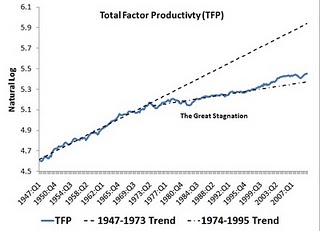
Two popular innovation metrics are total factor productivity the difference between output (like GDP) and the inputs (like capital and labor) used to produce it, or the number of unicorns, startups that reach a $1B valuation.  While total factor productivity seems rather flat, 


the number of unicorns seems to be accelerating.


The US seems to account for about half of them, maybe due to its tolerance for inequality, and light-handed regulation.  


Unicorns are concentrating in several US cities, sometimes called "innovation clusters."


 More posts about unicorns and innovation. 

HT:  Elad Blog

Saturday, June 12, 2021

G-7 countries collude to eliminate competition among themselves

 Countries compete for residents by offering to do more for less (lower taxes), in the hopes of attracting people and firms, e.g.,

Ireland’s low [12.5% corporate tax] rate has helped attract many of the new breed of footloose digital giants that don’t need to be close to consumers to sell to them, and can register their intellectual property—from which their profits derive—just about anywhere.
Like any cartel, the G-7 can make itself better off by fixing prices (corporate tax rates at 15%), thus eliminating competition among its members for residents and firms.

 Without competition to motivate them, I predict that:
  1. these countries will become less responsive to those they are supposed to serve; and/or
  2. they will "cheat" on the collusive agreement by competing in other dimensions, e.g., reducing property taxes, cutting red tape, giving away land, subsidizing wages.

Friday, June 11, 2021

Should Dropbox make or buy cloud services?


 By in-sourcing IT services, Dropbox saved $115 M over two years, doubling its gross profit margin.  

Actual spend as a percentage of COR is typically even higher than committed spend: A billion dollar private software company told us that their public cloud spend amounted to 81% of COR, and that “cloud spend ranging from 75 to 80% of cost of revenue was common among software companies”. 

Tuesday, June 8, 2021

Inflation and the weak dollar

 Good post about inflation, here is one part related to chapter 11


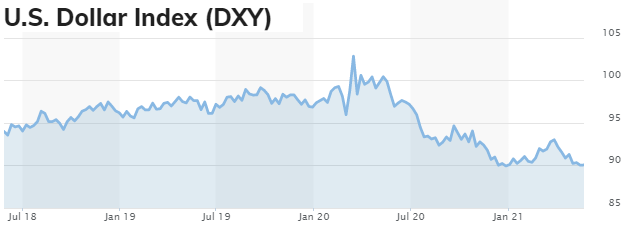
6) The USD is at a 3-year low. The way I look at it — and this is a vast oversimplification — is that a weak USD buys less in foreign goods, which increases the price of imports, contributing to inflationary pressures.

In other words, the falling dollar increases demand for domestic good because it raises the price of substitute imported goods.  

HT:   MarginalRevolution.com 

Saturday, June 5, 2021

the reason behind the labor shortages, soaring wages


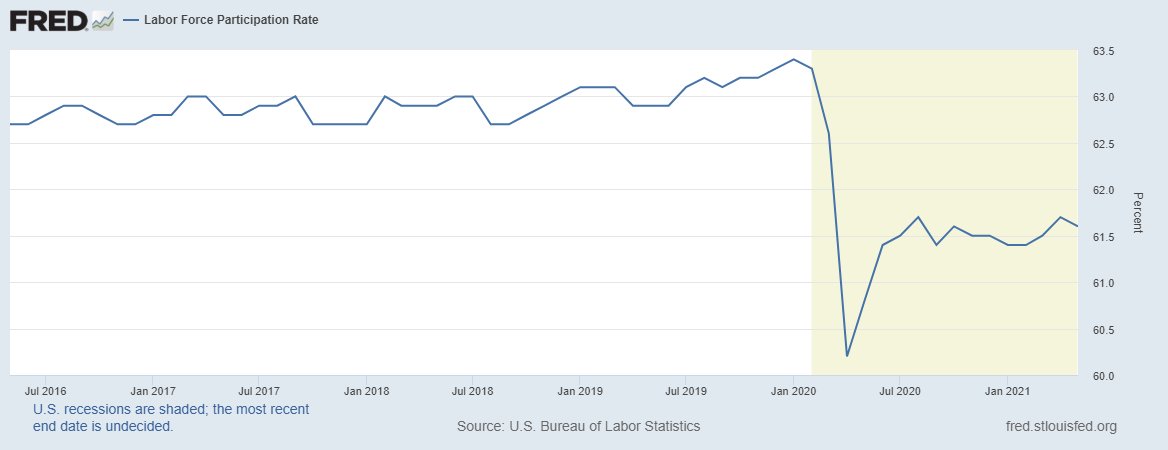
The graph above shows the labor force participation rate has fallen, two percentage points since the pandemic, decreasing the supply of labor.  A reduction in supply increases prices (wages increased at an 8.7% annual rate) and decreases quantity.  

HT:  marginalrevolution.com 

Thursday, May 27, 2021

How do you align the incentives of sea captains transporting criminals to Australia with those of British public (1800's)?

By paying them for the number who arrive alive--instead for number who board the ship--death rates dropped from 30% to 1%.

This anecdote is taken from the introductory lecture from our friends at George Mason University, who had put their Microeconomics class online:

Introduction to Microeconomics

Wednesday, May 26, 2021

Why Finding a Rideshare is So Difficult in Boston

Because the state restricted surge pricing. Boston Magazine has a nice article explaining the market for ride-sharing. A relatively new state law that forbids “surge pricing” during declared emergencies. Surge pricing is a higher than normal price when demand temporarily increases more than supply. The higher price, and higher payment to drivers, was meant to encourage more drivers to participate. Since the pandemic has been declared a state of emergency, surge pricing has been banned for the past year. It is just not worth it for many Uber and Lyft drivers to take on riders anymore. 

That is, it is not worth it to drive people.  Delivering food is still worth it.

Not all of those Uber drivers got off the road entirely—gig workers looking to pick up some extra money have been kept pretty busy transporting meals instead of late-night revelers. Sales at apps like DoorDash and UberEats more than doubled this past year. Working for these services, and not having to risk interacting with an anti-masker in your back seat, may simply be a more attractive option right now.

Also, unlike ridesharing services, food delivery apps can charge surge prices whenever they want.

Sunday, May 23, 2021

Do criminals respond to incentives? (II)

 In San Francisco they do.  In 2014, the city reclassified nonviolent thefts as misdemeanors if the stolen goods are worth less than $950.  With a lower expected penalty for stealing goods, and big expected benefits, like open air markets that allow thieves to fence stolen goods, crime has surged.

As I was paying for [a purchase], a man walked into the store, grabbed a handful of beef jerky and walked out. I looked over at an employee, who shrugged. Then I went to Safeway next door for some groceries and I saw a man stuffing three bottles of wine into a backpack and walking casually toward the exit.  ...   

Thieves “are obviously choosing locales based on what the consequences are,” Safaí said. “If there are no consequences for their actions, then you invite the behavior. Over and over.” ...

Walgreens said that thefts at its stores in San Francisco were four times the chain’s national average, and that it had closed 17 stores, largely because the scale of thefts had made business untenable.

HT:  MarginalRevolution.com

On the post-pandemic future of cities

Bloomberg has an optimistic vision of the post-pandemic central business district (CBD), as more work from home, and density has come to be associated with disease:

... The CBD can no longer function as a collection of low-end grab-and-go cafeterias, chain coffee shops, restaurants and salad bars. To evolve and survive, its offerings will have to become more local, authentic and actively curated. A day at the office will be spent less in a single building and become more like a localized business trip, with maybe an onsite meeting, checking some emails at an outdoor workspace, doing a group fitness session with colleagues, and taking some offsite meetings over lunch or coffee. The downtown expert David Milder dubs this as a shift from the old Central Business District to what he terms the Central Social District, in which workers and people meet, collaborate and socialize together. As I see it, the Central Business District will evolve into a hub in a system of more decentralized Neighborhood Business Districts that span from the city center out to the suburbs and rural areas. Far from being dead, the CBD is perhaps the single best place to be transformed in this way.