Monday, October 24, 2022

If you subsidize homelessness, you get more of it

This article
The Way Los Angeles Is Trying to Solve Homelessness Is ‘Absolutely Insane’ misses the big picture in two ways:
  1. It ignores the simple idea that if you subsidize anything, like homelessness, you get more of it; and
  2. The NIMBY wars over zoning that raise the price of housing is one of the causes of homelessness.  
On the plus side, it describes the costs of the NIMBY wars in LA in ironic detail:
When do Angelenos want affordable housing? Now! Where do they want it? Not here!
And it documents the added cost of the zoning which reduces supply.
“If you look at the inflated cost [$500,000/unit] that comes along with all of the regulation and rules and restrictions and limitations,” Galperin said, “then basically all of this money is going to feed the beast of covering the cost of the regulations. ... We’ve created an absolutely insane system.”
PREDICTION: Nothing will get done, despite Homelessness being voters' #1 concern: "The politics of the affordable housing crisis are terrible. The politics of what you’d need to do to solve it are even worse."

Former student Mike Saint (deceased) said as much a while ago in his book NIMBY Wars: The Politics of Land Use

HT: MarginalRevolution.com

Tuesday, October 18, 2022

Get rich quick: turn a brown company green

The WSJ has a get-rich-quick scheme on their editorial page.  Since green companies carry a 300-basis-point equity-valuation premium over brown ones, buy a brown one, turn it green, and then sell it. 

Here is an example: 
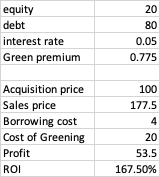
According to Cushman & Wakefield, midmarket offices with LEED certifications carry a 77.5% premium over noncertified offices. Upgrading buildings from “brown” to “green” would generate significant financial value.

If you could do this in a year, put 20% down and borrow the rest from a bank at 5%, you would generate a 167.5% return.


WARNING:  Correlation is not causality.  It could be that valuable companies are the ones that go green because they are the only ones that can afford it.  If so, do not try this, unless of course the government pays you to do it.

Teacher's note:  Quick is an adjective, not an adverb.  See Hold on Loosely by 38 Special.


What President Trump got right: Regulatory Reform

 from Discourse:

  • ...Trump instituted the first federal regulatory budget. He imposed caps on the amount of cost federal agencies could impose on Americans with their rules. Joe Biden dismantled the budget, but a cap is an idea that’s making waves in the states and is sure to make a comeback at the national level. States like Ohio and Virginia have both adopted a version of the regulatory budgeting idea and they are even setting aggressive reduction goals on the order of 25 to 30%. 
  • Trump’s most famous regulatory policy was probably his “one-in, two-out” program where for every new rule two had to be eliminated. Intellectuals hated this simple policy, calling it a “gimmick” in the media. However, its simplicity also makes it useful as a communication device. This helps explain why Idaho, Arizona, Texas, Ohio and Oklahoma have all adopted some version of this policy since Trump took office. 
  • Trump, and populists generally, have a reputation for being anti-science. A lot of people don’t know this, but the data behind some of the U.S. Environmental Protection Agency’s most expensive air pollution regulations is not accessible to researchers. So the studies that justify billion-dollar regulations can’t be replicated because no one can access the data. The Trump administration created a requirement for the Environmental Protection Agency to give greater consideration to studies whereby the underlying health data is publicly available and reproducible. So, who in fact is anti-science here? 
  • The Trump administration was, in other ways, also more sensible on energy and climate issues. Trump instituted a National Environmental Policy Act reform to accelerate the approval of energy and infrastructure projects. Biden scaled back Trump’s reforms, but permitting reform will be critical to the implementation of the Inflation Reduction Act, a Biden priority. The progressive dream of a clean energy future won’t be possible if solar and wind farms, along with the transmission lines to connect them to the grid, can’t be built because permitting requirements and lawsuits drag projects out for years.
HT:  MarginalRevolution.com

TRUTH IN BLOGGING:  I served as Chief Economist of the FTC and DOJ/Antitrust during the Bush and Trump administrations.  

Friday, October 14, 2022

Does it matter that ESG goals are hard to measure?

From Steve Hayward:
If businessmen do have a social responsibility other than making maximum profits for stockholders, how are they to know what it is? Can self-selected private individuals [management] decide what the social interest is?
In other words, if managers can pick their own vague performance metrics, expect them to shirk or follow objectives of their own choosing.  One would think that management consultants would recognize this, but look at PwC:
...PricewaterhouseCoopers published a “sustainability survey” of 140 major U.S. corporations, arguing that “companies that fail to become sustainable–that ignore the risks associated with ethics, governance and the ‘triple bottom line’ of economic, environmental and social issues–are courting disaster.” The triple bottom line, PwC concluded, “will increasingly be regarded as an important measure of value.”
To be fair, PwC's Guide to Key Performance Indicators, seems to recommend clear performance metrics: 
Key performance indicators (KPIs), both financial and non-financial, are an important component of the information needed to explain a company’s progress towards its stated goals,
... in addition to "management accountability," and "corporate transparency." But pursuing ESG, with the conflicting "triple bottom line" makes it harder to hold managers accountable. Claiming to be Green is easy.  Doing it is much harder.  And no one wants to talk about the tradeoffs which, as Hayward notes, may be substantial:
Despite its flexible criteria, the DJSI (Dow Jones ESG Index) lagged the Dow Jones Industrial Average significantly. Over the last decade it has achieved an annual return of 5.2 percent, while the DJIA has returned 15 percent per year, and the S&P 500 14.8 percent.
And don't you violate your Fiduciary duty if you follow ESG goals at the expense of profit? 

Here are past blog posts on performance measurement. 

BOTTOM LINE: If you cannot measure it, you cannot control it.

Wednesday, October 12, 2022

What do markets say about Democratic Chances in the midterm elections?


PredictIt.org trades contracts that payout $1 if the event occurs, so the prices can be interpreted as probabilities.  The graph above shows that the probability of a Democratic win has fallen from about 68% to 52%.

Below, the probability that Republican's will win the House has risen to about 81%.

Tuesday, October 11, 2022

Marketing to influencers

Are central banks in a prisoner's dilemma?

...A rate rise in one country may attract money from investors elsewhere, causing the currency to strengthen. This means a reduction in import costs, which may help to cool domestic inflation. But other economies then face higher import bills, which exacerbates their inflation problems. Uncoordinated policy tightening can become its own sort of currency war, in which each country works to shift the burden of inflation elsewhere, with the net result being too much tightening.

Source: The Economist 


Monday, October 10, 2022

Is EU headed for recession because of US?

When the Pope called on the US to stop raising interest rates because it would force the rest of the world into recession, he must have been reading my previous post, What happens when US Interest Rates Rise?  

Now the The FT reports that the EU is saying the same thing, that US efforts to fight inflation by raising rates will lead to recessions in other countries:

The Federal Reserve is leading a worldwide rush of central bank rate rises that risks tipping the world into a recession, the EU’s top diplomat said, as he warned the union is not fighting its corner in the world. 
Josep Borrell, the high representative of the 27-member bloc, said central banks were being forced to follow the Fed’s multiple rate rises to prevent their currencies from slumping against the dollar...

Friday, October 7, 2022

Can negative bond yields last?


If bond yields are less than inflation ("negative real interest rates"), there is an arbitrage opportunity: borrow money in the bond market (at 3% in the graph above) and invest it in an asset (stocks, housing, gold) whose price will increase with inflation (8%).

This kind of arbitrage increases demand for borrowing, driving up the price of borrowing (the yield), until bond yields are driven above the inflation rate.  

You can probably make money if you know when this will happen.