Thursday, May 26, 2022

Investors Need Not Worry about Climate Risks

Stuart Kirk, the global head of responsible investing at HSBC Asset Management, gave a short and provocative talk on why climate risk will not seriously affect investors (click here for the YouTube page). Short at under 17 minutes and provocative enough to get him suspended (I am glad my university still claims to support academic freedom.)

Key takeaways of his talk: 

  • The most dire forecasts have climate change reducing GDP by 5% over 100 years but this is relative to to a forecast of a 1000% increase (similar to the previous 100 years)
  • Despite continued dire warnings, financial markets hardly respond
  • In order to get the dire forecasts demanded by regulators, banks must "cook the books"

Wednesday, May 25, 2022

The importance of a mom's high school education

 MarginalRevolution.com has a good summary of the evidence in a book review of The Parent Trap.  Among the insights:

Hilger argues that racism does play an important role in explaining Black-white wage differentials but it’s the historical racism that made black parents less skilled and less able to pass on skills to their children. In the twentieth century, Asians, Hilger argues, were discriminated against in the United States at least much as Black Americans. But the Asians that came to the United States had high skills while the legacy of slavery meant that Black Americans began with low skills. Asians, therefore, were better able to overcome discrimination. The success of Nigerians and Jamaican immigrants in the United States also speaks to this point.  (Long time readers may recall that in 2016 I dubbed Hilger’s paper on Asian Americans and Black Americans the Politically Incorrect Paper of the Year .)
  

The implied causal link in the graph above is from the mom's high school education ==> child's education ==> income.   

As you can see there is an effect but it is almost all from the mother going from having less than a high school education to graduating high school (11 to 12 years). In contrast, the mother can move from graduating high school to having a PhD and there is very little change in the education level of an adoptee.

Monday, May 23, 2022

What does Jerry Brown know that Mayor Cooper has yet to learn?


Nashville Mayor John Cooper signed a bill to require developers to build affordable housing.  This makes housing more costly, reducing supply, so Cooper also includes incentives to increase supply, trying to give back with one hand what he is taking away with the other.  This is exactly what the Stanford Law Review [see below] called a " 'kludgy' set of policies that can actually prevent new development and end up increasing housing prices."  

Cooper is repeating--rather than learning from--the mistakes of the past.
  • Affordable housing mandates reduce the supply of affordable housing
    • These kinds of zoning restrictions are popular because they drive the price of existing housing above replacement cost, benefiting Nashville's homeowners. But they come at the expense of renters and new residents. As the Financial Times put it:
      They are the ransom that renters and recent buyers must pay to existing homeowners – whose homes the rules protect – for use of an artificially limited stock of housing. So severe have those restrictions become that the value of the ransom runs into the trillions. 
  • Nice summary of the affordable housing crisis from Stanford Law Review
    • [the cause of the affordable housing crisis] is uncontroversial among urban economists but not broadly understood by low-income families, advocates for low-income families, housing activists, and their allies in academia, policy, and government—in short, the housing advocacy community. In the face of higher housing costs, the housing advocacy community tends to argue for a “kludgy” set of policies that can actually prevent new development and end up increasing housing prices
To alleviate the crisis, reduce the barriers to expanding housing supply, like local zoning, regardless of what kind of housing it is.  New supply will bring down all prices.  But as the Financial Times notes above, this would be politically unpopular, as homeowners benefit from strict zoning that limits new supply because it raises their housing prices.  

Thursday, May 19, 2022

Cryptoeconomics

 New Chapter to their textbook free and online, by Tyler Cowen and Alex Tabbarock.  They explain cryptography, public and private keys, NFT's and # functions:

Here, for example, is a hash of the entire text of War and Peace: AB8257AE34CE51933B7D6F0B06A486CD1E189636C572B0723A5F 4E341B57A37A 

If you are wondering why it’s not a string of 256 0s and 1s, that’s simply because we encoded the same date in a shorter Hexadecimal format. An “A” in this format converts to 1010, for example. Now here is War and Peace hashed but with just one comma missing.

 F92D49FF6BF02E4B29469C8AC71A7D662E82139F0AD4EC9D027 DF1AA86B23426 

The two hashes look completely different and that is the sense in which a hash produces a digital fingerprint. Another important implication is that a hash function like SHA256 is said to be collision-resistant, meaning that it is infeasible to find two messages with the same hash.

Wednesday, May 18, 2022

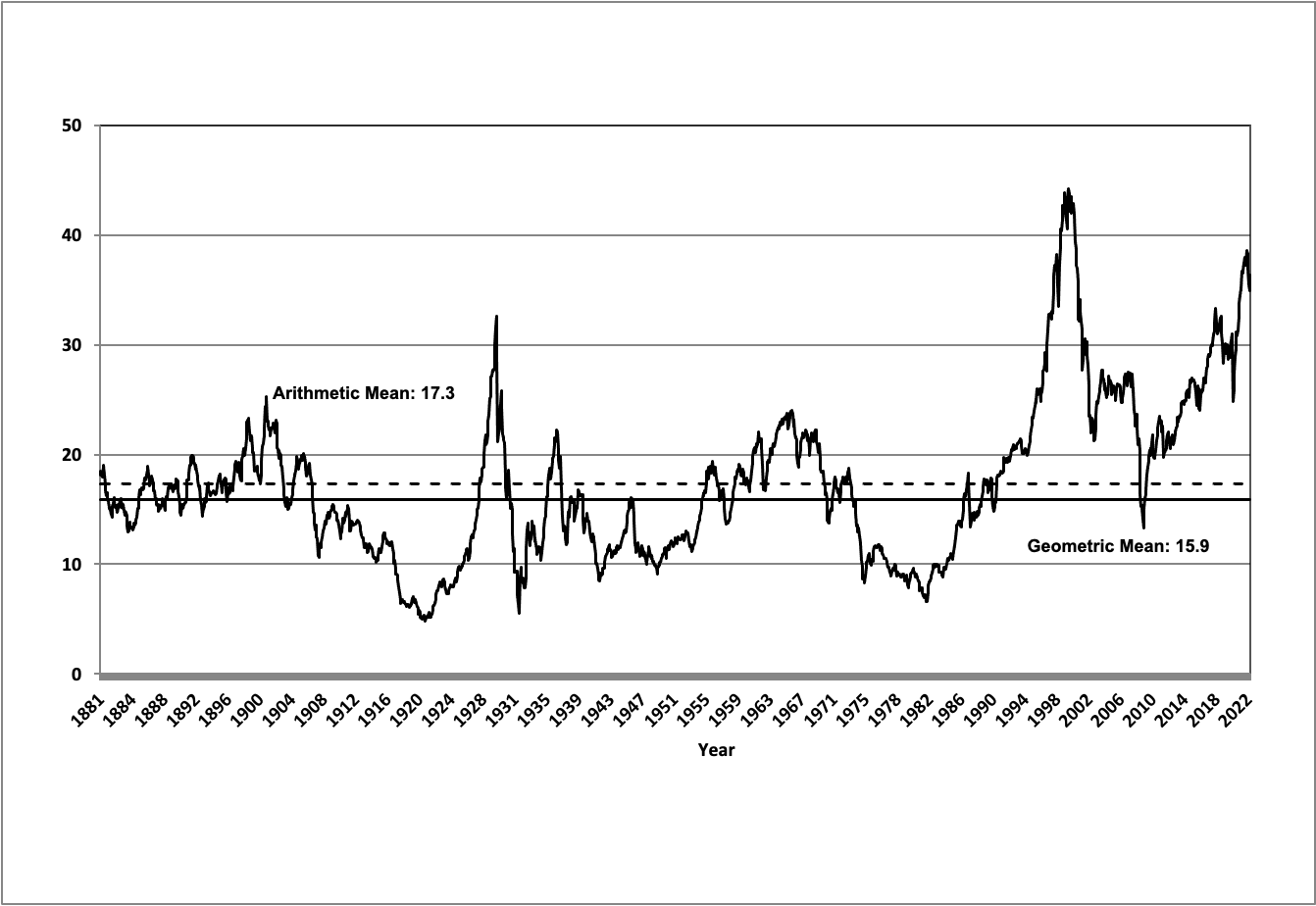
Is the stock market overvalued?


Shiller's CAPE (Cyclically Adjusted Price/Earnings ratio) and the WSJ, This Could Be a Lost Decade for Stocks, suggest that it may be:

The recent selloff could be the early stages of that adjustment, though, according to Christopher Bloomstran, a value-investing veteran who is president of Semper Augustus. He wrote in an email interview that tightening monetary policy is likely to be the catalyst.
“The Fed has a perfect record popping bubbles. They aren’t likely to fail this time,” Mr. Bloomstran wrote.
Another prominent value investor, Jeremy Grantham, co-founder of the asset manager GMO, wrote in January that U.S. stocks had entered their fourth “superbubble” of the past 100 years and that he expected them to drop by half. In addition to quantitative reasons such as statistical deviation from long-term trends, he cited a more subjective historical cue akin to ringing a bell near the top—“crazy” speculation, this time in meme stocks, EV makers, cryptocurrencies and NFTs.

Monday, May 9, 2022

Revealed Preference: Where are people moving to and from?

Here are the top 10 growth states, according to U-Haul data analyzing migration patterns from 2020: 

MOVING TO:
  1. Tennessee 
  2. Texas
  3. Florida 
  4. Ohio 
  5. Arizona 
  6. Colorado
  7. Missouri
  8. Nevada
  9. North Carolina
  10. Georgia
MOVING FROM:
  1. California
  2. Illinois
  3. New Jersey
  4. Massachusetts
  5. Maryland
  6. Oregon
  7. Louisiana
  8. Connecticut
  9. New York
  10. Pennsylvania
  11. Michigan

Facebook vs. Australia: The alternatives to agreement determine the terms of agreement

 The Australian govt. passed a law requiring Facebook and Google to start paying for news content that appeared on their sites. However, the law did not specify any criteria for identifying pages that were in violation of the law.  

This uncertainty creates a tradeoff when trying to design rules to comply with the law:    

  • An "overly broad" take down means that Facebook is less likely to violate  the law,  BUT
  • It also means that Facebook is likely to take down pages that shouldn't be taken down.  

According to WSJ

The documents show that Facebook deliberately created an overly broad process for deciding what was news and taking down supposedly news pages that swept up a lot of things that weren't news. And the document showed that it knew this. This was a choice. ...
The other thing Facebook didn't have ready was a process so that anyone who thought their page had been wrongly taken down could appeal to Facebook and ask to be reinstated. The company says it was still working on the appeals process when the takedown began. The massive takedown of Facebook pages may have wreaked havoc for the public, but for Facebook, it got the company back at the negotiating table with Australian lawmakers. ...
Within days, Australian lawmakers watered down the bill and added in language that said if Google and Facebook struck enough deals with the news publishers on their own, they could avoid that dreaded government run negotiation process: the so-called final offer arbitration. 

The reporter suggests that this was all part of a cleverly thought out plan to pressure Australia to watering down the law, but the overly broad take down could also be seen as Facebook's honest effort to comply with the law.  

Keynes vs. Hayek, round II

Saturday, May 7, 2022

Enlightenment Now!

Alex Tabborock opines I hate paper straws:
There is a wing of the environmental movement that wants to punish consumerism, individualism, and America more than they want to solve environmental problems so they see an innovation agenda as a kind of cheating. Retribution is the goal of their practice.
If you find yourself drawn to the weird atavistic sensibility to get back to the land (which would dramatically increase our carbon footprint--remember density is green), or unplug and return to a simpler (read dirtier, riskier, less interesting) golden past, don't. Instead read Steven Pinker's Enlightenment Now: The Case for Reason, Science, Humanism, and Progress.
In this elegant assessment of the human condition in the third millennium, cognitive scientist and public intellectual Steven Pinker urges us to step back from the gory headlines and prophecies of doom, which play to our psychological biases. Instead, follow the data: In 75 jaw-dropping graphs, Pinker shows that life, health, prosperity, safety, peace, knowledge, and happiness are on the rise, not just in the West, but worldwide. This progress is not the result of some cosmic force. It is a gift of the Enlightenment: the conviction that reason and science can enhance human flourishing. 
...Many commentators, committed to political, religious, or romantic ideologies, fight a rearguard action against it. The result is a corrosive fatalism and a willingness to wreck the precious institutions of liberal democracy and global cooperation.

And as if to prove this point, The Atlantic shows up:

...the Enlightenment emphasis on the autonomous, rational individual can also lead to alienation and isolation, which make tribalist mythology all the more appealing.