Monday, August 12, 2019

Why do women bid less for gigs?

They offer 4% lower prices, win jobs more frequently, and earn higher expected revenue (prob[win]*price) than men:  New working paper:

...we provide empirical evidence for a statistically significant 4% gender wage gap among workers, at the project level. We also find that female workers propose lower wage bills and are more likely to win the competition for contracts.

This raises the obvious question, whether women bid more aggressively than men because they think that the opportunity cost of their time is lower, or because they are bidding optimally, and men are not.

Effects of the trade war: Chinese selling US assets

As the trade war with China heats up, we begin to see its effects: highly leveraged Chinese firms are being forced to sell US assets so that they have enough money to service debt, especially as they earn less from trade with the US.
The government’s dramatic about-face from encouraging aggressive overseas acquisitions to cracking down on risky lending and overseas transfers underscores worries over the risk that the nation could run short of enough US dollars to make the interest and principal payments on its mounting debt at a time when the current account balance is coming under pressure.

HT:  MarginalRevolution.com

Are we on the eve of a recession?


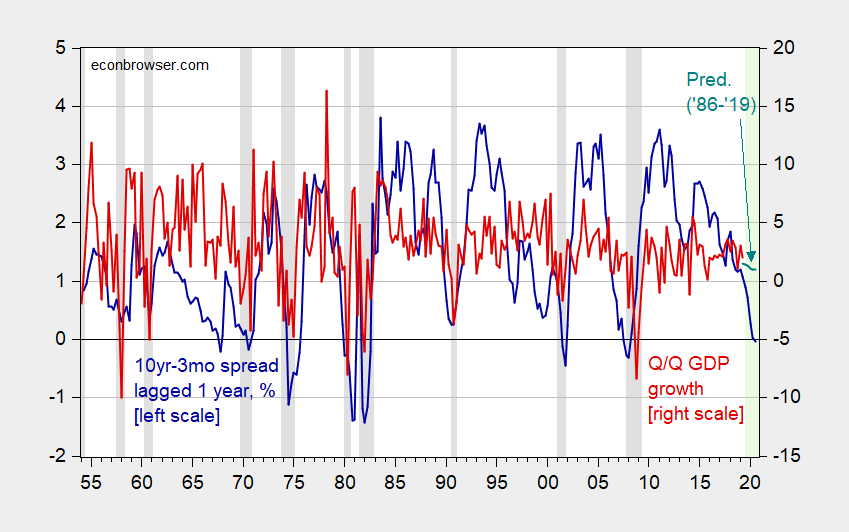
In the graph above, we plot two time series, the percentage growth in GDP (in red) and the difference between long and short term interest rates (in blue).  The red series has a mean somewhere between 1% and 2%.  The so-called "yield curve" (in blue) is usually positive to account for the greater risk of long term bonds.  

In all of past recessions in the graph, when the blue line has dipped close to zero before the red line goes negative.  Recently the difference has approached zero, which could be a signal of a coming recession.  Here is the theory:

Under unusual circumstances, investors will settle for lower yields associated with low-risk long term debt if they think the economy will enter a recession in the near future. For example, the S&P 500 experienced a dramatic fall in mid 2007, from which it recovered completely by early 2013. Investors who had purchased 10-year Treasuries in 2006 would have received a safe and steady yield until 2015, possibly achieving better returns than those investing in equities during that volatile period.

In other words, (i) if the alternative to holding treasuries is investing in the stock market, and (ii) you expect the stock market to fall in the the short term, then get out of equities into long-term bonds.  This drives up the price of long-term bonds.  Higher bond prices imply a lower yield because yield=(bond payment)/price.  

NOTE: there is one "false positive" for this indicator, in 1967, when the dip in the yield curve did not signal an immediate recession.  

DISCLAIMER:  If I really knew that a recession were coming, I wouldn't be teaching school, and I probably wouldn't tell you.  

Argentine peso drops 25% against dollar following leftist victory

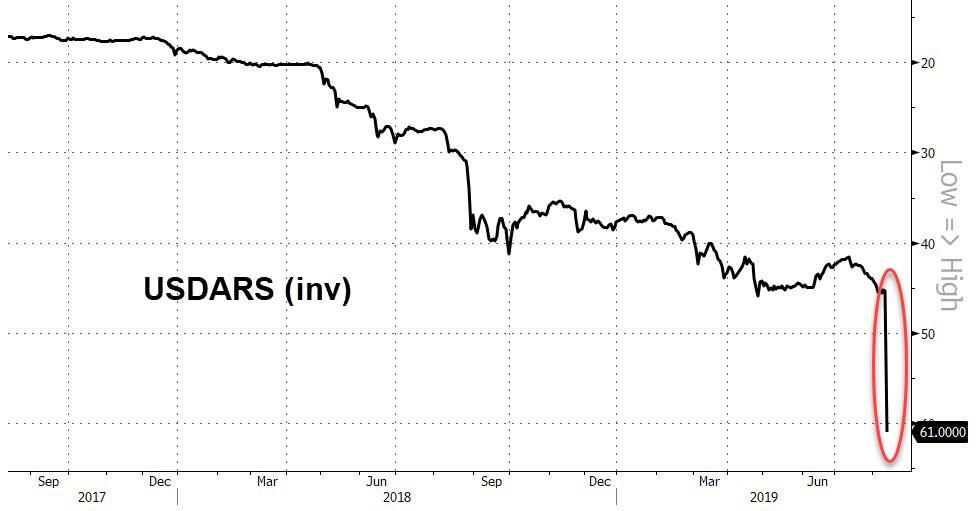
The graph above shows that the price of argentine peso in dollars went from 45 to 61 pesos/dollar, a depreciation of the peso by about 25%, following the election victory by a "leftist."

We can infer several things from the Chart. First the depreciation of the peso indicates that the markets think that demand for dollars will increase in the new regime.  Speculators' increase in demand for dollars may be due to the expectation that the leftist regime may may try to print pesos to stimulate the economy, weakening the peso.  If speculators expect the peso to be weaker in the future, they should sell pesos to buy dollars now to preserve wealth.  That looks like what is happening. 

Anticipate hold-up--China edition

From a friend who worked in China for two years:
I was working with an education consulting company, and had signed a contract prior to moving that said I would live and work in Chengdu for two years. After about 4-5 months in Chengdu, my company said they needed to relocate me to Shenzhen. I agreed under the condition that my move would financially covered.  
I arrived in Shenzhen the night before starting work. That next morning I received a message from my manager saying that I needed to sign a contract promising that if I left before my two years were up, I would have to pay back everything from my move! 
Obviously, I refused, and then had to speak with my boss back in Beijing. She expressed her "disappointment" in me, raised her voice, and said someone else had already signed and I should too. She came up with a few other solutions (one was that I would sign a contract promising not to tell my colleague that HAD signed, and if I did tell him then I would have to pay them the convenient amount of my move- haha), but ultimately realized I would not budge and dropped it.  
Needless to say, it was a strange experience! China can be a weird place. 

In this case, my friend was "held up" after she incurred the sunk moving costs.  She never received the reimbursement.  

The difficulties of anticipating hold-up and then contracting around it, make it more difficult for the Chinese economy to adapt to change, and to create wealth by moving assets to higher-valued uses. 

Wednesday, August 7, 2019

Are kids safer in a parent's lap?

...than in their own seat? The Federal Aviation Administration (FAA) says "yes." Although a child has a bigger chance of surviving a crash when belted into their own seat, doing so would cost extra.
That cost...would cause some families to revert to car travel, which is less safe. “Consequently,” states the agency in its latest response to the safety board, “entire families would be subject to far higher fatality rates, which would produce a net increase in overall transportation fatalities.”


Remember, when evaluating a policy, you want to consider all benefits and costs that vary with the consequence of a policy. If you miss some, you commit the "hidden cost" fallacy. BRAVO to the FAA for recognizing the hidden cost of mandating safety belts and for saving lives!

Socialism vs. Capitalism: funny video

Sunday, August 4, 2019

Is public philanthropy evil?

That lobotomies were not a good way to treat mental illness was known by 1941, yet lobotomies continued for thirty more years, mostly in public asylums.  Here's why:

Because superintendents [those managing publicly funded asylums] received federal funding based on the number of committed patients rather than offering effective medical care, treating patients was a secondary matter.  
[these superintendents]... sought low-cost treatment options. The lobotomy provided such an opportunity. Unlike the therapeutic or hydro and shock treatments available (all of which are still used today), the lobotomy was comparatively cheaper and did not take years to complete. It also frequently made difficult patients more docile and easier to manage.
In contrast, private asylums, which also faced overpopulation issues and treated the same patient demographics as public asylums, were funded by philanthropic donors and the patients’ legal caretakers. When patients failed to improve, were mistreated, or not offered sufficient quality of care, an asylum risked its profitability. Accordingly, using erroneous or excessively harmful treatment methods like the lobotomy would be detrimental to their bottom line.

QUESTION:  how would you better align the incentives of superintendents with the goals of patients (and their caretakers)?

HT:  MarginalRevolution.com

Saturday, August 3, 2019

AI makes marketing more powerful

There are two kinds of Artificial Intelligence (AI): symbolic logic, where automated rules replace human decision making; and machine learning, where outcomes, like sales, are related to policy, like advertising copy, to infer causality.  This from the WSJ seems to describe machine learning by Persado software:

In one test, a headline by human copywriters urged consumers to “Access cash from the equity in your home,” with the call to action “Take a look.” A variant created by Persado was headlined “It’s true—You can unlock cash from the equity in your home” and suggested “Click to apply.” 
The Persado version generated 47 weekly applications for home equity lines of credit, compared with 25 for the original version, JPMorgan Chase said.

Machine learning is designed to improve when given more data, like the A/B testing described above. In  general, following up marketing campaigns with A/B testing is a really good idea, regardless of whether you are using AI or not. 

Friday, August 2, 2019

"Smart" flashcards to learn students names and to teach vocabulary

This month, I began using anki “smart” flashcards to memorize student names  and it has been really helpful.  I also put up the glossary of my textbook on anki cards to help students learn the vocabulary of each chapter.  The anki software is free for computer (they charge if you want to put it on your phone or tablet.)

Here is how the cards work.  On the “front” is a photo of the student, and on the back where they work, job title, and name.  You look at the photo, then “turn it over” and push one of three buttons telling the program whether you got it wrong, whether you got it right, or whether you know it for sure.  Depending on your answers, and how frequently and recently you have seen the card, the built-in Artificial Intelligence of the smart cards will show the card again until you know it.  You see cards you don't know more frequently than those you do.  The program stops after it determines that I have reached my limit; apparently that is the best way to learn.   

I have never been able to learn students names, but this program changed that.  I have taught myself to invent mnemonic’s to help me learn faster.  This came naturally to me when I found myself missing the same names over and over.