Showing posts sorted by relevance for query risk premium. Sort by date Show all posts

Thursday, October 31, 2013

Risk-on, Risk-off trading

In our chapter 9 video, we illustrate how Vanderbilt Treasurer made money by selling risky assets and buying less risky ones when risk premia (the extra return investors receive for investing in risky assets) moved to historic lows.  He correctly reasoned that investors were ignoring risk in search of higher return, so when risk premia widened, in 2008, the price of risky assets fell relative to their less risky counterparts.  In the jargon of finance, this is known as a "risk off" trade.

We can illustrate risk-off trading, uusing Don Marron's "history of the European Union in one simple chart" below. It shows the premia that the Southern European PIIGS (Greece is in orange) had to pay to borrow money. 

In 1995, for example, Greece (in orange) had to pay 18% to borrow money, representing an 11% premium over Germany's (in red) 7% rate.  The risk premium disappeared in 2002 when Greece joined the EU.  In 2008, the risk premia re-appeared, as the interest rate on Greek debt rose to 16%, a 12% premium over Germany's 4%. 

From investopedia:

...During periods when risk is perceived as low, risk-on risk-off theory states that investors tend to engage in higher-risk investments. When risk is perceived as high, investors have the tendency to gravitate toward lower-risk investments.  ... The 2008 financial crisis was considered a "risk off" year, in which investors attempted to reduce risk by selling existing risky positions and moving money to either cash positions or low/no-risk positions, such as U.S. Treasury bonds.

If you can anticipate changes in risk premia, you can make money:

  • A prescient "risk-off" trade would have been to short Greek debt and buy German debt in 2007, and sell in 2011.  
  • Conversely, a prescient "risk-on" trade would have been to buy Greek debt and short German debt in 1995, and sell in 2001. 

Thursday, June 4, 2026

Has the risk premium for owning stocks disappeared?

Axios reported that the equity risk premium (ERP) — the extra return investors expect for holding risky stocks instead of safe Treasuries — has shrunk to almost nothing. A safe 10-year Treasury bond pays about 4.5%. Stocks, measured against the companies' current earnings, return only about 3.7%. So right now the safe bond actually pays more than risky stocks, even though stocks have historically paid 3–5% extra. It looks as if you'd be taking on the risk without the usual reward.

HOWEVER: That 3.7% is based on what companies earn today. Stock prices are high because investors expect much bigger earnings in the future, driven by AI. If those bigger earnings actually arrive, then the price you pay today is reasonable, and stocks aren't really overpriced after all.

BOTTOM LINE: The risk premium you calculate depends on which earnings you use — today's or the future's. The historical rule assumes today's earnings are a good guide to the future. If AI changes how much companies earn, that assumption breaks, and the real risk premium is unknowable until we see whether the growth shows up.

Monday, May 18, 2009

How Big is the Equity Risk Premium?

We've blogged a couple of times on the equity risk premium, or the amount of compensation investors receive for holding risky stocks rather than risk-free bonds. Not everyone agrees what the number is though. Pablo Fernandez, a finance professor from IESE Business School in Barcelona, Spain surveyed finance professors around the world about the market risk premium they use.
Abstract:
The average Market Risk Premium (MRP) used in 2008 by professors in the USA (6.3%) was higher than the one used by their colleagues in Europe (5.3%). We also report statistics for 18 countries: the average MRP used in 2008 ranges from 4.1% (Belgium) to 10.5% (India).

The dispersion of the MRP used was high: the average MRP used by professors of the same institution range was 3.5% and the one of the same country was 6.9%.

The average MRP used in 2007 was 1.5% lower than the one used in 2000. 15% of the professors decreased their MRP in 2008 (1.5% on average) and 24% increased it (2% on average). 66% of the professors used a lower MRP in 2007 than in 2000 (22% used a higher one).

Most surveys have been interested in the Expected MRP, but this survey asks about the Required MRP. The paper also contains the references that professors use to justify their MRP, and comments from 180 professors that illustrate the various interpretations of what is the required MRP and explain the confusion of students and practitioners about its concept and magnitude.

We also report 416 answers from the field: the average MRP used by European Companies in 2008 was 6.4%.

Wednesday, January 19, 2011

Is the stock market over-valued relative to bonds?

The P/E ratio of the previous post can also be expressed as a "yield" (E/P) so that it can be compared to ten year treasury bonds. Using this metric, stocks (in blue) look historically cheap.

Stock yields are historically lower than bond yields because stocks have a growth premium built in.  The growth premium should drive up the stock price, and drive down the yield.  Bonds have no such upside potential.

However, stocks also have a risk premium built in because they are typically riskier than bonds.  The risk premium should drive down the price, and raise the yield.  The relatively high stock yields in 2010 suggest that risk premium is outweighing the growth premium.

The difficulty of course, is that dividend yields are affected by inflation, but stock yields are not (because both denominator and numerator are affected).
Slide from Roger Brinner of the Parthenon Group.

Thursday, April 6, 2023

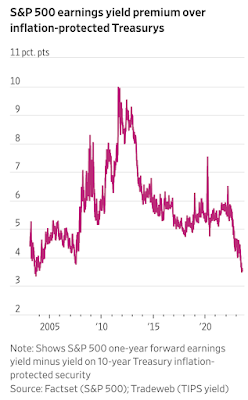
Why is the stock risk premium so low?


WSJ article:

The equity risk premium—the gap between the S&P 500’s earnings yield and that of 10-year Treasurys—sits around 1.59 percentage points, a low not seen since October 2007.

What does this mean?  Investors have a choice between investing in stocks or bonds.  Stocks are historically more volatile/risky than bonds, so risk-averse investors have to be compensated for investing in stocks, with a return that is about 3.5% higher.  As of the end of March, 2023, the risk premium had fallen to less than half of that.   

In 2006, Bill Spitz (former Vanderbilt Treasurer), saw something similar (my 2006 Blog Post).  He noticed that the risk premia between returns on stocks vs. bonds, low vs. high quality stocks (low debt, high and stable profit margins), and emerging market debt vs. US debt were at all time lows.  Either the world had gotten less risky, or investors were ignoring risk in the search for higher return.  Spitz thought it was the latter which motivated his investment advice at that time: 

  • Avoid Riskier assets 
  • Stick with quality 
  • Be skeptical of the rush to alternatives 
  • Moderate return expectations 
  • Borrow now if you are a marginal credit  
The implication was that when investors stopped ignoring risk, the prices of riskier assets would fall, which would increase the risk premia.

Monday, July 31, 2023

Risk premium for stocks near all time low


WSJ reports:  
The gap between the earnings yield of the S&P 500 and the yield on the 10-year U.S. government bond dropped to around 1.1 percentage point last week, its narrowest since 2002.
And here is the reason:
Bond yields haven’t risen as much, but stocks have taken flight—lifted by investors’ growing optimism about the economy.

In other words, investors are investing as if stocks are only slightly more risky than bonds.  If they change their minds, and think that stocks are more risky than bonds, stock prices will fall which will raise the expected return of investing in stocks or bond prices will rise which will decrease the bond yield, and bring the equity risk premium back up, closer to its mean.

This isn't the first time that the equity risk premium has fallen, See earlier posts to see past instances of this, like in 2008, when Vandy Treasurer Bill Spitz's advised:

  • Avoid Riskier assets 
  • Stick with quality 
  • Be skeptical of the rush to alternatives 
  • Moderate return expectations 
  • Borrow now if you are a marginal credit
But unlike 2008, the Shiller CAPE (cyclically adjusted price to earnings ratio, a measure of value) is not as high, though twice its long run mean of 16.  
DISCLAIMER:  if I really knew what was going to happen, I wouldn't be teaching school.

Saturday, May 3, 2008

Where did the risk go?

The Volatility Index (invented by colleague Bob Whaley) which measures the implied risk in options prices (the higher the options price, the bigger implied risk) is down to 18% from a high of 32% in March. This means that the expected change (the standard deviation) in the returns from holding the S&P index for the next year is 19%. The decline in risk has corresponded to an increase in the price of the S&P 500. The market "prices" the decline in risk by reducing the risk premium necessary to get investors to hold the risky asset. A higher current price means lower expected future return, and thus a lower risk premium for holding stocks.Or for a longer run view,

Monday, February 12, 2024

Are stocks over-valued?

 DISCLAIMER:  If I really knew, I would not be teaching school.

WSJ summarizes five valuation methodologies:

  • Price/Earnings Ratio:  "Analysts are more optimistic about the profit picture for this year and project that earnings among the companies in the S&P 500 will rise roughly 11%. That could offer stocks more room to run."
  • Price-to-book Ratio: "Akin to the price/earnings ratio, the price-to-book ratio divides a company’s stock price by its book value, a measure of total assets minus liabilities. ... It is less useful for tech companies because their growth prospects often aren’t captured on company balance sheets...The S&P 500 is trading at a forward price-to-book ratio of 4.15, above its 10-year average of 3.26 and its 20-year average of 2.76. In comparison, Nvidia’s price-to-book ratio is 22.48."
  • Equity Risk Premium: "Comparing the trailing earnings yield with the 10-year Treasury yield shows that the S&P 500’s equity risk premium is at 0.7 percentage point, near the lowest level in about two decades. (The lower the ratio is, the more expensive stocks are.)"
  • Price/Earnings Growth Ratio: "The PEG ratio is the market’s valuation of a company relative to its earnings prospects. To calculate it, divide a company’s price/earnings ratio over the past 12 months by its projected annual future earnings growth. A PEG of 1 indicates the stock’s price is in line with its growth expectations. ... The S&P 500’s current PEG ratio is 1.48, below its 10-year average of 1.49 and above its 20-year average of 1.35. Nvidia’s ratio of 0.78 makes it look cheap in comparison."
  • CAPE: "At 33.4, the S&P 500’s CAPE ratio is higher than it has been more than 96% of the time since 1881, but it is still well below the prior peaks seen in the late 1990s and 2021."

Wednesday, November 8, 2023

Equity risk premium for stocks at all time low

 
WSJ:  Whatever happens to change it, there is a consensus on Wall Street that the equity-risk premium can’t stay this low forever.

ANALYSIS:  This is the Chapter 9 logic to value stocks relative to bonds, and right now it looks as if the stock market is over valued relative to bonds. 

DISCLAIMER:  if I really knew, I wouldn't be teaching school and I would charge you for the information.

Wednesday, April 15, 2009

Equity risk premia since 1929

We have blogged about the equity risk premia, the volatility index, and the drop in almost all risk premium right before the recent crash. The risk is back, or at least the market recognizes that risk is back. This means that investors are asking to be compensated handsomely for bearing risk.

Tuesday, January 29, 2008

If Democrats raise taxes on investments, ...

From Real Clear Markets
The higher the taxes on investment returns, the higher the rate of return investors will require for their investments and the less they will pay for a given investment. A natural extension of this concept is that if the tax rate on investment returns increases, the value of those investments in the economy will decrease. In the context of the stock market, moving from lower investment tax rates to higher investment tax rates will lead to a drop in market values, all other things equal.

Equity Discount Rate:

Candidate Investment Tax Rates Base Rate Risk Premium Tax Premium Equity Discount Rate
A (Rep.)
15% 4% 0 0.7% 4.7%
B (Dem.)
35% 4% 0 2.2% 6.2%

[A Democratic proposal] to increase in investor tax rates will increase the equity discount rate by more than 30%. To put this into perspective, let us value a hypothetical company that is expected to generate $100 a year of cash flow into perpetuity. Under these circumstances, the values of this company under the policies of Republican and Democrat Candidates are $2127 and $1613, respectively. (Please note that these calculations did not require a premium for inflation or risk. Incorporating these factors into the discount rate, only serves to increase the final return demanded by investors and further reduce market values and economic growth.)

Wednesday, August 5, 2015

Gig economy aligns incentives, shifts risk, but is more rewarding

A host of applications like Uber, Monster.com, and Airbnb are replacing lifetime employment on a salary with contractors who must bid for jobs and build reputations for quality service based on immediate feedback by customers:
The gig economy is only part of a shift in employment over the past three decades, unleashed by technology and global trade. It has created many winners and losers, both by outsourcing jobs from the west to Asia and Africa, and by changing the terms on which most people work. Financial and contractual risk that used to be borne by companies has been transferred to employees.

This change better aligns incentives of firms (contractors) with the goals of consumers (lower price, higher quality), but it also exposes contractors to more risk, for which they must be compensated.  However, the benefits of being self employed seem to far outweigh any risk premium:

More self-employed people in Europe and the US report enjoying their jobs than those who are employed. Many entrepreneurs, even those who run a tiny business that amounts to self-employment, like their freedom and self-reliance and the possibility that they could become wealthy.

...which is reflected in falling compensation:

...the average income from self-employment fell 22 per cent in the UK between 2009 and 2014, even as self-employment contributed 732,000 of the 1.1m rise in total employment.

Wednesday, May 8, 2019

Why don't insurers try to mitigate risk?

Allison Shrager's terrific book, An Economist Walks into a Brothel, contains all sorts of innovative risk mitigation strategies pursued by people in all walks of life (see earlier blog post, How are Jet Skis like Financial Derivatives).  So why don't insurance companies spend more time figuring out how to mitigate risk?

The answer is simple:  Risk mitigation is not a source of "sustainable competitive advantage:"
Argument #4: mitigation is easy to copy. Underwriting risk selection is much less tangible and secrets can be a protected source of advantage. People can reverse engineer a dongle but not underwriting strategy. Once copied mitigation provides a one-off benefit to the market, changing the rate level but not the profit level (bit of a negative inventive because lower claims means lower premium and so less float!).

 Instead, insurers spend most of their time classifying risks (classification strategies are proprietary) which offers the benefits of diversification:

Argument #3: Improved classification allows for stratification and so diversification. Insurers are diversifiers. If you can segregate genuinely distinct classes of risk, portfolio volatility will drop.

Friday, February 6, 2015

Is this really an arbitrage opportunity?

Kansas has an under-funded, defined-benefit pension system that is becoming more and more costly to fund, diverting expenditures from roads, schools, and the like:

Many investors in the municipal-bond market are concerned that retirement costs will eventually cripple states, particularly in Illinois and New Jersey, which also have settled SEC charges related to pension disclosures. State retirement systems have far less funds than they need to meet all their projected payouts, with the Pew study putting the combined shortfall at $915 billion as of 2012.

Instead of trying to reduce its pension obligations, Kansas wants to earn some money by borrowing at 5%, and then investing the money in its pension fund, where it thinks it can earn 8%.  This would represent an arbitrage opportunity, except for the fact the the pension investments are in higher risk securities which naturally earn a risk premium.  This means that the extra return that they generate are compensation for the additional risk that Kansas will incur.
Even under the best circumstances, pension bonds come with the risk that expected spreads won’t materialize. Since Oakland, Calif., sold the first pension-obligation bonds in 1985, cities and states have issued about $105 billion of the debt, the Center for Retirement Research said last year. Those deals have had returns averaging 1.5% annually since 1992, thanks to market gains following the financial crisis, the center said.

We have blogged about under-funded pensions before.  They arise because the median voter, and the politicians they elect, typically do not understand or care about the problem. Refreshingly, Nashville's Mayoral candidate David Fox has raised the issue in his campaign:

...The danger of debt is probably the issue he's most passionate about: He gives the sense that the city's unfunded liabilities and debt really do keep him up at night.  
"What do you think is gonna happen when our national economy, as it will do cyclically — when our national economy goes sideways for several years?" Fox asks. "We're going to see a lot of municipal bankruptcies. Because unfunded liabilities are too big, the balance sheets are way out of whack, you have way too much debt at the municipal level, and a lot of cities are going to go bankrupt. That's not gonna be an accounting adventure, that's gonna have a real bad effect on people who live in these cities."

TRUTH IN BLOGGING DISCLAIMER:  I am leaning towards Fox (and his wife is a former student).  

Friday, November 22, 2013

Risk on trading in Greek debt

Following up on our earlier post about Risk-on, Risk-off trading.

Here is an update of the time series graph, showing that after peaking at 48%, when the European Central Bank said it would buy Greek Debt, the risk premium on Greece debt has dramatically fallen. 

HT:  Matt D.

Friday, November 18, 2022

Netflix's decentralized organizational form

https://jobs.netflix.com/culture
  1. encourage independent decision-making by employees
  2. share information openly, broadly, and deliberately
  3. are extraordinarily candid with each other
  4. keep only our highly effective people
  5. avoid rules
We can put this "culture" into the taxonomy of our textbook (decision rights, performance metrics, reward schemes):
  1. Decision rights are decentralized (employees have tremendous freedom)
    • There are virtually no spending controls or contract signing controls. Each employee is expected to seek advice and perspective as appropriate. “Use good judgment” is our core precept.
    • Our policy for travel, entertainment, gifts, and other expenses is 5 words long: “act in Netflix’s best interest.” We also avoid the compliance departments that most companies have to enforce their policies.
    • Our vacation policy is “take vacation.” We don’t have any rules or forms around how many weeks per year. Frankly, we intermix work and personal time quite a bit, doing email at odd hours, taking off weekday afternoons for kids’ games, etc. Our leaders make sure they set good examples by taking vacations, often coming back with fresh ideas, and encourage the rest of the team to do the same.
    • Our parental leave policy is: “take care of your baby and yourself.” New parents generally take 4-8 months.
    • Each employee chooses each year how much of their compensation they want in salary versus stock options. You can choose all cash, all options, or whatever combination suits you. You choose how much risk and upside you want. These 10-year stock options are fully-vested and you keep them even if you leave Netflix.

  2. Subjective performance metrics designed to identify the highest performer
    • We focus on managers’ judgment through the “keeper test” for each of their people: if one of the members of the team was thinking of leaving for another firm, would the manager try hard to keep them from leaving? Those who do not pass the keeper test (i.e. their manager would not fight to keep them) are promptly and respectfully given a generous severance package so we can find someone for that position that makes us an even better dream team.

  3. Rewards are set at the highest level (including a "risk premium" to compensate employees for the risk of getting fired)
    • To help us attract and retain stunning colleagues, we pay employees at the top of their personal market. We make a good-faith estimate of the highest compensation each employee could make at peer firms, and pay them that maximum. Typically, we calibrate to market once a year. We do not think of these as “raises” and there is no raise pool to divide up. The market for talent is what it is. We avoid the model of “2% raise for adequate, 4% raise for great”. Some employees’ market value will rapidly rise (due both to their performance and to a shortage of talent in their areas) while other employees may be flat year-to-year, despite doing great work. At all times, we aim to pay all of our people at the top of their personal market.

Wednesday, February 3, 2021

Wage Floors move Grocery Workers to Lower Valued Uses

The LA Times reports that, when the city of Long Beach imposed $4 an hour additional hero pay, some super markets decided to close instead.

Kroger, the owner of Ralphs, Food 4 Less and other retailers, said Monday that it would close two stores in Long Beach in response to city rules mandating an extra $4 an hour in “hero pay” for grocery workers during the COVID-19 pandemic. In addition to the Ralphs, the company will close a Food 4 Less on East South Street. The moves will affect 200 workers. 

During the pandemic, grocery workers,and other essential workers, are "heros." They are taking on a greater risk of infection and a larger share of them are becoming infected. We usually expect wages to include a risk premium. Usually these are the result of the market equilibrating to a higher wage from a decreased supply of workers willing to take on this risk. In California, collective bargaining facilitated finding a mutually agreed upon wage. 

No government needs to impose these premiums on most labor markets. Since the article suggests that grocery jobs are hard to find, the city's new wage floor appears to be higher than the market wage. Some of the Hero Pay would be passed on grocery consumers in the form of higher prices and some would be passed on to owners in the form of a lower return on investment. Some consumers would patronize now cheaper stores in neighboring cities and some owners would allocate their capital to other, now higher return, projects. Not all stores remain profitable. The closed stores are of lower valued use than opened stores.

Tuesday, March 3, 2009

Market timers vs. asset allocators

Modern Portfolio Theory tells us to hold a balanced portfolio of stocks and bonds. If we want higher returns, we have to increase the portion of our portfolios devoted to risky stocks.

Jeremy Siegel takes this argument one step further and notes that if you have a longer time horizon, e.g., 20 years, there is no tradeoff between risk and return: holding bonds serves only to reduce return:
Stocks on the long term have returned 6.8% per year after inflation, whereas gold has returned -0.4% (i.e. failed to keep up with inflation) and bonds have returned 1.7%. The equity risk premium (excess return of stocks over bonds) has ranged between 0 to 11%, it was 3% in 2001[8]also.
John Mauldin has a good column on the revenge of the market timers. He shows, in the table below, that it matters when you get into the market.

The implied prescription is to look at market fundamentals and enter the market only when stocks are relatively cheap (as Shiller's methodology currently says it is).

Saturday, March 16, 2013

Market timers vs. asset allocators

Reblog from Tuesday, March 3, 2009
Modern Portfolio Theory tells us to hold a balanced portfolio of stocks and bonds. If we want higher returns, we have to increase the portion of our portfolios devoted to risky stocks.

Jeremy Siegel takes this argument one step further and notes that if you have a longer time horizon, e.g., 20 years, there is no tradeoff between risk and return: holding bonds serves only to reduce return:
Stocks on the long term have returned 6.8% per year after inflation, whereas gold has returned -0.4% (i.e. failed to keep up with inflation) and bonds have returned 1.7%. The equity risk premium (excess return of stocks over bonds) has ranged between 0 to 11%, it was 3% in 2001[8]also.
John Mauldin has a good column on the revenge of the market timers. He shows, in the table below, that it matters when you get into the market.

The implied prescription is to look at market fundamentals and enter the market only when stocks are relatively cheap (as Shiller's methodology currently says it is).

Monday, October 5, 2015

Why isn't our richest state saving enough for its state pensions?

Conneticut has a ``huge'' pension problem.  They have only 52% of the assets necessary to pay their discounted future pension liabilities, AND they are discounting future liabilities at an 8% rate.

Remember from earlier posts, a higher discount rate makes future liabilities look smaller, so cities and states save less for their pensions.  If they don't earn, e.g., at least 8%, then they wont have enough to pay the pensions when they finally come due.  This is what happened to Detroit.

What makes Conneticut so interesting is that they are the richest state in the USA and have saved the least, behind only Illinois and Kentucky.  Ordinarily, states which have big unfunded liabilities like this would have trouble borrowing money because investors would demand higher compensation (higher interest rates) for holding bonds with a higher risk of default.  However, because Conneticut has high taxes, and many high-income residents, there is a big demand for state's tax-deductible bonds.  This keeps the cost of borrowing low, and allows state politicians to ignore the pension problem:


“There’s almost limitless money to buy Connecticut bonds,” said Matt Fabian of research firm Municipal Market Analytics. Investors “are getting less of a risk premium than I think you deserve because of the high demand created by the wealth of the taxpayers in the state,” added Paul Mansour, head of municipal research at Hartford, Conn.-based Conning.