Thursday, June 15, 2023

Why are US sports leagues more profitable than European ones?


Could it be that there is less competition? The Economist thinks so:
Unlike European football, where teams can be promoted or relegated across various tiers of leagues, American sports tend to be “closed”—there is no way for new teams to accede to the top tournament.
In other words, EU teams compete to avoid relegation, while US teams' only concern is maximizing the value of their franchises.

What happens if we cannot measure ESG?

 Barrons:  Tesla (electric cars, batteries) was just added to the S&P ESG Index, albeit with a lower ESG score than Phillip Morris, a US Tobacco manufacturer. From Free Beacon:

ESG ratings are supposed to guide investors, and their money, toward ethical enterprises. But Big Tobacco has lapped Tesla in the ESG ratings race more than once: Sustainalytics, a widely used ESG ratings tool, gives Tesla a worse score than Altria, one of the largest tobacco producers in the world. And the London Stock Exchange gives British American Tobacco an ESG score of 94—the third highest of any company on the exchange's top share index—while Tesla earns a middling 65.

Here's why:

How could cigarettes, which kill over eight million people each year, be deemed a more ethical investment than electric cars? It may have something to do with the tobacco industry's embrace of corporate progressivism.
Companies like Altria have gone out of their way to emphasize the diversity of their corporate boards and the breadth of their social justice initiatives, from funding minority businesses to promoting transgender women in sports. But Tesla, whose executives are overwhelmingly white men, has resisted that bandwagon, going so far as to fire its top LGBT diversity officer last year.

If we cannot measure ESG, we cannot align the incentives of those companies that follow ESG with the investors who want to invest in them.  

Wednesday, June 14, 2023

Expect adverse selection for investments in China

From the Economist:

"[The crackdown on] Mintz, Bain and Capvision struck a nerve in foreign boardrooms because they targeted the investigators, consultants, lawyers and other advisers on whose expertise outsiders ... [depend on] order to understand whom they are doing business with, to identify any hidden risks ...
The Communist authorities have always looked askance at such work and put in place rules on data-sharing and state secrets that, if enforced, could be used to curb it. Practitioners report that this year enforcement has become much more common. In areas like Xinjiang and chipmaking corporate investigations now appear entirely out of bounds. ...
The crackdown on analysts who provide info on Chinese firms to foreign investors will result in what Chapter 20 calls "asymmetric information" (Chinese firms know what their prospects are, but US investors do not).  With less information (e.g., "A few Chinese analysts working for foreign companies have been visited by authorities and pressed to present a rosier image of China"), foreign investors should expect Adverse Selection, i.e., not invest in Chinese Firms or, if they do, anticipate adverse selection by assuming the worst.  

Monday, June 12, 2023

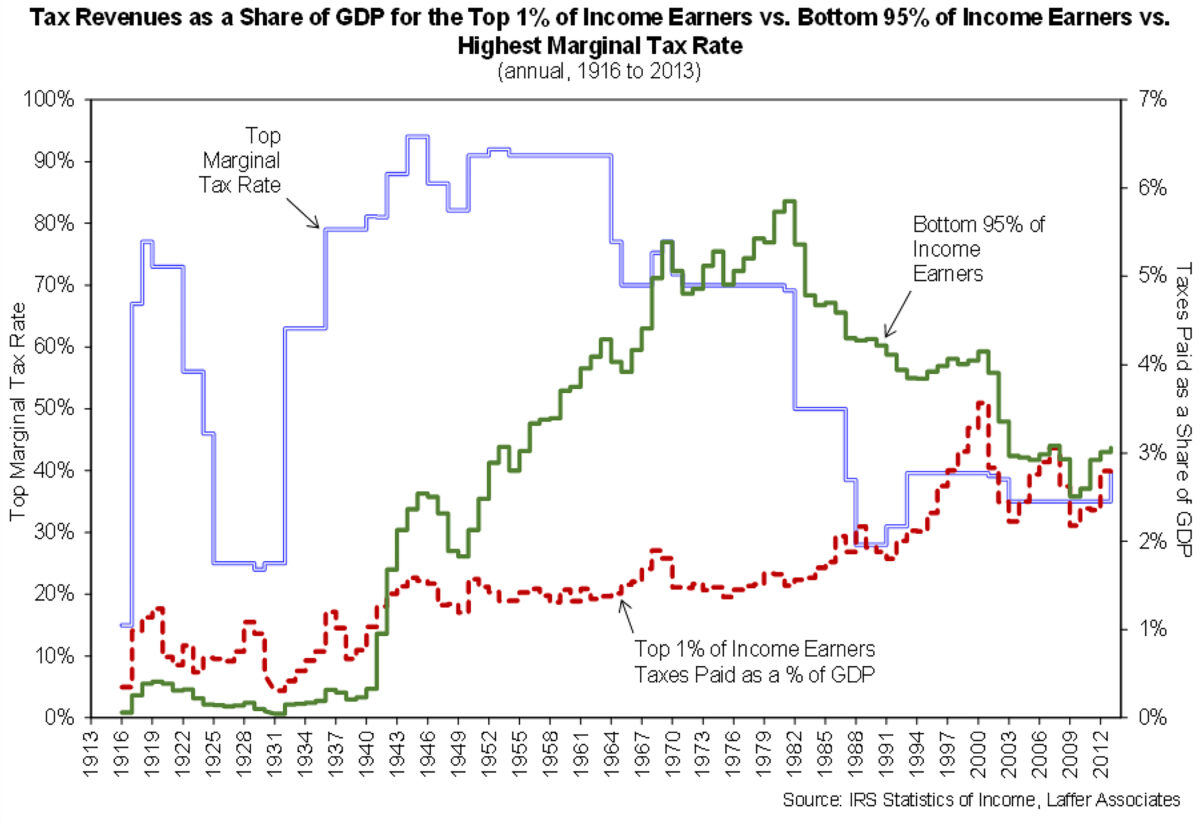
Why don't the rich pay more in taxes?

The graph shows that though the top marginal income tax rate has dramatically changed from 15% in 1913 to 37% today (marked by a blue line, left scale), but the share of taxes paid by the top 1% has not (red line, right scale). Here's why:
“Rich people are different than we are,” Laffer told The Epoch Times. “They can change the location of their income, they can change the volume of their income, they can change how many hours they work, they can change the composition of their income—how much of it is capital gains and how much of it is ordinary income. They can also change the timing of their income—things that normal people don’t think of, but rich people do.
UPDATE:  Loopholes are also available to the wealthy. Sec 1202 is used by wealthy to avoid tax up to $10 million. They put C Corp PE investments in multiple trust accounts to avoid $10 million multiple times. The carried interest is another unfair option. If the working class had the same tax rates as PE, they would have more money to invest in these funds. Shouldn’t everyone have the same opportunity to invest? We need lower tax rates for the working class so they have more opportunities to invest like the wealthy.
But these are pre-tax dollars.  After taxes and transfers, the share of the top 1% has not changed much, at least since 1960, plotted below (black line, from earlier post).

Saturday, June 10, 2023

Did the PGA just admit their merger eliminates competition?

 From the WSJ:

When LIV launched a year ago, it brought unprecedented money into professional golf. The $25 million of prize money it offered at its regular-season tournaments was a record high. And to further induce top talent such as Phil Mickelson and Dustin Johnson to sign on, LIV offered enormous appearance fees, some of which reportedly exceeded $100 million.
Monahan bluntly stated last year that “if this is an arms race, and if the only weapons here are dollar bills, the PGA Tour can’t compete.” But as LIV continued to pick off top golfers—it announced Brooks Koepka as an addition during the same press conference last June when Monahan uttered those words—the Tour participated in that financial arms race anyway.

UPDATE from Truth on the Market: 

Some regulators will have a knee-jerk response that the merger of PGA and LIV would create a monopoly that will make many worse off than if the two organizations competed against each other.
But, this is the wrong way to look at it. Before LIV entered less than two years ago, the PGA was a monopoly with which few people (mostly just Phil Mickelson) had a problem. Would rolling back the clock a couple of years really impose irreparable harm? I doubt it.
Instead, it seems just as likely that the merged organization will incorporate the lessons it learned from their “LIVed” experience. Payout pools may drop relative to last year, but there is no evidence that those high payout pools were sustainable.

In other words, the bidding war for top golfers caused by LIV's entry may be unsustainable.  If so, the apparent high prices are temporary.  If profitable entry is unsustainable, then the merger would have no long run effect.  

Reminds me of an old joke:

  • QUESTION: How many economists does it take to screw in a lightbulb?
  • PUNCHLINE: None, the Market will do it.  

Thursday, June 8, 2023

Is private school worth it?

Economist:  "Should you send your kids to private school?" 
The benefits are probably bigger in America than they are in Britain, at least for pupils sitting in the swankiest private classrooms. That is because their alumni continue to enjoy access to the best universities at rates which would cause a furore in the old country. That might surprise anyone who assumes that American society is less ridden by class than British society. ...
By the time they turn 25 Britons with private education earn 17% more than other workers from similar homes, according to a study from 2015. The pay premium widens by the age of 42, according to earlier research, to around 21% for women and 35% for men. In part this is because privately schooled people are more likely to enter high-earning professions, such as finance. Alumni networks may help in this, but peer pressure and parental expectations probably play a big role, too.
[In US]...on average about 34% of their new undergraduates were educated in private high schools (see chart). That is astonishing given that the private sector educates just 8.5% of American high-schoolers. Pupils from “independent” schools do brilliantly. The most recently published data suggest they made up about one-third of new undergraduates at Dartmouth and more than a quarter at Princeton. “Legacy” preference, whereby the relatives of alumni get a leg-up in admissions, may explain some of this. Nothing so brazenly unfair happens at British universities.
EXERCISE:  Give two causal explanations for the correlation between private schooling and success in the US.  

Is the China Real Estate Bubble popping?

Barron's via Instapundit:

So much for the Chinese economic boom. Last year China ended a disastrous zero-Covid policy that had crippled its economy. A rush of growth was widely expected to follow. Instead of booming, five months after the ending of its Covid restrictions, the Chinese economic recovery is sputtering. That is due in no small measure to the bursting of its outsized housing and credit market bubbles.   ...
A bundle of recent disappointing Chinese economic data, including retail sales, factory orders, and imports, all suggest that the Chinese government will have trouble meeting its 5% economic growth target. So too do indications that a number of major Chinese local governments are struggling to meet their debt obligations and that Chinese youth unemployment has risen to a worrying record 20.4%.

Tuesday, June 6, 2023

Will bad real estate loans cause more problems for banks?

 Two potential problems:

Interest-only loans:  Nearly $1.5 trillion in commercial mortgages are coming due over the next three years, according to data provider Trepp. Many of the commercial landlords on the hook for the loans are vulnerable to default in part because of the way their loans are structured.

Reduced demand for office space:  After the spate of bank closures that included Silvergate, Signature NY, Silicon Valley Bank (SVB) and Credit Suisse, there is now talk of a major crisis—not just in the banking sector, but in other sectors, especially in commercial real estate.

There is an oversupply of office space in big cities like Los Angeles, San Francisco and New York that has been complicated by the work-from-home and quiet quitting trends.

Tuesday, May 30, 2023

US and Singapore know how to grow

 From Jon Hartley's tribute to Bob Lucas in NATIONAL REVIEW:

In the 1980s, Lucas stopped doing work on business cycles (the subject that had originally made him famous in his work on rational expectations) once he realized that the concerns of broad-based economic growth and long-term economic trends far outweighed the importance of business-cycle fluctuations. In other words, a recession that may cause the U.S. — per capita — to lose 5 percent of GDP (like during the Great Recession) pales in comparison to the fact that U.S. GDP per capita has grown 300 percent in real terms from the end of World War II to 2023, or the fact that the GDP per capita of the U.S. remains 550 percent greater than the GDP per capita of China or 3,100 percent greater than the GDP per capita of India.


Lucas famously wrote, in what would become his most cited paper, “On The Mechanics of Economic Development,” that “the consequences for human welfare involved in questions like these are simply staggering: Once one starts to think about them, it is hard to think about anything else.”

Saturday, May 27, 2023

How will AI change Education and Computer Science?

Bryan Caplan as an answer:

  • What will change for students is workload and evaluation. Professors are used to assigning homework, papers, and projects. Using AI to cheat on such work will soon be child’s play. Sufficiently harsh punishments for cheating might preserve the status quo, but modern schools give cheaters a slap on the wrist, and that won’t change. Unmonitored schoolwork will become optional, or a farce. The only thing that will really matter will be exams. And unless the exams are in-person, they’ll be a farce, too. I’m known for giving tough tests of deep understanding - yet GPT-4 already gets A’s on them. 
  • AI could drastically reduce employment in CS over the next two decades. Humans will specialize in whatever AI does worst.
  • What about we humble professors? ... Except for cutting-edge empiricists, however, AI will make research even more of a scam than it already is. If Sokal or Boghossian-Lindsey-Pluckrose can successfully “punk” humanities journals, AI will be able to do the same on an industrial scale. If you want a picture of the future, imagine a bot writing a thousand turgid pages a second about “neoliberalism,” “patriarchy,” and “anti-racism” — forever. Outside of the most empirical subjects, the only rationing tools left to determine academic status will be uniquely human: networking and sheer charisma. My fellow scholars, now is a great time to reread Dale Carnegie’s How to Win Friends and Influence People.