A simple way to do the comparison is to look at something called the rent ratio: the purchase price of a house divided by the annual cost of renting a similar one. The number 20 provides a useful rule of thumb. When you do the math, you discover that a ratio above 20 means you should at least consider renting, especially if you may move again in the next five years or so. When the ratio is well below 20, the case for buying becomes a lot stronger.With the decline in housing prices, renting looks less attractive in many markets.
Wednesday, April 21, 2010
Renting vs. Buying
David Leonhardt at the New York Times reports on a recent study comparing the costs of renting vs. buying in 54 US metropolitan markets.

Tuesday, April 20, 2010

Monday, April 19, 2010
Blonde Women Make More Money
According to a forthcoming study , "Physical appearance and wages: Do blondes have more fun?" in Economic Letters:
This study investigates the influence of hair colour, in particular blonde hair, on women’s own wages and also their spouse’s wages using a large U.S. data set. Regression results indicate that blonde women receive a wage premium equivalent in size to the return for an extra year of schooling. A significant blondeness effect is also evident in the marriage market. Blonde women are no more or less likely to be married; but, their spouse’s wages are around six percent higher than the wages of other spouse’s.
Thursday, April 15, 2010
Do tax cuts increase the incentive to work?
Art Laffer is laughing:
Over the past half century, the top marginal tax rate has fallen from 91 percent in the 1950s and early 1960s to 35 percent today. Thus, the amount a person gets to keep at the margin has risen from 9 percent to 65 percent, that is, by a factor of 7.2. If the elasticity of taxable income with respect to 1-t is one, as some studies find for high-income taxpayers, then the incomes of the rich would have risen by a factor of 7.2 as well. If the elasticity is one-half, then their incomes would have risen by a factor of 2.7. In either case, the change in pretax income attributable to the tax cuts is substantial.
Wednesday, April 14, 2010
It Ain't Easy Being Green
Our campus is going green. Our student newspaper, The Shorthorn, reports that we are going to put solar panels on top of a new parking structure to be built. How much are you willing to pay so that our energy is "green" rather than "brown?" A lot it turns out.
We will get a $1.8 million grant from the state to purchase and install the 500kw solar panels. I did some digging and discovered that an efficient system operates 2,400 hours a year, so ours could possibly generate 1,200,000 kwh per year. With an expected lifespan is 20 years and at an discount rate of 10% this is equivalent to a present value of 10.22million kwh over the project's lifespan for a cost of just under $0.18 per kwh. These are the average capital costs per kwh. There may be additional, likely minor, operating costs. However, the highest electricity rate in Texas, for residential service, is about $0.12 per kwh (my provider charges me $0.10 per kwh). This means that the capital costs alone are at least 50% greater than the opportunity cost.
This opportunity cost does not include the externalities but if these external costs are less than 50% of the current price, this is a bad deal for Texas taxpayers. It is a great deal for the campus (free money? where do I sign up). Moreover, we get the marketing value of striving for sustainability (sic).
We will get a $1.8 million grant from the state to purchase and install the 500kw solar panels. I did some digging and discovered that an efficient system operates 2,400 hours a year, so ours could possibly generate 1,200,000 kwh per year. With an expected lifespan is 20 years and at an discount rate of 10% this is equivalent to a present value of 10.22million kwh over the project's lifespan for a cost of just under $0.18 per kwh. These are the average capital costs per kwh. There may be additional, likely minor, operating costs. However, the highest electricity rate in Texas, for residential service, is about $0.12 per kwh (my provider charges me $0.10 per kwh). This means that the capital costs alone are at least 50% greater than the opportunity cost.
This opportunity cost does not include the externalities but if these external costs are less than 50% of the current price, this is a bad deal for Texas taxpayers. It is a great deal for the campus (free money? where do I sign up). Moreover, we get the marketing value of striving for sustainability (sic).
Tuesday, April 13, 2010
Bankruptcies, not bailouts, for a healthy economy
Former student John Tamny tells Bernanke that he is part of the problem:
Bernanke's support of taxpayer bailouts as the economy's savior is the equivalent of the drunk waking up hung over, fingering the hangover as his problem, then resuming the drinking in order to blunt the pain caused by the previous night's activities.
Monday, April 12, 2010
Supply, Demand, and Reproduction
A new study from the American Sociological Review suggests that supply and demand forces don't do a particularly good job of explaining the treatment and compensation of sperm and egg donors.
Almeling, whose findings appear in the June issue of the American Sociological Review, uncovered a topsy-turvy market that often defies not just conventional wisdom but also the basic law of supply and demand.
“Men donors are paid less for a much longer time commitment and a great deal of personal inconvenience,” she said. “They also are much less prepared for the emotional consequences of serving as a donor of reproductive material. Women, meanwhile, are not only paid more for a much shorter time commitment, they are repeatedly thanked for ‘giving the gift of life.’
. . .
“A pronounced double-standard exists in the way that men and women donors are valued by the fertility industry, and it can’t be explained medically or by market forces,” Almeling said. “Based on the availability of donors alone, you would expect the abundance of potential egg donors to drive down compensation fees and the scarcity of potential sperm donors to drive up their fees. But I found just the opposite.
Friday, April 9, 2010
Should we replace our sales tax with a carbon tax?
The Stand Up Economist delivered some funny jokes in Nashville this week but also proposed replacing our sales tax with a carbon tax. He argued that it is more efficient to tax consumption of goods with bigger external costs (there is pollution, traffic, and sprawl, even if you don't think carbon is causing climate change) rather than goods with smaller external costs (sales, business income).
Each year, Tennessee consumes about 142 million tons of carbon so a $30/ton tax would raise more than $3 billion (assuming a 20% reduction in carbon consumption). This would allow us to cut our state sales tax in half, or eliminate our state business tax entirely. $30/ton of carbon is about $0.30/gallon of gasoline.
I think i am down with this, but haven't heard the other side.
Each year, Tennessee consumes about 142 million tons of carbon so a $30/ton tax would raise more than $3 billion (assuming a 20% reduction in carbon consumption). This would allow us to cut our state sales tax in half, or eliminate our state business tax entirely. $30/ton of carbon is about $0.30/gallon of gasoline.
I think i am down with this, but haven't heard the other side.
Thursday, April 8, 2010
What would it take to get you to invest in Greek bonds?
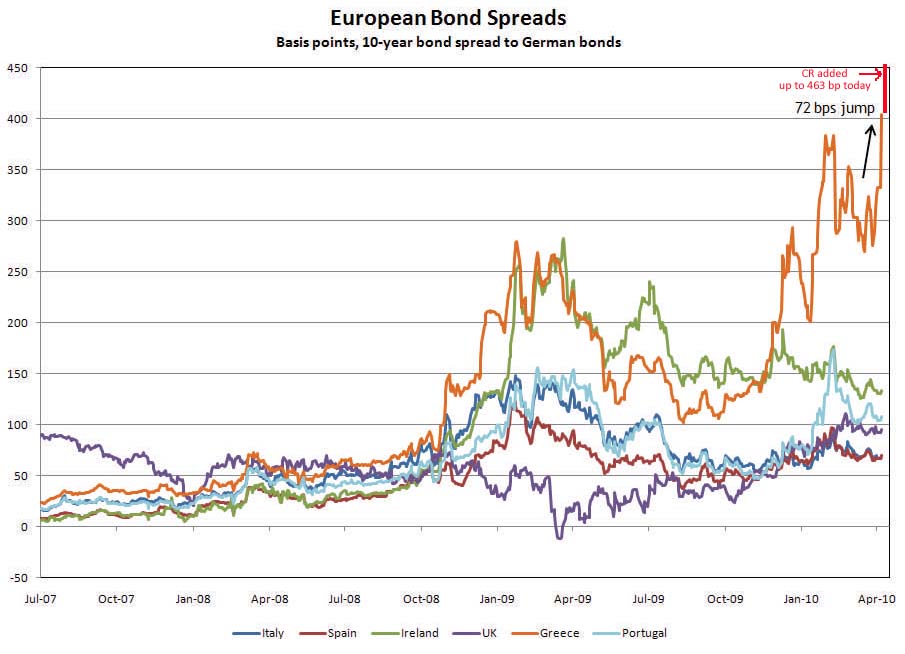
Greek Bond spread increased to an all time record 463 bps today (shown on graph in red).
Subscribe to:
Posts (Atom)