Showing posts sorted by relevance for query pensions. Sort by date Show all posts

Thursday, August 21, 2014

Tennessee forces Nashville and Memphis to fund their pensions

Two cities in Tennessee manage their own defined-benefit pensions, and it is no coincidence that both are majority Democratic, and both are underfunded.  We have discussed the reasons for this in past  blog posts.

Efforts at pension reform have been slow because voters in these cities do not seem to understand or care much about the future pension liabilities, which means that it is not a high priority for politicians.

For example when Nashville went to a more realistic discount rate, from 8.25% down to 7.5%, the city also changed the assumptions on pension growth so that the net effect was no additional savings.  So Nashville gave the appearance of change, without the substance.    

Also, for underfunded pensions, this kind of discounting creates an incentive for fund managers to go into riskier assets.  Indeed, Nashville's pension manager has adopted a riskier investment strategy.  Cross your fingers.   

And we still save nothing for medical pensions.  That is the elephant in the room.  

The obvious solution is a defined contribution schedule, like the Swedes, or  a more reasonable rate linked to the 30 year treasuries, adjusted for tax free status, e.g. 6.5%.

The latest development is a new state law, designed to force these cities to fully fund their pensions.  It does not force cities to make up for past underfunding.  

Tuesday, August 24, 2021

How did our underfunded public pensions do during the pandemic?

Previous posts have focused on the underfunding of public pensions caused by unrealistically high discount rates, e.g., 7%.  For these "defined benefits" plans, the states and cities usually do not save enough.

For example, if a pension fund needs to pay a teacher $100 in 20 years and uses a 7% discount rate, it must save 100/(1.07)^20=$26.  Then, if it invests $26 and earns a 7% return, the fund will have $100 in 20 years when the employee retires.  

However, if it earns only 4.7%, the fund will have only $26*(1.047)^20=$65, a shortfall of 35%.  

MarketWatch reports on a Boston College study of the effect of the pandemic on defined benefit pensions:

2020 funding of public-pensions to invest sector plans at 74.7%, up from 72.8% last year.

The good performance was due to the huge stockmarket gains.  Instead of using the gains to move to a defined contribution plan, like Wisconsin's, I fear the gains will sow the seeds of the next pension crisis by inducing pensions to increase the discount rate they use.  


Monday, February 4, 2013

How are public pension funds like Aesop's grasshopper?

Low interest rates are leading to low investment returns, which is causing private pensions to save more.  Formally, the official discount rate has been reduced from about 5% to 4% which means that the discounted pension liabilities facing companies are a lot bigger, so they save more.  Here is what happened to Ford:

...falling interest rates in the U.S. and Europe, where Ford has had operations in England for 100 years, erased its gains. Ford's pension plans had strong real-world returns—up more than 14%. But the company had to lower its discount rate to 3.84% from 4.6%, which created a bigger liability on its balance sheet.

Ford, intent on hitting a goal of getting to a fully-funded pension by mid-decade, is committing to spend $5 billion on its pensions this year. It is using $1.2 billion in borrowed funds to pay into the accounts, as well as cash on hand.

GM, Verizon, ATT, Boeing, Dow are all facing losses due to increases in pension liabilities caused by the lower discount rates.  In contrast, public pensions are still discounting future liabilities at about 7.5%-8%.  This makes the future liabilities look much smaller, so cities and states can spend more.  Of course when the future finally gets here, things are going to be bad. 

This insight is not new.  Aesop recognized the importance of using low discount rates in his classic fable "The Ant and the Grasshopper." 

Friday, October 18, 2013

How will the the municipal bankruptcies end?

For years, I have been trying to convince Nashville politicians to stop spending more than we are taking in, by fully-funding our pensions. 

Here is an interesting talk about what is likely to happen in places like Detroit, Chicago, Philadelphia, and Nashville.   It is long, so I will summarize:

  • Cities bargain with municipal employees, but since employee unions support policitians, the bargaininig is far from "arms length."
  • It is unlikely that overly generous, unfunded pensions will be restructured, except through bankruptcy.
  • Fortunately, restructuring is likely to be found legal under the bankruptcy laws because funding is like "collateral." 
  • This will fix the balance sheets of city governments, but also give the unions a stake in funding the pensions (fix the income problem)


Thursday, June 19, 2014

Under-funded muni pensions exposed by new accounting rules

We have blogged extensively about the way that mayors, including Nashville's, promise big pensions to city unions, and then hide the cost of the promises with accounting "gimmicks."  For example, a high discount rate, like Nashville's 7.5%, reduces the present value of future pension promises, and reduces the amount that a city has to save for the future.

Now, the GASB (govt. acct. stds. bd.) is proposing rules that will give taxpayers visibility into what mayors are doing by forcing mayors to add promises to the balance sheets of a city and use lower, more realistic, discount rates.  The net effect seems small

According to the Center for Retirement Research at Boston College, a group of 150 public-employee pensions that were 72%-funded in 2013, meaning their assets were 72% of their obligations, would have been only 65%-funded under the revamped rules.

But for cities and states with particularly egregious accounting, the effect is likely to be much bigger.

In a related development, young people seem to be noticing that they will be stuck with the bills run up by irresponsible politicians.  Here is an advertisement aimed at Louisiana's Federal Senator:


Tuesday, September 20, 2016

Public pensions keep two sets of books

Guess which one they disclose?
The market-based numbers are “close to the truth of the liability,” Professor Sharpe said. But most elected officials want the smaller numbers, and actuaries provide what their clients want. “Somebody just should have stopped this whole charade,” he said. For years, people have been trying to do just that. 
In 2003, the Society of Actuaries, a respected professional body, devoted most of its annual meeting to what was called “the Great Controversy” — the notion that the actuarial standards for pensions were fundamentally flawed, causing systemic underfunding and setting up a slow-moving train wreck when baby boomers retired. It drew a standing-room-only crowd.

So what is the biggest difference between the two methodologies?
The problem is, which rate should be used? An economist would say the right rate for Calpers is the one for a risk-free bond, like a Treasury bond, because public pensions in California are guaranteed by the state and therefore risk-free. And that’s what Calpers does when it calculates market values. It used 2.56 percent when it calculated the bill for the pest control district, producing a $447,000 shortfall. 
But the rest of the time, Calpers and virtually all other public pension funds use their assumed annual rate of return on assets, now generally around 7.5 percent. Presto: This makes a pension appear to have a much smaller liability — or even a surplus.

 Since I have been blogging about this for as long as I have been blogging, I am going resist saying "I told you so."

Thursday, September 26, 2013

What can Nasvhille learn from Detroit's troubles?

In Detroit, where unions controlled the politicians, the politicians appointed union reps to administer the pensions:

Most of the trustees on Detroit’s two pension boards represent organized labor, and for years they could outvote anyone who challenged the payments.

They use this power to "redistribute" wealth from taxpayers to city workers, retired or not: 

Detroit’s municipal pension fund made payments for decades to retirees, active workers and others above and beyond normal benefits, costing the struggling city billions of dollars and helping push it into bankruptcy,

And they made it very difficult for outsiders to get the data necessary to "see" what they were doing. 

An investment banker now advising Detroit, Charles M. Moore, has said in a court declaration that the trustees of the general pension plan were “effectively robbing” the fund when they diverted its assets...

In Nashville, city pensions are underfunded by about half a billion, but our medical pensions are underfunded by about two billion.

Monday, October 5, 2015

Why isn't our richest state saving enough for its state pensions?

Conneticut has a ``huge'' pension problem.  They have only 52% of the assets necessary to pay their discounted future pension liabilities, AND they are discounting future liabilities at an 8% rate.

Remember from earlier posts, a higher discount rate makes future liabilities look smaller, so cities and states save less for their pensions.  If they don't earn, e.g., at least 8%, then they wont have enough to pay the pensions when they finally come due.  This is what happened to Detroit.

What makes Conneticut so interesting is that they are the richest state in the USA and have saved the least, behind only Illinois and Kentucky.  Ordinarily, states which have big unfunded liabilities like this would have trouble borrowing money because investors would demand higher compensation (higher interest rates) for holding bonds with a higher risk of default.  However, because Conneticut has high taxes, and many high-income residents, there is a big demand for state's tax-deductible bonds.  This keeps the cost of borrowing low, and allows state politicians to ignore the pension problem:


“There’s almost limitless money to buy Connecticut bonds,” said Matt Fabian of research firm Municipal Market Analytics. Investors “are getting less of a risk premium than I think you deserve because of the high demand created by the wealth of the taxpayers in the state,” added Paul Mansour, head of municipal research at Hartford, Conn.-based Conning.

Friday, April 10, 2009

Defined benefit pensions threatening civil order

We have previously blogged about looming defined benefits crisis:
And now, we discover how difficult this problem will be to solve:

State pension benefits are protected by law, and must be paid even if the fund is making a loss. Calpers, the largest fund, has lost $70bn in value in the past eight months, but still has to pay $11bn in benefits this year. Unless the fund starts recouping its losses soon, the California state government, which is already mired in a huge deficit, will have to lift contributions to Calpers starting from next year.

...According to the Pension Benefit Guaranty Corporation, which regulates and insures pensions, ...the current underfunding in public plans, which cover about 22 million workers, seems to be something north of a trillion dollars. And they're not insured.

The funds that are responsible are a different sort of headache; they'll be slapping heavy levies on local school districts and governments to shore up their capital. That will be a nasty burden on strapped local governments, particularly in places that are already in decline. ... In good years, the market booms, tax revenue soars, and not only does their mandatory pension contribution fall, but the state often offers extra help out of the tax windfall. In bad years, the state aid disappears, their mandatory contribution goes up, and the senior citizens on fixed incomes start assembling pitchforks and torches for the march on city hall.

Wednesday, May 12, 2010

More on California Pensions

I mentioned last week that over 9,000 retirees in California are receiving pensions in excess of $100,000 annually from public entities. One of the reasons cited for high pensions is that high risks taken by public safety workers lead to shorter life spans (so, the high pension is a compensating wage differential offered in exchange for a shorter life). Sounds reasonable, yes?

Unfortunately, the data indicate that retired public safety workers have similar life spans to non-safety-workers. Oops.

Friday, March 16, 2012

What's the difference between Keurig Coffee and Nashville city government?

In order to persuade coffee drinkers to switch from normal drip coffee makers to Keurig's unique K-cup coffee system, Keurig has to keep the initial system price low by essentially giving away their coffee makers. Whatever Keurig loses on the machines, it more than gains on future sales of K-cups.

Similarly, Nashville discounts its future pension liabilities at the unreasonably high rate of 8.25%. This allows the city government to save less--and spend more--than they should.

Both Keurig and Nashville are taking advantage of people's irrational over-weighting of the present relative to the future, which is so common that economists have given it a name, hyperbolic discounting.

The difference is that Keurig will make up for the initial loss with profit from future sales whereas Nashville has no such plan. In the meantime, the size of our unfunded debt keeps growing. Someone else--presumably our kids--will wind up with the bill.

As strange as it may sound, we could learn something from California. Just yesterday, Calpers took the unusual step of lowering its discount rate to 7.5% (the actuary had recommended 7.25%). It is unusual because the the policy alleviates future problems, but causes pain today, exactly the opposite of what hyperbolic discounting tells them they should do.

By lowering the so-called discount rate, Calpers could ask the state to eventually contribute an additional $300 million annually. The pension board asked the staff to come up with a plan to phase in the increased contributions from state and other government agencies over the next two years to help soften the financial blow.

That such a small change in the discount rate (0.25%) can have such big effects illustrates the power of discounting. Imagine what would happen if they had to lower their discount rate to a much more realistic number, say 6.5%? (Derivation here).

See also Stossel on city pensions; and how the Swedes solved their pension mess.

And as if this weren't scary enough, the pension problems are dwarfed by the unfunded medical benefits:
while most public pension plans are 75 percent funded, the figure for health-care plans is only 4 percent nationwide. So unlike pensions, governments are setting aside little money in advance to pay for their future obligations.

HT: Instapundit

Wednesday, March 12, 2008

Perhaps we can learn something from Norway

They are tackling their pension problems:
All the parties also agreed that pensions should be adjusted to take account of rising life expectancy, with the value of annual pensions to be correspondingly reduced. In addition, the link between annual pension increases and wage rises will be cut (instead, increases will be based on a lower figure related to wage and price growth). The new system is due to be phased in from 2010.

Friday, March 12, 2010

What’s the difference between General Motors and California?

California hasn’t gone bankrupt. At least, not yet.
Over several decades the leaders of both GM and GS (that is, the Golden State) caved in to the demands of aggressive unions, choosing what seemed the path of least resistance. Both gave their employees richer and richer retirement plans during their respective boom years and assumed that their revenue growth and the hefty returns on their pension fund investments would go on forever. Not so long ago, in fact, officials of both GM and California boasted that their employee pension plans were in good shape.

When the economic crisis struck and car sales collapsed that fall, GM’s cash reserves evaporated, even as repeated rounds of layoffs left the company saddled with ten retirees for every active employee. The company required a massive federal bailout and bankruptcy to stay in business. Only thanks to cash from the feds did GM’s retirees keep their pensions intact. Retirees of GM’s then-bankrupt auto-parts subsidiary, Delphi Corp., also kept their benefits.

In the Golden State, meanwhile, the California Public Employees’ Retirement System, or CalPERS, had sharply increased benefits for state retirees in 1999. “CalPERS’s investment returns provide this historic opportunity,” then-board president William Crist declared, “without causing any additional taxpayer burden.”
Since then the state’s public employee pension outlays have ballooned by 2,000 percent, while state revenues have increased only 24 percent. In the current fiscal year alone, some $3 billion has been diverted from other state programs to pay pensions. And California’s general obligation bond ratings from all three agencies — Fitch Ratings, Moody’s Investors Service and Standard & Poor’s — are the lowest among the country’s ten most populous states.

Tuesday, August 8, 2023

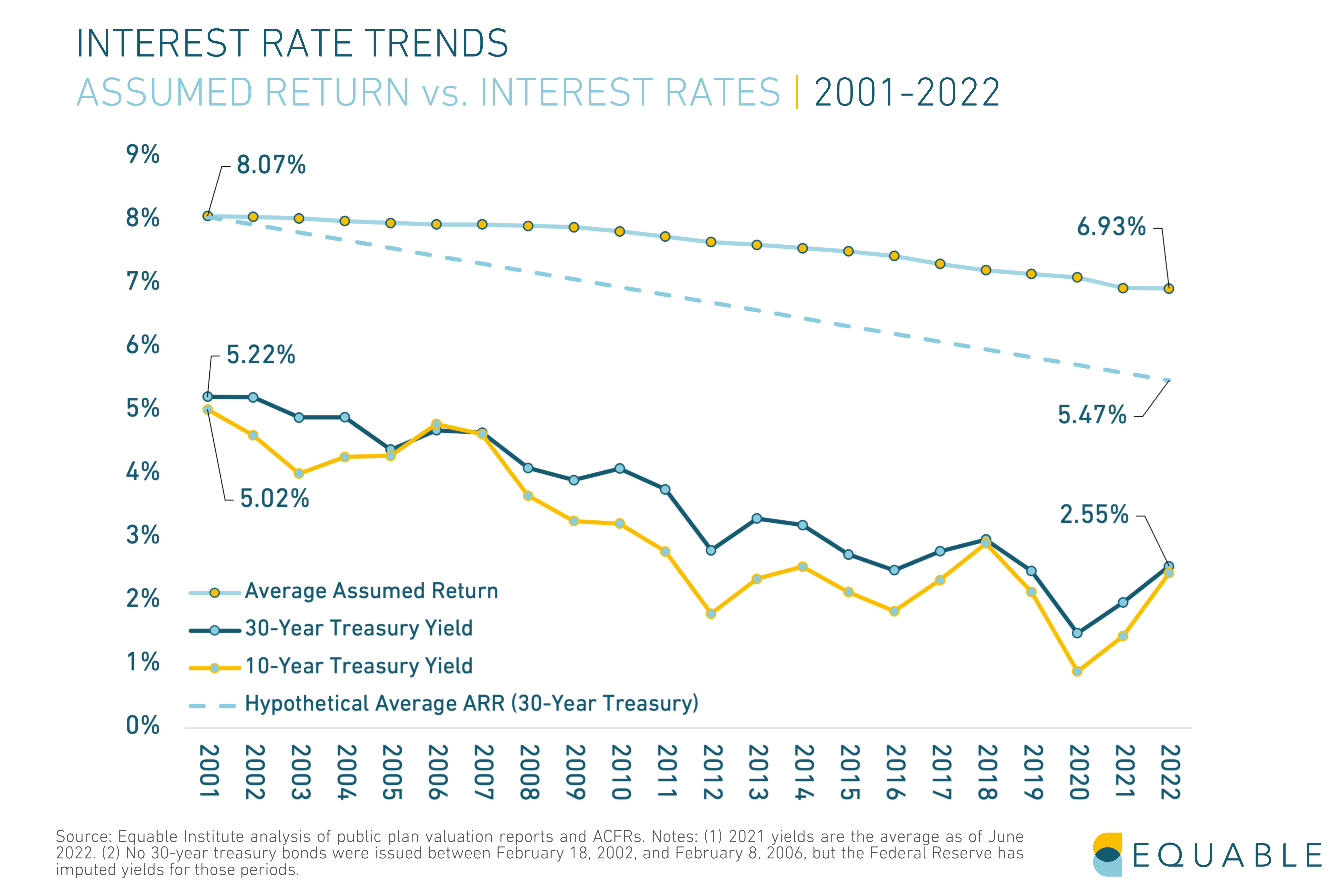
Assumed rates of return for public pensions vs. interest rates


As a result, Public Penions are 30% under-funded. To figure out why we aren't saving enough for our public pensions, ask three questions

  • Who is making the bad decision?
    • We the People
  • Do We have enuf info to make a good decision?
    • No, We the People don't know how to compound, much less discount.
  • And the incentive to do so?
    • No, We the People over-weight the present, called "hyperbolic discounting," and act as if our discount rates are really big, which means we don't save enough.  

Friday, October 28, 2016

Cross your fingers: Nashville's risky pension portfolio

In the past, when Nashville's pension fund earned more than required to fund the pensions, the politicians spent the surplus; but when it came up short, they did not fund the difference.  This lead to systematic underfunding.  Then the State passed a law to force Nashville and Memphis to fund their pensions.

Now, we learn that Nashville is investing in risky assets to reach its targeted 7.5% return:

Since the 2008 financial crisis, Nashville’s pension managers have been shifting taxpayer money into junk bonds, hedge funds, troubled mortgages, private equity funds and other alternatives to conservative stocks and bonds. If successful, these “alternative investments” can earn greater profits, but they also demand high fees and carry the risk of heavy losses.

So how is it doing?

Nashville's investments have shown mixed results. After taking out fees, the city’s fund grew by 4.7 percent a year since 2008, on average, while the Standard & Poors 500 gained 6.6 percent.

Keep your fingers crossed!

HT:  Preston

Friday, April 11, 2014

85% of public pension will go bankrupt, unless

... they earn a 9% rate of return.  Bridgewater associates released its own stress test of public pensions this week.  What it found is not pretty:

Public pensions have just $3 trillion in assets to invest to cover future retirement payments of $10 trillion over the next many decades, Bridgewater says. An investment return of roughly 9% a year is needed to meet those onerous obligations.

Unfortunately, they are expected to earn only 4%.  If this happens, 85% of them go bankrupt.  

Sunday, August 7, 2016

Who would want to suppress an actuarial report on pensions?

Right now, public pensions discount future liabilities at 7.5%.  This means that cities and states that face a pension payout of, e.g., $100,000 in 25 years, must set aside $16,398=($100,000)/(1.075)^25.  If the pension fund invests $16,398, and earns 7.5%, then in 25 years the pension fund will have $100,000 to pay out (compounding).

HOWEVER, if the fund earns only 5% (a more realistic return), then the fund should put away $29,530=($100,000)/(1.05)^25, about 80% more than they are currently saving.

committee of actuaries who wrote a report pointing this out and suggesting a more realistic discount rate has been disbanded to prevent the report from leaking out.

Monday, December 15, 2025

European Pensions are in bad shape

Europe’s fastest-ageing countries also already offer some of the most generous pensions and lowest retirement ages. The average French retiree now spends 23 years drawing a pension, longer than in any other OECD country (see chart below). In Denmark, by contrast, pensioners draw one for 19 years on average. Its government plans to raise the retirement age from 67 to 70 by 2040, which would be the highest in Europe.

Friday, June 13, 2008

Are we ready to take control of our pensions?

Defined contribution plans have overtaken defined benefit plans, but it is not clear whether employees are ready for the change:
When it comes to pensions, the buck has been passed from employers to employees. But too few workers realise how much they need to contribute to guarantee a decent retirement or feel confident enough about how to invest their funds. This will not lead to the headlines about bankrupt pension funds that marked the decline of the DB scheme. But it will be bad for many workers all the same.

Tuesday, April 3, 2012

Bankruptcy gives cities bargaining power

In the past we have blogged about our underfunded municipal pensions.

Today, we talk about a potential solution, bankruptcy. Remember that the alternatives to agreement determine the terms of agreement. Bankruptcy gives cities a much better alternative, and allows them to gain a more favorable split of the proverbial pie. Bankruptcies in Stockton, Detroit, Jefferson County, and Rhode Island resulted in smaller payments to city employees and pensioners.

Robert G. Flanders Jr., the state-appointed receiver for Central Falls, R.I., said his city’s declaration of bankruptcy had proved invaluable in helping it cut costs. Before the city declared bankruptcy, he said, he had found it impossible to wring meaningful concessions out of the city’s unions and retirees — who were being asked to give up roughly half of the pensions they had earned as the city ran out of cash.

“The municipality is on bended knee asking the retirees and unions to come to the table and give up their contract rights,” he recalled. “All of that leverage shifts once you have the gumption to pull the Chapter 9 trigger. And guess what? That produces agreements quicker and more effectively than otherwise.”

The article speculates that as soon as a major city, like Oakland or Los Angeles, declares bankruptcy, that the flood gates will open.