
WSJ:
...An aging population with a preference for free time and job security over earnings ushered in years of lackluster economic and productivity growth. ...
...An aging population with a preference for free time and job security over earnings ushered in years of lackluster economic and productivity growth. ...
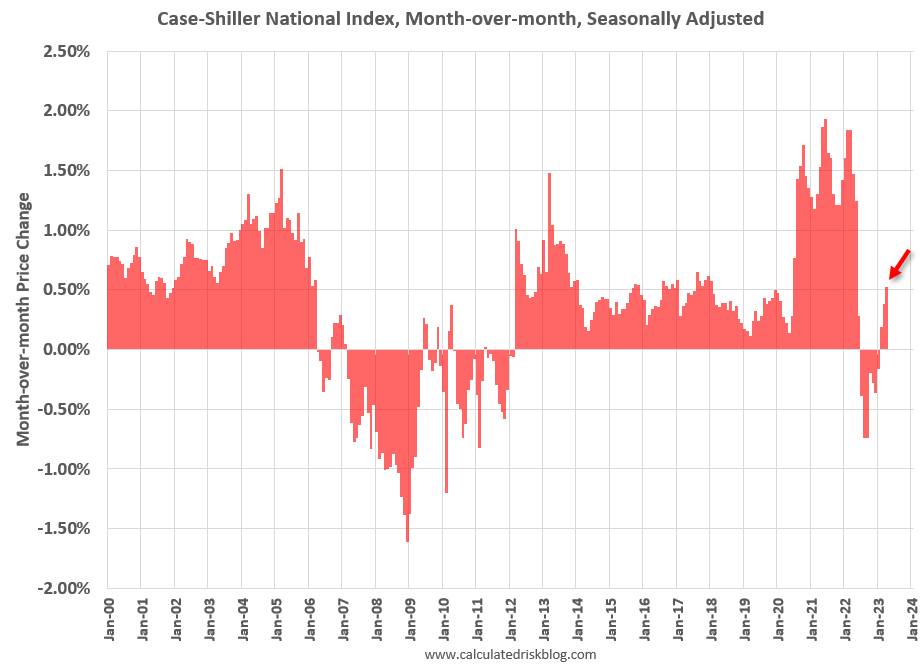
Inventory is pushing up prices, and affordability (the change in monthly payments) is pushing down prices. And it appears this battle will continue … there is no relief in sight for inventory or for mortgage rates....
First, we can be very confident - barring another crisis - that we will not see a large wave of distressed sales and cascading declines in nominal house prices. Lending has been reasonably solid over the last decade, and most homeowners have substantial equity in their homes.From Chapter 8: In the short run supply of houses ("inventory") is low, but so is demand (due to high interest rates) so we don't know which way price will go.
When the baby-boom generation starts moving to retirement homes or warmer climates, inventory will likely increase. But that is mostly a 2030s story, see
The left-leaning Economist thinks so:
Both sides agree that the old order that prized expertise, free markets and free trade—“neoliberalism”, usually invoked as a pejorative—was a rotten deal for America. Corporations were too immoral; elites too feckless; globalisation too costly; inequality too unchecked; the invisible hand too prone to error.
Anyone who has—or has been—a teenager knows how turbulent those years can be. Surveys confirm that teenage daughters and fathers, in particular, get on each other’s nerves. They also show that parents of teenage daughters argue more about parenting than do the parents of sons, and that mothers of teenage daughters report significantly more disagreements with their partners over money, and become more open to the idea of divorce. Earlier research has also shown that one of the most common things parents fight over is how much they should control their teenagers’ personal choices, such as how they dress, whom they date and where they work.
In light of all this, it is intriguing to note that Dr Kabatek and Dr Ribar found one type of couple who seem immune to the daughter effect: those in which the father grew up with a sister. Having seen things somewhat from a sister’s point of view may act as a sort of social inoculation.
“Our delivery workers have consistently delivered for us — now, we are delivering for them,” New York City Mayor Eric Adams said when announcing the law. “This new minimum pay rate, up by almost $13/hour, will guarantee these workers and their families can earn a living, access greater economic stability, and help keep our city’s legendary restaurant industry thriving.”
On the day of the announcement, DoorDash responded with a blog post in which it said the policy will have unintended consequences and will undermine the workers it aims to support.
Suppose, for a minute, that you are a finance minister in the developing world. At the end of a year in which your tax take has disappointed, you are just about out of money. You could plough what little remains into your health-care system: dollars spent by clinics help control infectious diseases, and there is not much that development experts believe to be a better use of cash. But you could also spend the money constructing an electrical grid that is able to handle a switch to clean energy. In the long run this will mean less pollution, more productive farmland and fewer floods. Which is a wiser use of the marginal dollar: alleviating acute poverty straight away or doing your country’s bit to stop baking the planet?
The thought experiment is a simplified version of a dilemma currently facing global institutions and developing countries. On June 22nd politicians arrived in Paris for a summit to design “a new global financial pact”. The aim was to work out how to spread the cost of climate change. Leaders from poor countries turned up in droves; aside from Emmanuel Macron, France’s president, no Western head of state made it. Little surprise, then, that the jamboree ended without rich countries contributing a single extra dollar. Instead, attendees tinkered with the World Bank and the imf, the biggest of the multilateral agencies that seek to reduce poverty. The lack of action means painful trade-offs lie ahead.

Date Written: June 23, 2023
[When a firm like Amazon consolidates routes, e.g., by convincing groups of stores to use Amazon’s fulfillment services instead of independent alternatives], the reduction in delivery miles results in lower costs, less pollution, and fewer accidents, injuries, and deaths.
Keywords: Travelling Salesman Problem, Vehicle Routing Problem, Economic Tradeoffs, ESG, merger effects, merger efficiencies


Green firms tend to be services firms. So, think Spotify, Prudential, Goldman Sachs, Allstate, MetLife, American Express. Silicon Valley Bank, which recently collapsed, is one of the greenest firms in our sample, which makes sense. How can a bank pollute that much, right? ... If it gets easier for these green firms to access capital, their environmental impact barely changes.Instead consider investing in Brown Firms:
My analysis shows that brown firms are the firms with the greatest scope to change their environmental impact. So, in addition to investing in brown firms, it might be helpful to engage with their management.CITE: Hartzmark and Shue, "Counterproductive Sustainable Investing."
