WSJ:
Democrats warn that tax cuts will slash state revenue and services to the bone, ... Republicans caution that higher taxes will risk an exodus by wealthy residents who create jobs.
Democrats warn that tax cuts will slash state revenue and services to the bone, ... Republicans caution that higher taxes will risk an exodus by wealthy residents who create jobs.
...“Warren is deliberately trying to choke off investment in the construction of new single-family rental properties. This is profoundly regressive. Why is it OK for large investors to build and rent out apartments but not single-family homes?” He adds: “Warren’s policy effectively helps rich people keep working-class renters out of their towns.” ...BOTTOM LINE: More investment increases supply which reduces price.
Ski resorts used to be weather-dependent businesses — essentially farmers who grew snow. Bad snow year, bad revenue. In 2008, Vail CEO Rob Katz asked a different question: what if we could sell skiing in advance, before anyone knew how good the conditions would be? The Epic Pass was the answer.
The business model is textbook: bundle access to dozens of resorts onto a single pass, price it attractively, sell it in the offseason, and collect nearly $1 billion in revenue before a single lift spins. Weather risk transfers from the firm to the customer. Cash flow becomes predictable. Vail can now plan capital investments, acquire more resorts, and grow — all without watching the sky.
The tradeoff is equally textbook. To make the pass look cheap, you make day tickets look expensive — some now top $300. That's not accidental; it's price discrimination by design, nudging committed skiers toward the bundle. The side effect is crowded slopes and squeezed independent resorts that can't compete with a bundle their customers already bought.
The Santa Clara County Association of Realtors surveyed contractors who estimated costs per home at $43,950 to $224,000. Its figures rely on replacing stoves and dryers as well as water heaters and furnaces.
Let’s pick a random lower figure and assume the Bay Area Air Quality Management District ban will cost each home $12,000. If 120,000 homes need a new water heater annually, the cost will be about $1.5 billion every year. That is a lot of money to “avoid an estimated 37 to 85 premature deaths,” assuming there’s a basis for that claim.
What could we do instead with that amount of money?
One answer would be to spend $1.5 billion annually to remediate homeless encampments. Encampment fires are ubiquitous in Santa Clara County. San José Spotlight reported in February that “over the past year thousands of non-structural fires have been sparked by homeless camps, causing toxic fumes and safety problems for people and property.”Stroll correctly points out that the opportunity cost of the mandates is whether there are better uses for the money.
CCMBS/Treasury spreads, in contrast, widened significantly last month
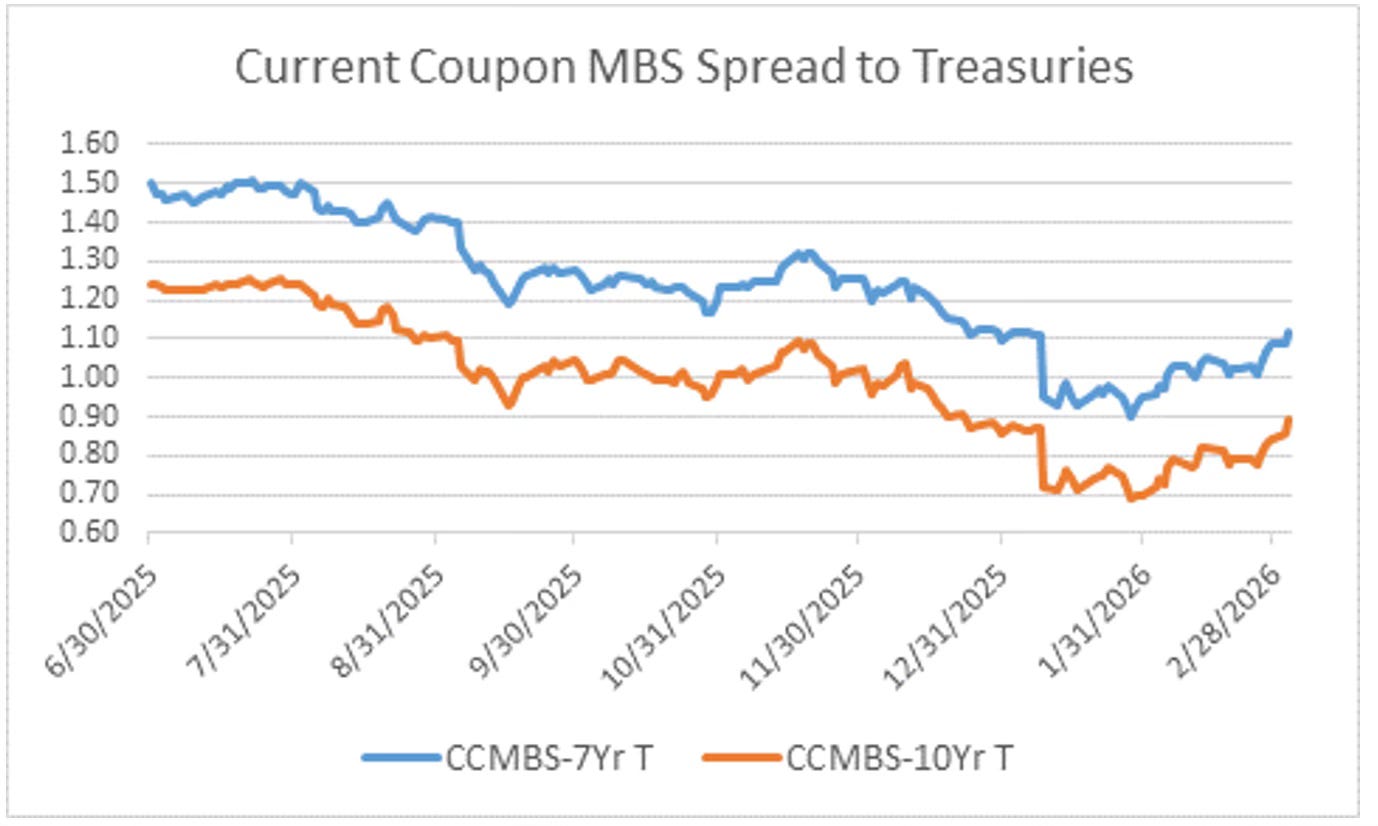
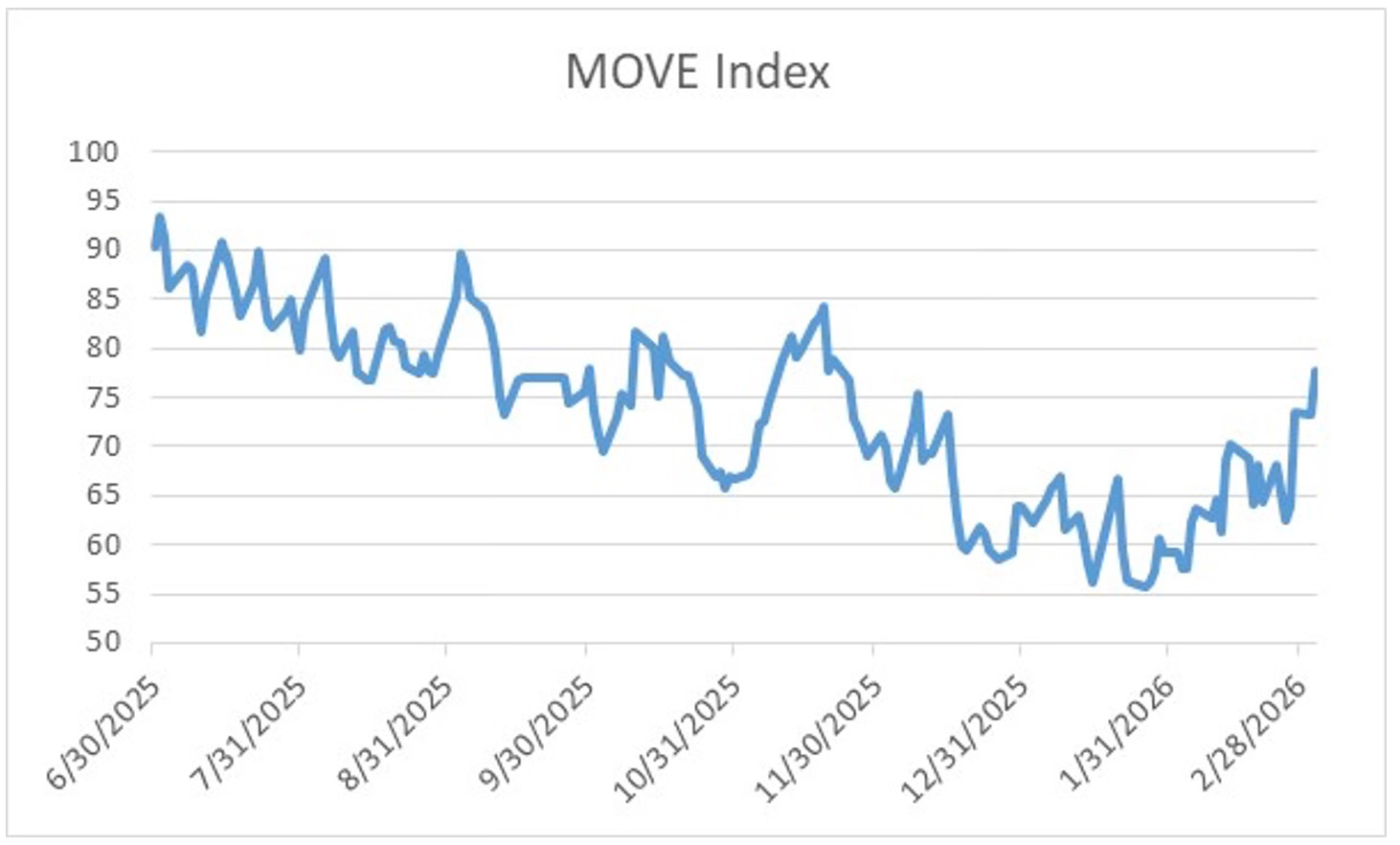
One reason CCMBS/Treasury spreads have widened since January is that implied and actual interest rate volatility [a measure of risk] has increased ... Below is a chart of the MOVE index, a measure of implied interest rate volatility from options on Treasury securities across the curve.
... Canada has long been “the socialist neighbor to the north—an overtaxed, overregulated, overcontrolled economy,” resulting in low productivity and weak growth. ... the prescription is straightforward: lower taxes, less spending, and deregulation.

Jolted by the deterioration of Europe’s relationship with America, policymakers are redoubling efforts to strengthen its technology ecosystem. At the same time, America and China have made decisions that make Europe relatively more attractive to tech workers and investors. The continent’s established tech companies, though few in number, are now nurturing a new generation of startups. ...
Europe is also getting over its reluctance to let techies make lots of money. ...Now European tech companies are giving out more options...
Mr Trump’s demand that Europe (including Ukraine) do more to defend itself is also spurring high-tech arms-making in a region that had little of it. ...
China, too, is helping inadvertently. Its model of state-directed innovation has crowded out private investment and shrunk VC spending, pushing some towards Europe.
The idea of prediction markets may have begun as a small research tool in Iowa in the 1980s with trading volumes measured in the thousands of dollars. After a few decades, monthly dollar volume for private prediction markets had reached millions of dollars. Recently, prediction markets have hit the big time. The WSJ reports that Polymarket and Kalshi now do about $3-4 billion of volume in a month. To be sure, this is still three orders of magnitude smaller than the volume of the NYSE or NASDAQ of $2-3 trillion. But this impressive growth indicates broad acceptance.

Non-traders, perhaps ignorant of how new information will affect the probability, need only look at how much the price has changed to infer what more knowledgeable individuals think of the information. Prediction markets harness "the wisdom of the crowd." The growth of these markets is an indicator of how valuable this information can be.

[in 2000], the rich spent about 40 times more than the poor; today the figure is closer to 18. ...
But in many countries where populist politicians lament that poor folk have been left behind, consumption gaps have more recently narrowed—suggesting that lower-income households are catching up. This has happened quickly in Spain and Greece, and also in Britain and France. Inequality can be gauged in different ways. On consumption, it’s mostly good news.■
The “Robin Hood” state, which takes from the rich to give to the poor, has obvious appeal. Governments across the developed world are strapped for cash. Budgets are burdened by legacy debts, ageing populations and the need to spend more on defence.
INSTEAD ...
The limited revenue-raising power of the rich is why European governments have to fund their big spending with broad-based levies, such as taxes on consumption. By contrast, America, with its low overall tax burden, can get by with one of the world’s most progressive tax systems.
Broad-based taxes do not only raise much more money. They are also politically healthier. A society where the many pay tax and benefit from spending is stronger than one where the few have to pay for the many.
BOTTOM LINE: lower rates on a broader base typically produce more tax revenue ... than high rates on a narrow base. ...
HOWEVER, if progress on artificial intelligence concentrates incomes at the top, as almost everyone in Silicon Valley expects, then the tax system will require fresh thinking: ... we may have to figure out how to redistribute wealth without destroying too much of it.
Finding out that GLP-1 drugs can help reduce weight has been life changing for many and could stem the social costs of being overweight. Recently, prices have fallen dramatically. I asked ChatGPT to for some summary data for Wegovy & Zepbound which I plot below.
Competition matters. Initially, Wegovy was the effective monopolist selling at a list price of $1,349. In November 2023. Zepbound was approved and entered at just over $1,000 but dropped its price to ~$500 in Spring 2024. Wegovy may have sold at discount by Fall 2024, but it's direct-to-consumer price did not fall to ~$500 until Jan 2025.
It will be interesting to see if similar adjustments occur over the next few years as at least three new entrants are expected..
Testifying on Media consolidation 2006.

Back Row: Cowboy Troy, Big & Rich, Harold Bradley, Rick Carnes, Econ Prof Luke Froeb, Dobie Gray, Sharon Kay
Front row: Naomi Judd, George Jones, Jenny Toomey, Porter Wagoner, Bud Walters, Craig Wiseman, Law Prof Christopher Yoo
From: Carlos Chavez, On Causality
Difference-in-differences has undergone a methodological renaissance. The method’s intellectual roots reach back further than most economists realize - to the 1840s and 1850s.
Superbowl players earn $178,000 each if they win and $108,000 if they lose. But California taxes athletes based on the number of "Duty Days" spent in the state, eight for the Superbowl. Jeffrey Degner, of the American Institute for Economic Research (AIER),crunched the numbers to calculate that the average player will leave California with much less.
"What that means here is that the winning team, their take-home pay will be approximately $86,000. If you're on the losing side, the take-home would be about $49,800," Degner said.
Because the tax is based on you salary, winning Seahawks QB Sam Darnold will actually pay more in taxes than his Superbowl compensation. I suspect the NFL Players Association will want to revisit holding future Superbowls in California.
The merging of what is arguably Musk’s most successful company, SpaceX, with the more speculative xAI venture is a risk. Founded in 2023, xAI’s main products are the generative AI chatbot Grok and the social media site X, formerly known as Twitter. The company aims to compete with OpenAI and other artificial intelligence firms....
With this merger, he plans to use SpaceX’s deep expertise in rapid launch and satellite manufacturing and management to deploy a constellation of up to 1 million orbital data centers. This will provide the backbone of computing power needed to support xAI’s operations.HT: MarginalRevolution
The January 2026 cold snap, "Winter Storm Fern,"was unprecedented in both its severity but also in its size. It that blanketed two-thirds of the US causing considerable stress on the market for natural gas. While the media often focuses on surging heating demand during these events, the historic price spike was equally driven by a leftward shift in the supply. Due to plummeting temperatures, the industry faced record-setting "freeze-offs" where water in the gas stream freezes and physically blocks wellheads. Even though demand increased, gas production fell from a pre-storm average of 108 Bcf/d to a of 95.8 Bcf/d. This 12% contraction in total output meant supply shifted leftward by more than demand shifted rightward. Just as the market required more fuel, less was being produced. Both shifts created a deficit that could not be reconciled through normal operational adjustments.

Market equilibrium would have to be achieved by moving up along a near vertical demand curve to an extreme price point to clear. While the American Gas Association (AGA) noted that demand hit an all-time 7-day high, the scarcity was compounded by the fact that roughly 18.1 Bcf/d of expected production simply vanished from the grid. The result was that the spot price surged in some locations by over 1,000%, with the national average more than doubling to over $7/MMBtu over the typical of around $3/MMBtu. A total system collapse was prevented by the rapid withdrawal of 360 a record Bcf from storage. The price was not merely a reflection of high usage, but also included a scarcity premium.
One way of looking at the a policy of increased ICE enforcement of US border security is as a debate over decision error costs. The expressed goal is to remove the worst of the worst criminals. Few would disagree with this goal. However, in this dragnet, immigrants without criminal backgrounds have also been detained. The administration may see this as representing a small cost to pay, while the protesters see this as an unacceptable consequence.
The graphic below from the Financial Times indicates how many more criminal and non-criminal detainees the policy change has resulted in. Your position in this debate likely comes down to whether you think the benefit of detaining ~6,000 more criminals outweighs the cost of detaining ~25,000 more with no criminal background. Reasonable people can disagree over what would be acceptable, but few have stated what value they consider to be acceptable.

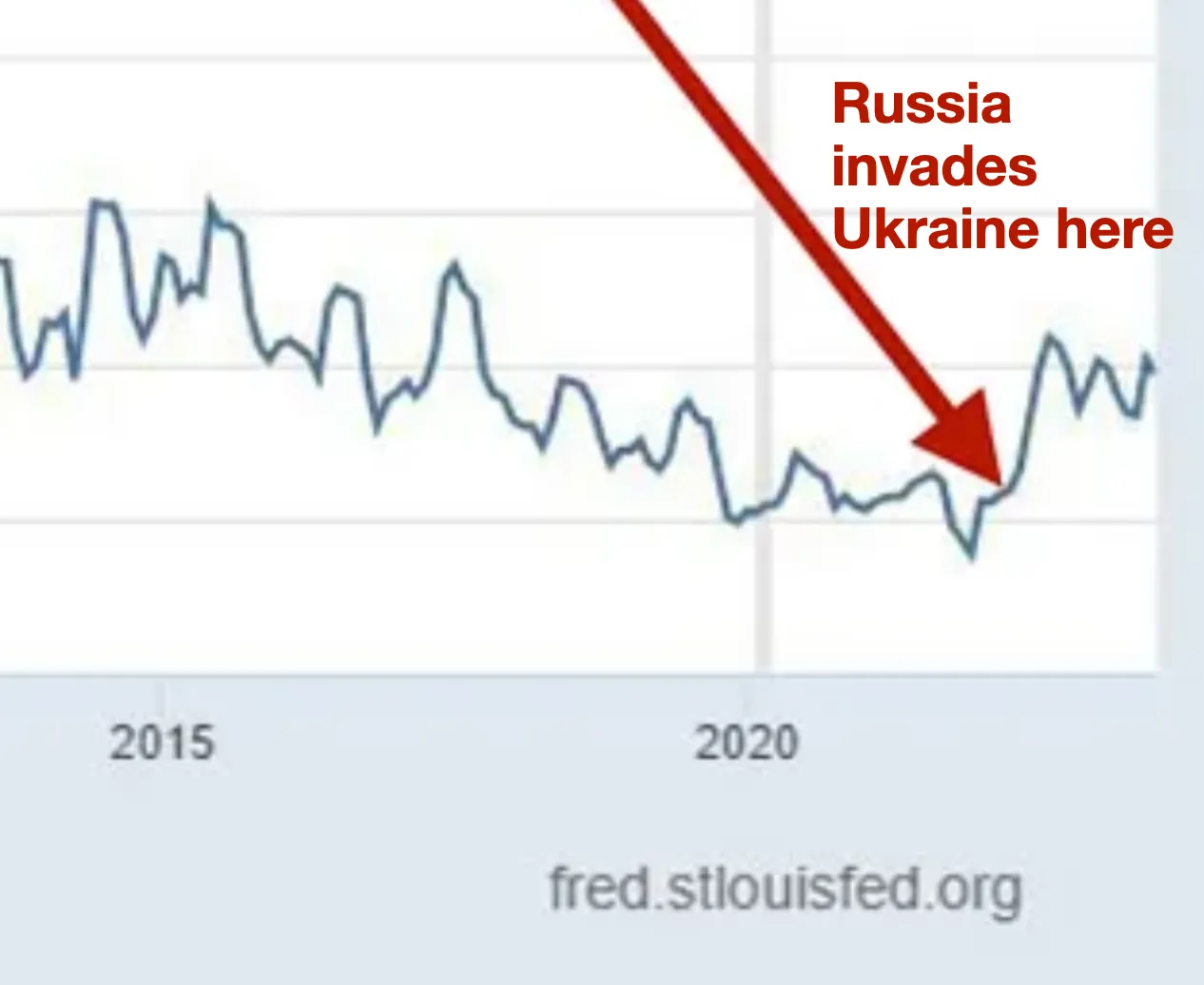
...Russia invaded Ukraine, Europe stopped buying Russian gas, America was suddenly competing with European countries more for natural gas from other places, and natural gas prices spiked for a bit. Here’s a graph of natural gas prices:
HBR:
SUMMARY:
As companies grow, they often switch from a functional organization to a divisional one:
Business history and organizational theory make the case that as entrepreneurial firms grow large and complex, they must shift from a functional to a multidivisional structure to align accountability and control and prevent the congestion that occurs when countless decisions flow up the org chart to the very top.
But, you end up with general managers who lack technical expertise making decisions. Instead:
...Apple relies on a structure that centers on functional expertise. Its fundamental belief is that those with the most expertise and experience in a domain should have decision rights for that domain. This is based on two views: First, Apple competes in markets where the rates of technological change and disruption are high, so it must rely on the judgment and intuition of people with deep knowledge of the technologies responsible for disruption. Long before it can get market feedback and solid market forecasts, the company must make bets about which technologies and designs are likely to succeed in smartphones, computers, and so on. Relying on technical experts rather than general managers increases the odds that those bets will pay off.
Example: Apple puts cameras in iPhones, computers, laptops, and iPads.
...Apple’s more than 600 experts on camera hardware technology work in a group led by Graham Townsend, a camera expert. Because iPhones, iPads, laptops, and desktop computers all include cameras, these experts would be scattered across product lines if Apple were organized in business units. That would dilute their collective expertise, reducing their power to solve problems and generate and refine innovations.
What happens when functional areas disagree?
The answer is collaborative debate. Because no function is responsible for a product or a service on its own, cross-functional collaboration is crucial. When debates reach an impasse, as some inevitably do, higher-level managers weigh in as tiebreakers, including at times the CEO and the senior VPs. To do this at speed with sufficient attention to detail is challenging for even the best of leaders, making it all the more important that the company fill many senior positions from within the ranks of its VPs, who have experience in Apple’s way of operating.
BOTTOM LINE:
APPLE’S FUNCTIONAL ORGANIZATION is rare, if not unique, among very large companies. It flies in the face of prevailing management theory that companies should be reorganized into divisions and business units as they become large. But something vital gets lost in a shift to business units: the alignment of decision rights with expertise.
Why do companies so often cling to having general managers in charge of business units? One reason, we believe, is that making the change is difficult. It entails overcoming inertia, reallocating power among managers, changing an individual-oriented incentive system, and learning new ways of collaborating. That is daunting when a company already faces huge external challenges. An intermediate step may be to cultivate the experts-leading-experts model even within a business unit structure. For example, when filling the next senior management role, pick someone with deep expertise in that area as opposed to someone who might make the best general manager. But a full-fledged transformation requires that leaders also transition to a functional organization. Apple’s track record proves that the rewards may justify the risks. Its approach can produce extraordinary results.

Advances in Virtual Power Plants (VPPs) illustrate how changes in Minimum Efficient Scale (MES) can reshape
industry structure. Traditionally, electricity generation exhibited a high MES:
firms needed large, capital-intensive plants to achieve low average costs,
reinforcing concentration. VPPs lower MES by allowing thousands of small,
distributed assets, such as rooftop solar, batteries, smart appliances, and EVs, to be
aggregated through software and operated as a single, dispatchable resource.
Because efficiency now comes from coordination and data rather than plant size,
firms can enter electricity markets without owning large-scale generation
assets. When MES falls relative to market demand, entry becomes easier and
market structure shifts toward greater competition and fragmentation.
Not only are VPPs an example of how lower MES in physical assets reduces market power, they also relocate it. While generation-scale economies decline, new scale economies emerge in aggregation, customer acquisition, data analytics, and platform integration. As a result, competition increasingly resembles a platform market, where firms that control large networks of enrolled devices or superior optimization software can achieve cost and reliability advantages even without owning physical capacity. Declining MES at the asset level intensifies entry and rivalry, while increasing MES at the coordination layer may create strategic bottlenecks that generate a potential winner-take-most outcome.
Under Maduro's "socialism of the 21st century," ... Venezuelans resorted to eating dogs and scavenging trash to survive.


