Monday, October 31, 2022

Truth in Education: which majors go into which jobs?

Research from Conlon & Patel showing that "many more students expect to attain their major’s stereotypical career than actually work in that job: 

  • 65% of prospective art majors expect to be artists (only 17% are), 
  • 63% of biology majors expect to be doctors(23% are), 
  • 42% of communications/journalism majors expect to be writers or journalists (4% are), 
  • 62% of psychology majors expect to be counselors (21% are), 
BOTTOM LINE:
  • Majors more likely to end in disappointment:  "—e.g., fine arts, humanities, communications, psychology—have both rare stereotypical careers and low-paying alternatives." 
  • Majors less likely to end in disappointment: "STEM, business, education, and nursing, either because these majors’ stereotypical careers are objectively quite common or because wages are high even for those who end up in non-stereotypical careers."
Related Information on choice of majors (past blog posts)

Friday, October 28, 2022

What happens when you reduce a wealth tax?

 Evidence from Switzerland:

...1 percentage point drop in a canton's wealth tax rate raises reported taxable wealth by at least 43% after 6 years.  
Wealth reported to the government goes up because: 
  • Less tax evasion as the benefits of evading the wealth tax decrease (Ch03); 
  • Wealthy people migrate to lower-tax areas (Ch02); and 
  • House prices rise, increasing wealth, as the benefit of living in a lower-tax area increase housing demand (Ch09).
BOTTOM LINE:  markets discipline governments.

Thursday, October 27, 2022

zan, zindiqi, azadi (women, life, freedom)

From The Economist:

At the funeral women ripped off their headscarves. Police shot back with tear-gas, sparking protests that quickly spread. In scores of cities across an array of provinces they chanted Amini’s name, crying “Death to the dictator!”—the same cry that had toppled the shah in 1979. Could it happen to the ayatollahs? ...
For the first time in the Middle East, women have been leading the protests. They have had enough of men in turbans controlling how they must dress, travel and even work. By law, they still need male guardians to go between provinces or stay in hotels. If they have no male relative, a local mullah may have them married off. ...
Many religious Iranians are appalled by the corruption as well as the violence perpetrated in the name of their faith. They fume at the sight of ayatollahs’ sons driving Ferraris or Porsches. ...
What is certain is that Mr Khamenei and the Islamic regime are both in deeper trouble than at any time since the shah was toppled in 1979. They are dithering, unsure whether to repress more brutally or give ground. The protests could yet fizzle out, as they have before. But this time there is at least a chance that they will persist. The beginning of the end of the Islamic regime must surely be in sight. ■

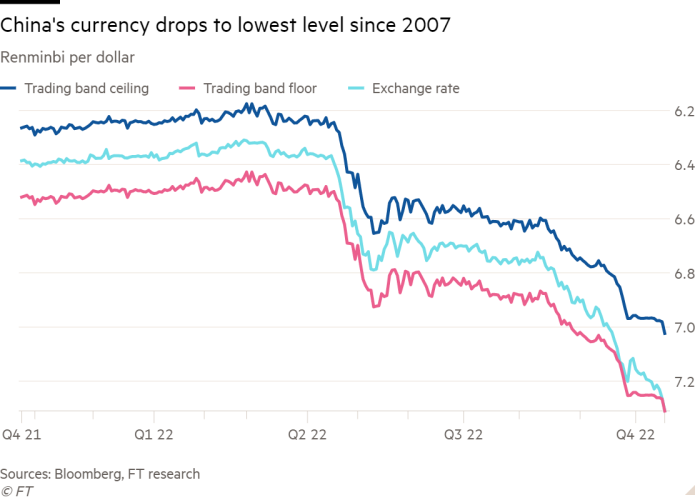
Evidence that Chinese are "running for the exits"

To exit, they sell their renminbi to buy dollars, increasing the supply of yuan, driving down its price (in terms of dollars).  Note that the vertical axis runs from a high of 6.2 yuan/dollar (16.1¢) to a low of 7.2 yuan/dollar (13.8¢).  

See earlier post, Time to run for the exits in China?, where I pre-register these hypotheses.
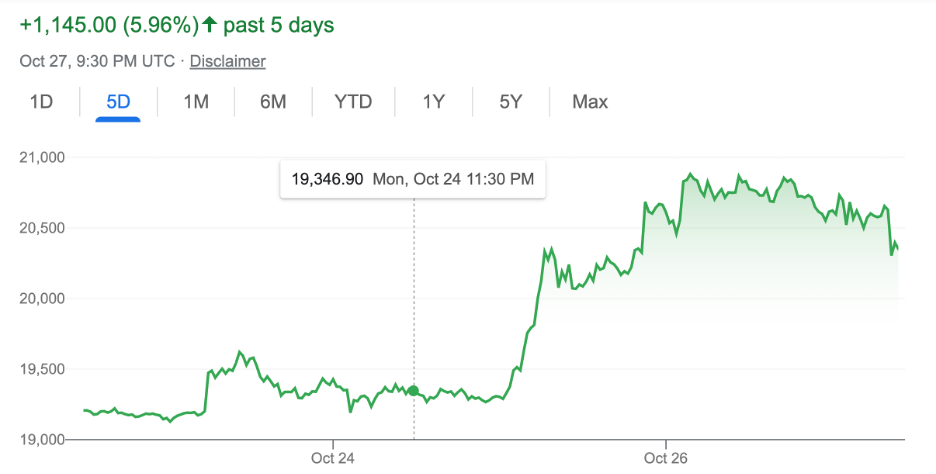
If this article is right, look for a devaluation of the yuan, and an appreciation in Bitcoin. 

Bono mugged by reality

MR Revolution reports:
...I thought that if we just redistributed resources, then we could solve every problem. I now know that’s not true. There’s a funny moment when you realize that as an activist: The off-ramp out of extreme poverty is, ugh, commerce, it’s entrepreneurial capitalism. I spend a lot of time in countries all over Africa, and they’re like, Eh, we wouldn’t mind a little more globalization actually.

Wednesday, October 26, 2022

Who won the PA senate debate last night?

 Talk is cheap, lets ask a prediction market.

Time to run for the exits in China?

The Financial Times reports that wealthy Chinese are trying to:
“Now that ‘the chairman’ is firmly in place . . . I have already received three ‘proceed’ instructions from various ultra-high net worth Chinese business families to execute their fire escape plans,” Lesperance said. ...
China’s rich, he said, are not only worried about rumours of an official wealth tax that would replace informal “common prosperity” donations. They are also increasingly concerned for their personal safety, even once they have left. ...
“The family motto has always been: ‘Keep a fast junk in the harbour with gold bars and a second set of papers’. The modern equivalent would be a private jet, a couple of passports and foreign bank accounts,” Lesperance says. “That is the world we are in . . . it is tough stuff.”
Gold bars show up on scanners at the airport. Maybe use crypto instead. 

BOTTOM LINE: If this article is right, look for a devaluation of the yuan, and an appreciation in Bitcoin. 

 RELATED: China’s property crash: ‘a slow-motion financial crisis’
...the slumping property market, the sputtering investment engines of local governments and a hefty burden of national debt signals the end for a model of growth that has not only transformed China but also been the biggest generator of global economic expansion for well over a decade. ...
In the free markets of the west, financial crises can erupt suddenly, taking governments and investors by surprise. But in China’s state-driven economy, infirmities metastasise more slowly as Beijing deploys political and financial capital to battle against the turning tide. This gives proceedings a more stately aura, but it does not mean that underlying problems are any less severe, analysts say.

Tuesday, October 25, 2022

How likely is a Red Wave on Nov 8?

Ask the prediction market that President Biden is trying to shut down. [The CFTC withdrew its "no-action" letter to PredictIt in August.]  

The contract which pays $1 if Republicans win the Senate is trading at $0.64 (in RED), implying a 64% probability.  The market is also predicting an 89% chance of a Republican House.  

Note that these kinds of prediction markets are easy to set up and can help Firms make more accurate predictions about their industry, and about their own strategies.

Why men pay to stay married

Steven Landsburgh's classic article

In the year following a divorce, women's living standards fall by 27 percent while men's living standards rise by 10 percent. What explains this?
...A 30-year-old woman who wants a family is getting close to the point where she has to choose the best of her available suitors. A 30-year-old man can always choose to wait another five or 10 years till someone better comes along. In general, the longer you spend searching for something—be it a car, a house, or a life partner—the happier you're going to be with the one you end up with. So—again, with myriad exceptions—a woman's optimal strategy is to settle for an imperfect mate and then try to change him. A man's optimal strategy is to search until he finds someone close to perfect. It's therefore no surprise that women, more often than men, should end up regretting their choices. 
In hindsight, it all makes sense. Once you realize there's a biological clock, you should be able to predict that men (having searched long and hard for the perfect partner) would make financial sacrifices to preserve their marriages, and that women who stay married to imperfect partners would be kept in their marriages by financial rewards—or, to say the same thing another way, that women who leave their marriages would make financial sacrifices. (And you should also be able to make a lot of auxiliary predictions, such as this one: Wives try harder to mold their husbands than husbands try to mold their wives—because husbands wait until they've found wives who need relatively little molding.) Fairness never had anything to do with it.

Monday, October 24, 2022

Book Review: Chaos Monkeys:

 Chaos MonkeysObscene Fortune and Random Failure in Silicon Valley is an autobiography of a Physics PhD from Berkeley who:

  • Went to Goldman Sachs to model credit derivatives; 
  • Founded a startup to be the Goldman Sachs of online ads:  instead of moving companies to their highest valued uses it moved ads to the best content .  
  • Created FBX (Facebook Ad Exchange) that allows advertisers to bid for targeted users.

The NY Times begrudgingly gave it a good review (they were able to look past the self-interested behavior the book celebrates and satirizes) because of its "educational value."  The book teaches readers:

1.  To anticipate opportunistic behavior caused by the incentive conflicts between entrepreneurs, angel investors, and venture capitalists.  

2. To understand how ad exchanges (i) find the highest-value ads for each piece of content, and (ii) find the highest-value content for each ad.  

3. How (not) to navigate the internal politics of Facebook, as it moves from a small startup ("move fast and break things") to a mature bureaucracy (self-interested bureaucrats), in a fast-changing environment.  

Useful tips for those working at startups:

  • Acquisitions are mainly about people, not ideas or technology.  Any acquired technology will require continuous updating, so the people who can do that are more valuable than technology they create.
  • Negotiate your stock bonus vesting schedule:  the longer it is, the less value it has because it "locks you in" to one company, regardless of whether that is your highest valued use  
  • Facebook's "one ask" policy on office romances.  To avoid creating a hostile work environment for the few women who worked at Facebook, it allowed employees only one time to ask another employee out.  If (s)he says "no," and you ask again, HR comes knocking.  

I found the book informative, a fun read, and loved the surprising ending.   Highly recommended.