Showing posts with label 22: Getting divisions to work in the firm’s best interests. Show all posts

Tuesday, April 14, 2026

WH Smith Divisional Incentives


High powered incentives appear to have backfired for WHSmith. In its North American travel retail division, performance evaluation and rewards were tied to aggressive profit targets. These appear to have encouraged managers to recognize income early, particularly from supplier rebates. On paper, the division looked like a strong performer. In reality, profits had been pulled forward, inflating results by tens of millions of pounds. When compensation is tightly linked to a single, measurable outcome like short-term profit, employees rationally focus on maximizing that metric, even if doing so decreases overall profitability.

Managers did not commit outright fraud but made possibly defensible accounting choices. While headquarters wants sustainable profitability, accurate reporting, and long-term relationships with suppliers, division managers are rewarded based on short-term profitability. The result is a predictable reallocation of profitability to where it will enhance compensation. This is a reminder that the problem is not just bad actors, it is often good agents responding optimally to poorly designed incentives.

Monday, January 12, 2026

A functional organization helps Apple innovate

 HBR

SUMMARY:

  • THE CHALLENGE: Major companies competing in many industries struggle to stay abreast of rapidly changing technologies.  
  • ONE MAJOR CAUSE: They are typically organized into business units, each with its own set of functions.  Thus the key decision makers—the unit leaders—lack a deep understanding of all  the domains that answer to them.
  • THE APPLE MODEL: The company is organized around functions, and expertise aligns with decision rights. Leaders are cross-functionally collaborative and deeply knowledgeable about details.

As companies grow, they often switch from a functional organization to a divisional one:

Business history and organizational theory make the case that as entrepreneurial firms grow large and complex, they must shift from a functional to a multidivisional structure to align accountability and control and prevent the congestion that occurs when countless decisions flow up the org chart to the very top.

But, you end up with general managers who lack technical expertise making decisions.  Instead:

...Apple relies on a structure that centers on functional expertise. Its fundamental belief is that those with the most expertise and experience in a domain should have decision rights for that domain. This is based on two views: First, Apple competes in markets where the rates of technological change and disruption are high, so it must rely on the judgment and intuition of people with deep knowledge of the technologies responsible for disruption. Long before it can get market feedback and solid market forecasts, the company must make bets about which technologies and designs are likely to succeed in smartphones, computers, and so on. Relying on technical experts rather than general managers increases the odds that those bets will pay off. 

Example:  Apple puts cameras in iPhones, computers, laptops, and iPads.  

...Apple’s more than 600 experts on camera hardware technology work in a group led by Graham Townsend, a camera expert. Because iPhones, iPads, laptops, and desktop computers all include cameras, these experts would be scattered across product lines if Apple were organized in business units. That would dilute their collective expertise, reducing their power to solve problems and generate and refine innovations.

What happens when functional areas disagree?

The answer is collaborative debate. Because no function is responsible for a product or a service on its own, cross-functional collaboration is crucial. When debates reach an impasse, as some inevitably do, higher-level managers weigh in as tiebreakers, including at times the CEO and the senior VPs. To do this at speed with sufficient attention to detail is challenging for even the best of leaders, making it all the more important that the company fill many senior positions from within the ranks of its VPs, who have experience in Apple’s way of operating. 

BOTTOM LINE:

APPLE’S FUNCTIONAL ORGANIZATION is rare, if not unique, among very large companies. It flies in the face of prevailing management theory that companies should be reorganized into divisions and business units as they become large. But something vital gets lost in a shift to business units: the alignment of decision rights with expertise. 
Why do companies so often cling to having general managers in charge of business units? One reason, we believe, is that making the change is difficult. It entails overcoming inertia, reallocating power among managers, changing an individual-oriented incentive system, and learning new ways of collaborating. That is daunting when a company already faces huge external challenges. An intermediate step may be to cultivate the experts-leading-experts model even within a business unit structure. For example, when filling the next senior management role, pick someone with deep expertise in that area as opposed to someone who might make the best general manager. But a full-fledged transformation requires that leaders also transition to a functional organization. Apple’s track record proves that the rewards may justify the risks. Its approach can produce extraordinary results.  

Friday, December 5, 2025

Transfer Pricing when Demand Increases

A recent news item seems to suggest that Samsung has a vertical relationship problem with its own subsidiaries. Part of Samsung's highly diversified product offerings is that it produces both memory chips and the mobile phones that use them. Samsung's mobile phone division had hoped to nail down pricing and supply for another year, but

... according to a report from SE Daily spotted by SamMobile, is that Samsung Semiconductor rejected the original order for smartphone DRAM chips from Samsung Electronics’ Mobile Experience division.

It appears that demand for memory chips for AI applications is so high that prices have skyrocketed and most chip makers are diverting production to these customers. As a profit center, the internal transfer price just isn't worth it for Samsung Semiconductor. Since the optimal transfer price should be the opportunity cost of its chips, the rejection of this order could be appropriate. This situation may be temporary until either the AI demand subsides or chip production capacity can be increased.


Thursday, September 26, 2024

Who Works From Home?

Work From Home (WFH) opportunities were dramatically broadened during, and after, the COVID-19 pandemic, but they existed pre-pandemic. Emanuel and Harrington (and ungated here) take advantage of when WFH went to voluntary to mandatory due to the pandemic to investigate which call center workers had selected WFH. Workers switching to WFH due to office closures during the pandemic were not as productive as before but those switching to remote work pre-pandemic were even less productive. The authors infer that those choosing WFH were adversely selected. Not only did they complete fewer calls, but they had higher customer hold times and more customer call-backs indicating that call quality suffered.

Interestingly, the voluntary nature of both pre- and post-pandemic WFH choices may limit its appeal.

Our model suggests that call-center firms were trapped in a prisoner’s dilemma with a low provision of remote work before the pandemic. All call-center firms would have been better off offering remote work jobs at similar wages as on-site ones — since the costs of remote work’s negative treatment effect would be offset by savings in office real-estate costs. Yet an individual firm hesitates to offer remote and on-site jobs at similar wages, due to concerns about attracting less productive workers into remote jobs.

Finally, the reduced worker productivity could be worth it due to offsetting reduced real estate costs. However,once you factor in the adverse selection, it may no longer make economic sense.

Tuesday, April 9, 2024

Diverse MBA teams perform worse

From "Diversity and Performance in Entrepreneurial Teams" (SSRN): 
  • Among the randomly-assigned teams [of MBA students], greater diversity along the intersection of gender and race/ethnicity significantly reduced performance. 
  • However, the negative effect of this diversity is alleviated ... [when teams can choose their teammates]
  • ...teams with more female members perform substantially better when their faculty section leader was also female. 

Thursday, March 14, 2024

FTC vs. Amazon: If there is no solution (remedy), there is no problem (liability)

The FTC asked a Washington court to split its monopolization case against Amazon (earlier blog post) in two: 1. to determine whether Amazon has a monopoly (liability), and then 2. what to do about it (remedy). 

Their argument (not yet posted) likely would be that bifurcation is more efficient because if FTC loses on liability, there would be no need for a remedy trial.  But if the FTC has to litigate both at once, it would change the trial.  The FTC would have to answer the questions "what should they have done differently?"  and "why is the choice they made bad for competition?"  The burden of answering it would fall on the FTC, and its economic expert. 

For example, suppose that the FTC thinks that the source of Amazon's market power is the integration of its fulfillment network with its electronic marketplace, and proposes a remedy to force divestiture of the two.  An economic witness would be forced to admit that divested companies may not perform as well as the integrated one (See Chapters 22, 23), e.g., by creating a double markup problem, or by foregoing some other economy of integration. 

The Dept of Justice brought (I was Chief Economist then), and then lost, the ATT/TimeWarner vertical merger challenge, in part because it could not overcome this burden of proof.

SOME RELATED ACADEMIC WORK:
  • Willem H. Boshoff, Luke M. Froeb, Wihan Marais, Roan J. Minnie, Steven Tschantz. Bargaining Competition and Vertical Mergers: The Problem of Model Selection, Review of Industrial Organization (SSRN). 
  • Cooper, James, Luke Froeb, Daniel O'Brien, and Michael Vita, Vertical Antitrust Policy as a Problem of Inference, International Journal of Industrial Organization, 23 (2005) 639–664. (SSRN)
TRUTH IN BLOGGING: I have done consulting work for Amazon.

Post will be updated as information becomes available.  

Tuesday, January 23, 2024

Smoothing the Incentives of Patent Examiners

How do you address employees gaming a production quota system? In 2011, the US PTO went from patent examiners having a bi-weekly quota system to adding bonuses tied to eliminating pending examinations on a daily basis. In "Deadlines Versus Continuous Incentives: Evidence from the Patent Office," Frakes and Wasserman examine how patent examiners responded to the new incentives to "clear the inbox." Instead of completing of assignments just before deadlines, there was  a near complete smoothing of task completion ...

leading to large reductions in average examination pendency while resulting in no corresponding reductions in the accuracy of examinations.

This is analogous to "Budget Games: Paying People to Lie" in chapter 22 in which workers have incentives to just meet budget goals. The solution, as the US PTO experience demonstrates, is to find ways to make incentives more linear and less lumpy.


Thursday, November 2, 2023

Organizational Form and Enforcement Innovation

  Antitrust Law Journal, Volume 85, Issue 2, (Oct 30, 2023)

Luke Froeb, Bruce H. Kobayashi, and John M Yun

  • Antitrust agency economists are uniquely situated to develop, adapt, and disseminate new methodologies to improve enforcement accuracy because of the multiple and conflicting roles that they play.
  • When economists arrive at the agencies, they are often thrust into decision-making roles where they must render judgments on messy, real-world cases, often in conflict with agency attorneys, political appointees, or the economists and attorneys who appear on behalf of parties.
  • We examine how the relationship between academia and the agencies can encourage what has become known as “enforcement R&D,” i.e., the development and application of new methodologies for screening and evaluating competitive effects.

Thursday, March 9, 2023

Decision Rights at Barnes & Noble

After a steady decline in profitability, Barnes & Noble is rebounding. It was purchased by a hedge fund in 2019 in order to implement a new strategy of more local autonomy. It turns out that book demand is quite regional and even local. The new strategy allows individual stores to make decisions on what titles to stock. They even stopped publisher promotions of potentially unpopular books in special displays.

  1. Who was making inventory decisions? HQ
  2. Did they have good incentives to make good choices? Yes
  3. Did they have good information on what choices to make? No

Solution: Allow at least some inventory decisions to be made at the stores who know their clientele's particular tastes. I suspect that this also required greater incentives  at the store level.

Friday, October 14, 2022

Does it matter that ESG goals are hard to measure?

From Steve Hayward:
If businessmen do have a social responsibility other than making maximum profits for stockholders, how are they to know what it is? Can self-selected private individuals [management] decide what the social interest is?
In other words, if managers can pick their own vague performance metrics, expect them to shirk or follow objectives of their own choosing.  One would think that management consultants would recognize this, but look at PwC:
...PricewaterhouseCoopers published a “sustainability survey” of 140 major U.S. corporations, arguing that “companies that fail to become sustainable–that ignore the risks associated with ethics, governance and the ‘triple bottom line’ of economic, environmental and social issues–are courting disaster.” The triple bottom line, PwC concluded, “will increasingly be regarded as an important measure of value.”
To be fair, PwC's Guide to Key Performance Indicators, seems to recommend clear performance metrics: 
Key performance indicators (KPIs), both financial and non-financial, are an important component of the information needed to explain a company’s progress towards its stated goals,
... in addition to "management accountability," and "corporate transparency." But pursuing ESG, with the conflicting "triple bottom line" makes it harder to hold managers accountable. Claiming to be Green is easy.  Doing it is much harder.  And no one wants to talk about the tradeoffs which, as Hayward notes, may be substantial:
Despite its flexible criteria, the DJSI (Dow Jones ESG Index) lagged the Dow Jones Industrial Average significantly. Over the last decade it has achieved an annual return of 5.2 percent, while the DJIA has returned 15 percent per year, and the S&P 500 14.8 percent.
And don't you violate your Fiduciary duty if you follow ESG goals at the expense of profit? 

Here are past blog posts on performance measurement. 

BOTTOM LINE: If you cannot measure it, you cannot control it.

Thursday, May 20, 2021

Agile Software Development

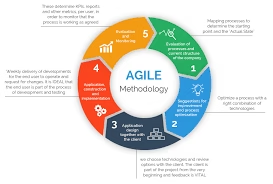
Traditional software development ("waterfall"), is plagued by predictable problems:  developers plan the next software release, then design, built, test, and release it, completing one phase before the next starts.  The entire process might take a year or longer, and by the time it is done, the product is not very good for one of two reasons:  either the technology has advanced, so that the software is obsolete before it is released, or the client's demands have changed, and they no longer want the product the developers have made.

Agile development, illustrated above, differs from the traditional approach by prioritizing and ranking changes, then taking them on one at a time.  By breaking the long development cycle into many short "sprints," each taking a week or so to complete, developers are able to deliver the most valuable changes immediately, and to adapt quickly to changes in technology or client preferences.  Clients get the changes they value more quickly and the developers can incorporate software innovations as they occur.  For example, Salesforce.com famously releases three model updates to its software each year.  

We can easily fit this into the problem-solving framework of Chapter One:
  • Who is making the bad decision?  
Clients and Developers are jointly deciding how to design software that will be available in a year's time.
  • Do they have enough information to make a good decision?
NO!  Clients don't know what their preferences are going to look like in a year and developers' don't know which capabilities are going to added to newer versions of the software.  
  • Do they have the incentive to make a good decision?
Yes

Agile development mitigates the client's and developer's information problems by shortening the planning horizon to a week or so.   Clients rank which features are most valuable, and developers use the latest and best technology.  If client preferences or software changes, Agile development adjusts by the next sprint. 

HT:  Halley and Brian

    Tuesday, December 1, 2020

    Incentive conflict between McDonalds and its Franchisees

    The incentive conflict between franchisees and franchisors is well known.  Franchisors want to protect their brands, and want franchisees to invest in building a better retail experience.  However, because franchisees earn only a fraction of the returns from these brand-building investments, they are reluctant to to make them.

    The conflict between McDonalds and its franchisees has come out into the open (2018 WSJ, 2019 Fortune, Twitter feed from a franchisee):
    But traffic has waned in recent quarters, leading franchisees to voice concerns that the money they were being asked to invest in their stores for initiatives like remodels, self-serve kiosks, fresh beef, delivery, and all-day breakfast were not paying off.

    “McDonald’s can set the direction of the brand, but you need the franchisees to buy into it,” says Senatore. “Franchisee alignment is so important to these systems.”

    One way to manage this incentive conflicts is with:
    1. Contracts to reward actions that are easily observable and contractible; and 
    2. Vertical restraints, like exclusive territories, for actions that are not.  

    Vertical restraints that restrict intra-brand competition among franchisees (e.g., with exclusive territories) give franchisees a profit stream that they are more eager to protect, i.e., with brand-building investments and higher-quality service.

    Note that franchisees on freeways don't have much repeat business, so they can make more money by free riding on the brand reputation (e.g., by shirking on service or quality).  This incentive conflict is so costly to manage that McDonalds finds it easier to own and run their restaurants on the freeway.

    HT:  Kaitlyn W.

    Thursday, October 1, 2020

    Which organizational forms can best adapt to change?

    One of the themes in this blog is that it is not necessarily the strongest firms that survive, but the most adaptable.  Kodak once dominated the film industry but now it is bankrupt.  How did this happen?

    Part of the fault lies with Kodak's centralized structure which was slow to react to the expiration of its patents, and the advent of digital photography.  Colby Chandler, former CEO of Kodak, admitted as much at the 1984 annual meeting:
    Like many companies, we are not used to working in an environment where there is rapid technological transfer from laboratory to the marketplace. But we know that will be important in our future.
    In 1984, in the hopes of encouraging innovation, Kodak decentralized decision making to 17 different business units with profit and loss responsibility.  However, the decentralized decision making was not accompanied by incentive pay.  Instead, small bonuses were doled out by officious bureaucrats, according to office politics. 

    As a result, Kodak continued its slow decline, and in 1993 the board of directors fired its CEO for not holding its managers accountable for failure.  This year, Kodak entered bankruptcy.

    The moral of the story seems clear to me:   decentralized decision making is better for adapting to technological change, but only if accompanied by strong incentive pay.  This may be the reason that much of certain types of innovation is done by small firms:  owner/operators have the strongest incentives to perform. 

    Thursday, August 20, 2020

    Economic profit replaces stocks as executive compensation

    Wall St. is finally listening to what economists have been saying for years, that economic profit is a better way to motivate employees.  Not only does it make visible the hidden cost of capital by including a charge for the capital being used, but it also can measure the performance of individual business units.

    With better performance evaluation metrics it is easier to align the incentives of employees with the profitability goals of an organization.  In particular, it "tells" employees that using capital has a cost, which makes it less likely that they commit the "hidden cost fallacy."

    "Whatever compensation scheme you have, that's exactly what your employees are going to respond to," says Daniel Rinkenberger, CFO of Kaiser Aluminum Corp., KALU +0.47% which has used economic profit to decide short-term incentives for key employees since 2006. "It's driving them to do things our shareholders want, like not having excess assets in the pool. It drives people to be more efficient in how they have inventory deployed."
    PepsiCo's new focus on economic profit will lower its capital spending to about 4.5% of sales this year, down from an historical average of about 5.5%, says Mr. Johnston, because employees are making better decisions. The company also has been able to cut the sums of money it has tied up in accounts receivable and inventory, boosting cash flow.

    This story ties into several of the themes in the book:
    • Chapter 1:  How to give employees enough informaiton to make good decisions, and the incentive to do so.
    • Chapter 3:  How to avoid the hidden cost fallacy.
    • Chapter 21 and 22:  How to align the incentives of employees and divisions with the profitability goals of a company.


    Thursday, April 30, 2020

    Musk Games High Powered Incentives

    The Daily Mail reports that Elon Musk has seemingly joined the chorus demanding the end to COVID-19 related lockdowns. But it also reports that he was about to get a large payout from Tesla linked to its stock price. Shares, which had been depressed, rose 10% just ahead of its quarterly report.
    Maybe he really believes this, but he sure has an incentive to feign belief.

    Tuesday, December 3, 2019

    Paying People to Lie: The Truth about Corporate Budgeting

    Michael Jensen's timeless classic is available here.  In it he describes how stock market analysts set earnings expectations for a company's stock.  Since the CEO is paid in stock options which will decline in value if earnings fall short of analysts' expectations, the CEO wants to ensure that each division makes enough money to meet analysts' expectations.  In consultation with division managers, she turns analysts' earnings expectations into performance metrics, with each division manager's bonus tied to meeting her division's share of company earnings. 

    With these incentives, each division manager has an incentive to understate (or lie about) how much her division can earn.  As a result, the negotiated division budgets need not reflect what managers actually know.   Important decisions are then made based on based on budgets constructed from lies.

    Fortunately, there is an easy fix:
     [by]...changing the way organizations pay people. In particular to stop this highly counterproductive behavior we must stop using budgets or targets in the compensation formulas and promotion systems for employees and managers. This means taking all kinks, discontinuities and non-linearities out of the pay-for-performance profile of each employee and manager. Such purely linear compensation formulas provide no incentives to lie, or to withhold and distort information, or to game the system.
    With a linear compensation scheme, there is no incentive to understate how much a division will earn.  And with better information, better decisions are made:

    I believe that solving the problems could easily result in large productivity and value increases - sometimes as much as 50 to 100% improvements in productivity.

    Thursday, May 30, 2019

    General Patton on decentralization (and Nike)

    Don't tell people how to do things, tell them what to do and let them surprise you with their results. 
    --George S. Patton

    One of Nike founder CEO Phil Knight's favorite management maxims.  From his well-written and fascinating autobiography, Shoe Dog.

    Reading the book makes me realize how Nike's success was driven more by belief in a higher cause or purpose than a concern for making money.

     The villains in the book were those erecting regulatory barriers to success, like Converse and Keds, domestic firms who manipulated customs laws to raise Nike's costs of importing.  Only when Nike hired people familiar with how Washington works (who filed an antitrust counter claim), were they able to resolve their claim. 

    For Nike, this kind of "rent seeking" seemed like both a prisoners' dilemma (Nike's optimal response was to do something similar as Keds and Converse), and a tax on innovative activity (it would up diverting Nike's attention from their primary business of designing, producing and importing shoes).

    Monday, April 10, 2017

    FCC Chairman uses management theory to improve agency decision-making

    FCC Chairman Ajit Pai wants to increase the quality of economic analysis done by the FCC staff:

    ...he explained that economic analysis, primarily in the form of cost-benefit analysis, is largely ignored. Actually, it is probably worse than that: Those types of analyses aren’t even done. For example, significant areas of the agency’s work in recent years ... contained nothing that would pass as economic analysis.

    So how to do this?  Chairman Pai wants to change the organizational structure from an M-form (with economists mixed in with attorneys) to a functional organization, with economists in their own division.

    Some middling economists had suggested exactly this in an article titled "The Economics of Organizing Economists."

    ... a functional organization has a couple of advantages over a divisional form. First, a functional organization is more likely to keep up with new methodologies and so be able to apply them to enforcement questions. Second, since the staff economists and attorneys produce information, not traditional goods or services, there is an advantage to the independent analyses done by attorneys and economists. Without two separate memos, the decentralization of decision making in a divisional organization is likely to result in less information reaching the ultimate decision makers.

    Monday, February 13, 2017

    Who monitors the monitors?

    In our problem solving framework we ask three simple questions to diagnose goal misalignment:
    • Q1:  Who made the bad decision?
    • Q2:  Did they have enough information to make a good decision?
    • Q3:  And the incentive to do so?
    Answers to these three questions will isolate the source of the problem and suggests one of three generic solutions:
    • S1:  Let someone else make the decision, someone with better information or better incentives.
    • S2:  Give more information to the current decision-maker.
    • S3:  Change the incentives of the current decision-maker.
    The first solution is always tempting, but you have to make sure that whoever makes the decision has goals aligned with those of the organization, i.e., enough formation to make a good decision, and the incentive to do so.  This is sometimes referred to as the problem of "who watches the watcher?"

    The economist has an article on the history of this problem:
    In business and finance, this is known as the “principal-agent” problem. Shareholders employ managers to run a company; investors use fund managers to look after their savings. That makes sense. It allows us to take advantage of the expertise of others, and of economies of scale in fund management (it costs little more to look after $10m than $1m). But it is extremely hard to align the interests of principals and agents exactly.

    To spoil the ending, the solution is always "it depends."