They are committing to playing hard rather than simply threatening to do so. Each side hopes these actions will be viewed as credible so as to affect the final agreement in their favor. A strike authorization strengthens the union negotiators’ ability to credibly threaten a walkout, while Boeing’s contingency investments reduce the cost to Boeing of allowing a strike to continue. Deliberately reducing your flexibility can improve the deal you receive. If your opponent knows that you have committed yourself to saying no, they may have to offer you more to get you to say yes.
Monday, August 31, 2026
Boeing / SPEEA Negotiations
Thursday, April 16, 2026
The alternatives to agreement determine the terms of agreement: Iran's alternatives are bad and getting worse.
“Iran insiders are rumbling about the looming economic catastrophe if Washington does not grant sanctions relief that would unlock prospects for economic recovery,” said Burcu Ozcelik, senior research fellow with the London-based Royal United Services Institute think tank. “Without the prospect of economic recovery, regime survival beyond the short term will face sustained structural and popular pressure.”...
“The attacks are not random,” said Kevan Harris, an authority on Iranian economic development and society at the University of California, Los Angeles. “They are targeting parts of the economy that are outward facing, that are bringing in foreign exchange which could be redistributed and directed at basic needs.” ...
Iranian oil that can’t be exported will fill the country’s storage tanks in two to three weeks, which would force the country to shut-in its oil production, data provider Vortexa said. Shut-ins in turn can damage fields and reduce their future output, analysts said. ...
Complicating Iran’s recovery is a host of economic and social ills that predate the recent war, including a worsening banking crisis. Pressure from international sanctions and economic mismanagement pushed Iran last year into an economic unraveling and drove hundreds of thousands of protesters into the streets.
The government’s own internet blackout—now at six weeks and counting—is contributing to the economic damage. Businesses rely on it to communicate with overseas customers and to complete orders, and a tech sector employs tens of thousands of Iranians.UPDATE from The Free Press
So now is the time to think big. This would entail making three basic demands of Iran’s regime: release political prisoners, end the execution of protesters, and turn the internet back on. In exchange, the U.S. can offer to lift sanctions and unfreeze assets the regime needs just to pay the salaries of government employees.
“The president has real leverage to call not for just a halt in executions, but to seek the termination of the death penalty for certain ‘offenses’ in Iran,” said Behnam Ben Taleblu, a research fellow at the Foundation for Defense of Democracies. He added that a precondition for the next round of talks should be to restore internet access for Iranians, which has been cut off now for nearly two months. In addition, Ben Taleblu said, Trump should demand the release of political prisoners arrested after the June 2025 war and more recently after the national uprisings and state-led massacres in January. He estimates 21,000 Iranians were arrested in June, and that more than 50,000 have been arrested since January.
Monday, September 29, 2025
Govt. Shutdown Showdown
Monday, August 11, 2025
Value Extraction by Bargaining over Wholesale Price
A new paper by Alvarez-Blaser et al analyzes how wholesale and retail prices respond to changes in costs for 2,000 household products from a global manufacturer. There are lots of interesting results on pricing dynamics, responses to idiosyncratic versus aggregate cost shocks, cost pass-through rates, and more. The result I was drawn to was how the value that is created is allocated between the manufacturer and retailers. The retailer markup is the retail price minus the wholesale price while manufacturer markup is the wholesale price minus cost.
Rather than passing on changes in the wholesale price, the above graph from the paper indicates that retailers respond with lower markups on their end. The two parties determine how much value they can each extract by bargaining over the wholesale price. This suggests that the final price to consumers is a hard limit on the value to be extracted.Friday, October 4, 2024
Bargaining with Longshoremen
How much bargaining power did the two sides have in the recent dock workers' strike?
For shippers, what is the cost of a one day delay in coming to terms? The port of New York handled 6.6 million Twenty-foot Equivalent Unit (TEU) containers in 2022, but the East cost and Gulf coast ports for which data are available handled ~21 million. The average value of a TEU is $54.500. Assume firms have a 20% annual discount rate for a little back-of-the-envelope calculation.
| Port of New York | All Affected Ports | Units | |
| Volume Handled 2022 | 6.6 | 20.8 | Million TEU |
| Value of TEU 2020 | $54.5 | $54.5 | $Thousands |
| Annual Value | $359.7 | $1,133.6 | $Billion/Year |
| Daily Value | $985.5 | $3,105.8 | $Million/Day |
| Daily Carrying Cost | $540.0 | $1,701.8 | $Thousand/Day |
The carrying cost alone is over $1.7 million per day, perhaps more in 2024 due to inflation and increases in trade volume. This is also a lower-bound since there will also be production disruptions & spoilage of goods. The cost to shippers might come to $3-5million per day.
What is labor's cost of a one day delay in coming to terms? The earnings of the 45,000 affected dock workers could be anywhere from $39/hour to $200,000/year. Suppose half of these would have worked on any day and that a typical day is eight hours of work, the 45,000*0.5*$39/hour*8hours = ~$7million per day. This is an upper-bound since opportunity cost of workers time is not $0. The cost to workers might be $3-5million per day.
You can adjust any of these assumptions as you deem appropriate, but it seems that the two parties were pretty evenly matched.
Thursday, February 22, 2024
The Market for Private-Label Products
There is a nice podcast on "Store-Brand Products" over at the "Economics of Everyday Things." It touches on many managerial economic concepts. There are multiple factors going into the store brands on the shelves.
1. Brand names may have excess capacity.
...some store brand products are actually made by the same companies that produce the name brand versions of those products. Take, for instance, Costco. Some of the Kirkland brand of coffee blends are made by Starbucks. Kirkland batteries? Duracell. And Kirkland diapers? Those come from Kimberly-Clark, the company that makes Huggies.
2. Brand names may be too expensive.
Bringing a store brand product to market usually starts like this: a national retailer like Albertsons has category managers who are in charge of specific kinds of goods. They might see that a certain name-brand tomato sauce is selling in big numbers, but it’s a little expensive — which means there’s an opportunity for a more affordably priced store-brand version.
3. Private label manufacturers often explicitly reverse engineer the existing product.
Retailers ask Winland Foods to reverse engineer name-brand products and create a new version.
BERINGAUSE: We have a large R&D facility in Chicago with a large group of food scientists. And we may have customers bring us something that they want us to develop. They may say we’d like an emulation or something better than a certain pasta sauce that is out there.
4. Private label manufacturers have little bargaining power
Marketing professor Kusum Ailawadi says that private label manufacturers don’t have much bargaining power when it comes to negotiating with retailers.
AILAWADI: Because nobody knows who the supplier is — the consumer doesn’t. So the supplier doesn’t have much leverage.
Wednesday, November 15, 2023
How PBM's and Government bargain
The “negotiation,” if you want to call it that, is “your money or your life” and fairness has little to do with it. The IRA also requires very costly inflation rebates, i.e. a price control/tax.This reduces the gains to innovation, equivalent to weakening patent protections at a time when the gains to innovation in pharma are big.
In contrast, the private sector uses PBM's to create bargaining competition to reduce drug prices (Froeb and Shor, 2023)
For 181 million Americans not on Medicare or Medicaid but insured through their employer, labor union, or private insurance health plan, the primary restraints on pharmaceutical prices are pharmaceutical benefit managers (PBMs) who administer health plan drug benefits. PBMs use the aggregate demand of their constituent plan sponsor clients — employers, unions, government agencies, health insurers, and others — to negotiate lower pricesThese PBM's create competition between drugs within a therapeutic class by setting up formularies (lists of covered drugs) for Health Plans. Drug manufacturers compete by offering lower prices to get onto the preferred tiers of formulary, those with lower co-pays.
... Consider Lipitor and Crestor, two leading statins, or lipid-lowering cholesterol medications. The placement of one drug on a more favorable tier than the other can considerably shift sales volume in favor of the preferred drug. Economists at MIT and Wharton estimate that the statin manufacturers are willing to offer rebates of up to 54% in return for favorable placement.
Thursday, August 31, 2023
Economist gets this wrong
Dear Editor:
Though I liked your article about negotiating drug prices, the sentence, “The system is packed with opaque middlemen such as pharmacy benefit managers, many of which are making big rents” is not only wrong but it tarnishes PBMs with the “middleman” slur.
See our recent paper on the industry, in which we survey the evidence. This is from our conclusion,
As a final reminder, we noted in the introduction that PBMs have derogatorily been called the “middlemen” of the pharmaceutical industry. As FedEx—a “middleman” between many retailers
and consumers—has reduced the overall costs of shipping, PBMs reduce the costs of offering pharmacy benefits. Not every plan sponsor needs to (nor can) negotiate with manufacturers, keep
up with clinical developments, contract with the nation’s 66,000 pharmacies, and build systems to adjudicate and process claims.
Happy to write an article for you on what PBM’s do, and how they negotiate lower drug prices, based on the paper. I think it would clear up a lot of misconceptions.
Loyal reader,
Prof. Luke Froeb
Vanderbilt University
---------------------------------------
CV Bio Textbook Blog MBA-BS'er LearnRegression.com CompetitionToolbox.com
“In twenty years [but don't wait!], it will
be seen as the standard way to teach
economics.” — Robert E. Litan,
Kauffman Foundation and the Council
on Foreign Relations
Formularies, Rebates, and the Economics of PBM Bargaining
Vanderbilt Owen Graduate School of Management Research Paper
60 Pages Posted: 9 May 2023
Luke M. Froeb
Vanderbilt University - Owen Graduate School of Management
Mikhael Shor
University of Connecticut Department of Economics
Date Written: May 8, 2023
Abstract
For 181 million Americans not on Medicare or Medicaid but insured through their employer, labor union, or private insurance health plan, the primary restraints on pharmaceutical prices are pharmaceutical benefit managers (PBMs) who administer health plan drug benefits. PBMs use the aggregate demand of their constituent plan sponsor clients — employers, unions, government agencies, health insurers, and others — to negotiate lower prices.
Recently, the use of formularies and PBM-negotiated rebates have come under fire. Critics allege PBMs act to maximize rebates rather than reduce prices, and that rebates lack transparency, contribute to increasing prices, and are not passed on to the benefit of patients. Yet, sophisticated plan sponsors have choices in how to administer their prescription drug benefits and almost all choose to hire PBMs to manage their drug benefit rather than internalize drug procurement, negotiation, clinical evaluations, and benefit administration.
This report examines the role of formularies and rebates in the provision of prescription drugs. We respond to the criticisms of PBMs by discussing the often misunderstood principles of formulary management and rebates and how they are essential parts of the bargaining process between PBMs and pharmaceutical manufacturers. We demonstrate that economic logic and evidence, as well as multiple investigations by independent and government groups, find that PBM bargaining reduces drug prices.
Keywords: drug pricing, pharmacy benefit managers, PBMs, rebates, formulary design, prescription drug market
JEL Classification: C70, D4, I11, I13, I18, L1, L42
Suggested Citation:
Froeb, Luke M. and Shor, Mikhael, Formularies, Rebates, and the Economics of PBM Bargaining (May 8, 2023). Vanderbilt Owen Graduate School of Management Research Paper, Available at SSRN: https://ssrn.com/abstract=4442064 or http://dx.doi.org/10.2139/ssrn.4442064
Sunday, January 8, 2023
Pay transparency laws shrink the Gender Gap by reducing male wages
...[Pay Transparency law] shrank the gender pay gap by 13%, but only because it curbed the wages of male employees. Studies of Britain’s gender-pay-gap law, which was implemented in 2018, have reached similar conclusions.Of course, the term "gender-pay-gap" refers to a statistical difference betweden what men and women are paid. It does not mean that men are paid more for the same work as women. See earlier post When are between group differences evidence of discrimination?
Tuesday, August 16, 2022
100 Rules for living (lot of econ in these)
5. “Use models.” — Don’t recreate the wheel. Learn from others and save time.
19. “Think probabilistically.” — Think grey. Not black and white. This comes from Annie Duke and her book, Thinking in Bets. Assign percentages to your beliefs instead of speaking in absolutes.
20. “Short engagements. Test situations.” — Test partnerships and commitments with trial runs. Build a small project together before going all in.
21. “Red team. Blue team.” — Approach decisions as a critic and a supporter. Answers often reveal themselves.
25. “Use simple language. Few syllables. Short sentences. Short paragraphs.” — Simplicity is hard to achieve. Work hard so your audience doesn’t have to.
26. “Our brains are built to enjoy stories.” — Stories help information stick.
28. “Don’t argue. Bet.” — Test belief through sacrifice not words.
29. “Appeal to interest, not reason.” — We don’t care about what makes sense. We care about what makes sense for us.
Monday, May 9, 2022
Facebook vs. Australia: The alternatives to agreement determine the terms of agreement
The Australian govt. passed a law requiring Facebook and Google to start paying for news content that appeared on their sites. However, the law did not specify any criteria for identifying pages that were in violation of the law.
This uncertainty creates a tradeoff when trying to design rules to comply with the law:
- An "overly broad" take down means that Facebook is less likely to violate the law, BUT
- It also means that Facebook is likely to take down pages that shouldn't be taken down.
The documents show that Facebook deliberately created an overly broad process for deciding what was news and taking down supposedly news pages that swept up a lot of things that weren't news. And the document showed that it knew this. This was a choice. ...
The other thing Facebook didn't have ready was a process so that anyone who thought their page had been wrongly taken down could appeal to Facebook and ask to be reinstated. The company says it was still working on the appeals process when the takedown began. The massive takedown of Facebook pages may have wreaked havoc for the public, but for Facebook, it got the company back at the negotiating table with Australian lawmakers. ...
Within days, Australian lawmakers watered down the bill and added in language that said if Google and Facebook struck enough deals with the news publishers on their own, they could avoid that dreaded government run negotiation process: the so-called final offer arbitration.
Tuesday, December 14, 2021
Tuesday, November 16, 2021
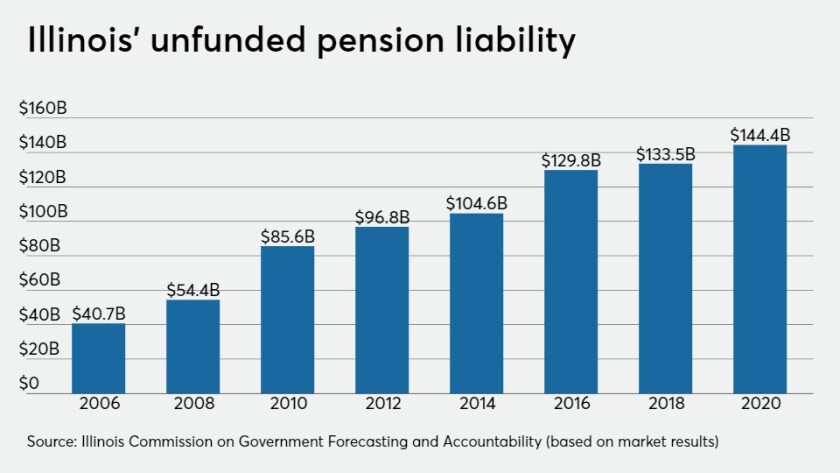
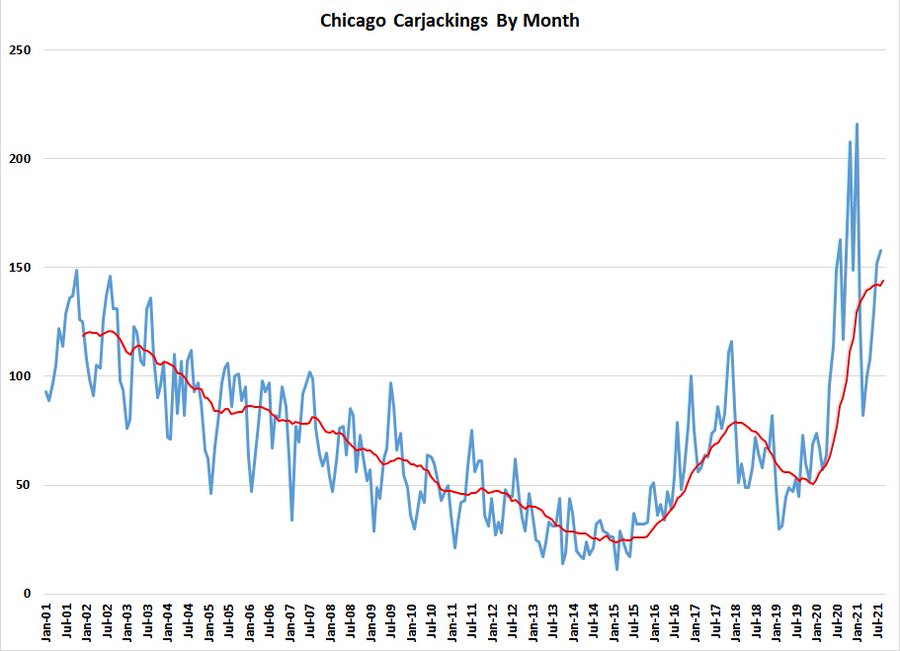
IL: unfunded pension liabilities; bad credit rating, rising crime, high taxes, low economic growth
Tuesday, September 14, 2021
Sunday, August 22, 2021
Price transparency at last!
Colleague Larry van Horn's efforts to require negotiated prices between payers (insurance companies) and healthcare providers (doctors, hosptials) be made public are about to bear fruit. Larry showed that
Even when insurance covers the cost, there is, on average, a 300 percent price variation within a market for the exact same services.
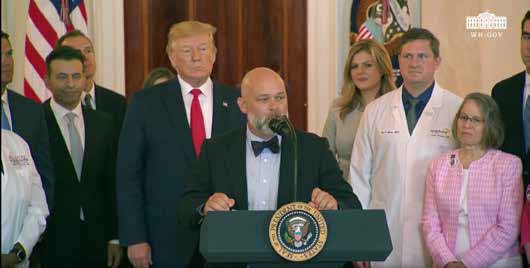
As a special advisor to President Trump, Larry encouraged the President to force the bargaining pairs to make public their negotiated prices.
The first data is now trickling out and the NY Times seems to approve, and gives President Biden credit for not reversing Larry's efforts:The requirement to publish prices is a rare bipartisan effort: a Trump-era initiative that the Biden administration supports
The insurer also may not have a strong motivation to [negotiate lower prices], given that the more that is spent on care, the more an insurance company can earn.
Vanderbilt alum Richard Stephenson is quoted in the Times article and runs Redu Health, a "national self-pay discount network empowers employees and members ... with transparent, upfront pricing."
Thursday, August 19, 2021
We are so busted!
https://freakonomics.com/podcast/reasons-to-be-cheerful-rebroadcast/
Good but long podcast. This caught my eye:Friday, July 30, 2021
Game theory: play the trust game online (Repeated free riding dilemma)
Pretty good teaching implementation of a repeated prisoners' dilemma. Very close to co-author Mike Shor's implementation of the same game.
Professors: Mike teaches one of the most innovative game theory classes, and has designed a good set of interactive apps.
Wednesday, April 7, 2021
Gig Workers of the World Unite!
Door Dash drivers are trying to beat the algorithm. When a specific meal needs to be delivered, Door Dash's algorithm will post the gig to available drivers with payment information. If no one accepts, the algorithm raises the compensation level. This is how markets are supposed to clear.
What if drivers organize to withhold their services until the rate rises enough? In labor markets, this is the main goal of employee unionization. In business markets, we call it collusion. (It is an open question if these gig workers are employees or independent contractors.) But there are a lot of drivers. It is not clear if you can get enough of them them to commit to this strategy. It is useful to employ moral suasion. The Facebook group #DeclineNow, was formed to share information and encourage compliance.
#DeclineNow has little patience for such naysayers. Users who question the $7 minimum rule are punished with suspension from the group or, as the group’s moderators like to put it, “a trip to the dungeon.” One former moderator, Josie Lindström, claims to have personally suspended hundreds of people, saying the intolerance for dissent was necessary to keep the group moving in the right direction. “It has to be all of us, or it doesn’t work,” she says. But Lindström eventually quit, citing what she described as a toxic atmosphere.
Monday, August 24, 2020
California plays chicken with Uber and Lyft
Washing Post Opinion piece:
Most recently, Uber and Lyft, based in San Francisco, announced they would close their California operations after a court ordered them to reclassify drivers as employees [under new law AB5]. They’re still running at the moment, having secured a last-minute stay, pending appeal, but ultimately, unless that appeal proves fruitful or the law changes, they say they’re pulling out. ...And you should believe them, though AB5’s architect, Democratic Assemblywoman Lorena Gonzalez of San Diego, seems to think they’ll blink if she just shows enough steely will. “These are billion-dollar companies who are publicly traded,” she told a local television station. “They have enough money to treat their employees correctly.”The pandemic has shifted the game, however. Now that Uber and Lyft are losing money, unemployment is high (so drivers dont have as many options), and public transport is suddenly very risky, it seems likely that Uber and Lyft will exit unless the State folds:
It was doubtful they could ever have stayed in California with AB5 in effect, but until the coronavirus is conquered, the thing is clearly impossible.
Lets see how well economics can predict this outcome of this bargaining game.
Wednesday, August 12, 2020
Negotiating with Ransomware Thiefs
Jack Stubbs has an interesting Twitter thread on negotiations after a ransomware attack. It was also picked up by Reuters. Its seemed very professional. They initially demanded $10 million but settled for $4.5 million, pretty close to the midpoint between disagreement values.
HT: Marginal Revolution