Economists were right that Tariffs would push up inflation (it went up slightly) and have little effect on the trade deficit (it didn't move much). President Trump was right when he predicted they would raise a lot of money.


In response to the 2018 U.S. tariffs on washing machines and other appliances, both LG Electronics and Samsung shifted manufacturing operations to the United States, effectively reshoring some production. The tariffs incentivized these companies to establish or expand manufacturing facilities in the U.S. to avoid the tariffs on imported appliances.
...The tariffs were credited with creating 1,800 new jobs in the U.S., but also raised consumer prices by an estimated $1.5 billion, according to one study. The study also concluded that the tariffs resulted in a high cost per job created.Re-shoring of Nvidia Chips in response to 2025 Tariff threats:
Contract chipmaker Taiwan Semiconductor Manufacturing (TSM) has started production of Nvidia Blackwell chips at its plants in Phoenix.
Contract assemblers Foxconn and Wistron are building supercomputer manufacturing plants in Houston and Dallas, respectively. Mass production at both plants is expected to ramp up in the next 12 to 15 months, Nvidia said.
Trade policy can resemble a Prisoners' Dilemma game: free trade is the best outcome (no tariffs), but that is not a Nash Equilibrium because any country can do better by imposing tariffs on imports as it helps domestic producers. The Nash equilibrium is for all countries to impose tariffs on imports.
One way out of this prisoners' dilemma is to play tit-for-tat (do whatever your rival did last period) because it gives foreign countries an incentive to keep their own tariffs low: if foreign countries put a tariff on imports from the US, their exports to the US will be treated similarly.
However, President Trump is computing reciprocal tariffs as (Trade Deficit with US)/(Exports to the US). This measure is determined largely by foreign investment in the US, not foreign tariffs on US goods. For example, China sells ¥to buy $ to invest in the US to buy US Treasuries. Such an increase in demand for $ raises the price of a $ relative to the ¥. The stronger $ makes Chinese exports look cheap to US consumers. This is both a US Trade Deficit (the US buys more Chinese goods than China buys US goods), and a Chinese Investment Surplus (China invests more in the US than the US invests in China).
As a result of the policy, US tariffs on foreign goods are set to dramatically increase, which will likely lead to tit-for-tat responses from foreign countries which will result in less trade. From Chapter One, we know that voluntary transactions create wealth, and with fewer of them, we are all poorer.
It might make some sense to set reciprocal tariffs equal to actual tariffs on a country-by-country basis, i.e.,(reciprocal US tariffs on foreign goods) = (foreign tariffs on US goods).
BOTTOM LINE: Reciprocal Tariffs, as calculated, would harm the US.
CAVEAT: The above analysis ignores: (i) the international nature of supply chains--domestic producers are also importers of foreign goods; and (ii) their harmful effect on consumers.
HT: Mike, Donna
The U.S. dollar is the world’s reserve currency, and the U.S. Treasury security is the global reserve asset. This means, respectively, that the dollar is the primary currency used in international trade, and that foreign central banks and other institutions store wealth in terms of dollars with Treasury securities.
...the dollar, because of its reserve status, tends to be overvalued. This makes foreign goods cheaper for U.S. consumers, but it also makes foreign labor and production cheaper ... a dynamic that has hollowed out America’s industrial base....
While imposing duties on imports will raise prices for American consumers, it will also appreciate the value of the dollar, ...
Tariffs might generate some revenue in the short run, but their larger effect—bringing countries to the negotiating table—could help the Trump administration achieve its [other] long-term objectives.
The dollar reached a two-year high against a basket of major currencies, bolstered by a strong jobs report, released on Friday. The data dampened expectations that the Federal Reserve will cut interest rates aggressively in 2025. Share prices in Asia fell, as investors fear that prolonged high interest rates in America will draw capital to the dollar, draining funds from weaker currencies and emerging markets.
From CalculatedRisk:
The bottom line is there will not be a huge wave of distressed sales as happened following the housing bubble. Most homeowners have significant equity, were well qualified, and have a mortgage with low rates that they can afford.
...I also strongly disagree with those who say that cheaper ruble is “good” for exporters and the budget. Exporters have yet to make good use of devaluing ruble – which they can’t do, because Russia is under all sorts of embargoes, and China and other Global South countries are not opening their markets to most Russian goods.
...China is only buying our most basic commodities at heavy discounts, while keeping its market closed for other Russian goods. There’s no investment or technology coming into Russia from China and other Global South countries. Everything is dependent on state subsidies – but the government’s financial reserves are running thin.Along with their low fertility rate, 1.52 (source), and it appears that Russia's future prospects are dim.
It is fashionable to criticise untrammelled globalisation as the cause of inequality, the global financial crisis and neglect of the climate. But the achievements of the 1990s and 2000s—the high point of liberal capitalism—are unmatched in history. Hundreds of millions escaped poverty in China as it integrated into the global economy. The infant-mortality rate worldwide is less than half what it was in 1990. The percentage of the global population killed by state-based conflicts hit a post-war low of 0.0002% in 2005; in 1972 it was nearly 40 times as high. The latest research shows that the era of the “Washington consensus”, which today’s leaders hope to replace, was one in which poor countries began to enjoy catch-up growth, closing the gap with the rich world.But the political consensus behind globalization is breaking.
As we report, the disintegration of the old order is visible everywhere. Sanctions are used four times as much as they were during the 1990s; America has recently imposed “secondary” penalties on entities that support Russia’s armies. A subsidy war is under way, as countries seek to copy China’s and America’s vast state backing for green manufacturing. Although the dollar remains dominant and emerging economies are more resilient, global capital flows are starting to fragment, as our special report explains.

The answer, of course, is politics:
To stop the war in Ukraine from disrupting energy markets, [Biden's] administration has overseen a big expansion in domestic fossil-fuel output. As well as being the world’s top LNG [liquified natural gas] exporter, America continues to be the biggest oil producer. That angers the climate-anxious left wing of Mr Biden’s Democratic Party. ...But US restrictions wont help:
...the impact of the pause on global markets—and thus on global emissions, which is what matters to the climate—will be minimal. Forgone American exports will be offset by fresh supplies from Qatar, Australia and elsewhere. “I think there is an opportunity,” declared Jonathan Wilkinson, Canada’s energy minister, on January 30th.BOTTOM LINE: President Biden's virtue signaling is worse than empty, as it is harming US producers by shifting US production to Qatar, Australia, and Canada.


• Home prices came in exceptionally strong in August, rising a seasonally adjusted +0.68% from July; August’s non-adjusted gain (+0.24%) was more than 60% larger than the 25-year same-month average (+0.15%)

Speculation: It may be a consequence of fear (flight to safety?) and/or trade restrictions against China.

From the Economist:
Russia’s rouble slumped to a 16-month low of 100 against the dollar, having lost around 25% of its value this year. Deteriorating foreign trade conditions and an escalation in military spending have accelerated its fall in recent weeks. The currency was already suffering from western sanctions and European countries’ diversification away from Russian energy supplies.The exchange rate is the "price" of the rouble which is set in a "market" where quantity demanded = quantity supplied. If the price falls it must be because
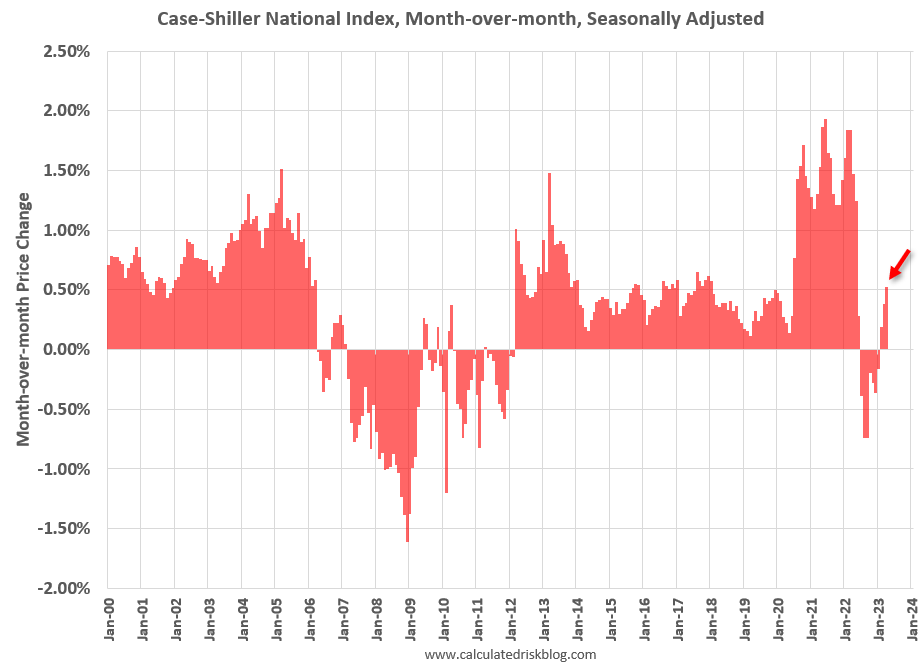
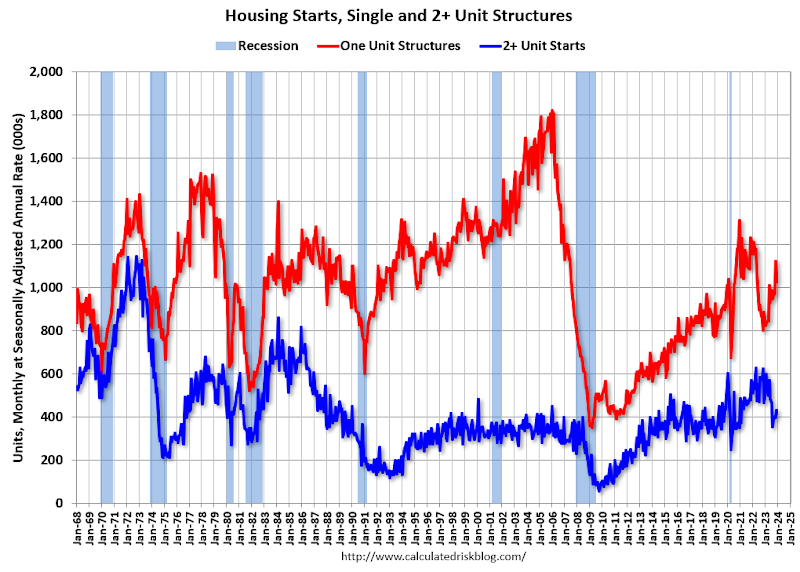
Inventory is pushing up prices, and affordability (the change in monthly payments) is pushing down prices. And it appears this battle will continue … there is no relief in sight for inventory or for mortgage rates....
First, we can be very confident - barring another crisis - that we will not see a large wave of distressed sales and cascading declines in nominal house prices. Lending has been reasonably solid over the last decade, and most homeowners have substantial equity in their homes.From Chapter 8: In the short run supply of houses ("inventory") is low, but so is demand (due to high interest rates) so we don't know which way price will go.
When the baby-boom generation starts moving to retirement homes or warmer climates, inventory will likely increase. But that is mostly a 2030s story, see
The left-leaning Economist thinks so:
Both sides agree that the old order that prized expertise, free markets and free trade—“neoliberalism”, usually invoked as a pejorative—was a rotten deal for America. Corporations were too immoral; elites too feckless; globalisation too costly; inequality too unchecked; the invisible hand too prone to error.

