Showing posts with label 04: Extent (how much) Decisions. Show all posts

Sunday, September 13, 2026

When driving is (almost) free


While I am pet-sitting for my sister in California, she is letting me use her beach-community house and electric car. It has been nice driving past gas stations with prices so high. She also has residential solar panels to charge her car (and run her other devices). The panels generate enough power that she is almost always "off the grid" with no electricity bill. So is the cost of driving zero? Should I be driving all over the place? 

Almost. The opportunity cost is what she would do with the surplus power she produces. Her utility will buyback her surplus power at $0.05-$0.08 per kwh while her retail rate is $0.45-$0.47 per kwh. Back in Texas these would be $0.07-$0.08 per kwh and $0.13-$0.19 per kwh. The opportunity cost in California is nearly 1/10 of the price while it is close to 1/2 in Texas. In Texas, I might drive a bit more if I had an EV and solar panels. In California, I would drive a lot more.

Saturday, May 30, 2026

Did incapacitation, deterrence, or rehabilitation reduce crime in Baltimore?

The Free Press:

Bates, ``a new tough-on-crime prosecutor, ... replaced a scandal-plagued `progressive.'” '' 

Incapacitation (selection): sometimes referred to as ``specific deterrence.''

Bates said that his office has identified about about 6,000 frequent, violent offenders and put between 3,000 and 3,500 of them in prison. The cooperation of federal law enforcement has helped take a number of these offenders off the streets.
Deterrence (incentives):
...more willingness to process felons in possession of a gun, and a more credible threat of punishment.
Rehabilitation:
“If you’re seeing your friends all going to prison, you’re going to go: ‘What? I don’t want to go to prison,’ ” Bates said. “Now all of a sudden, that job or that program someone’s offered you before that you didn’t want to talk about—now it looks pretty appealing.”

Saturday, February 21, 2026

If we tax the rich, ...

...they will leave, work less, and there are not enough of them to raise much money. 

The Economist: 

The “Robin Hood” state, which takes from the rich to give to the poor, has obvious appeal. Governments across the developed world are strapped for cash. Budgets are burdened by legacy debts, ageing populations and the need to spend more on defence. 

INSTEAD ...

The limited revenue-raising power of the rich is why European governments have to fund their big spending with broad-based levies, such as taxes on consumption. By contrast, America, with its low overall tax burden, can get by with one of the world’s most progressive tax systems.

Broad-based taxes do not only raise much more money. They are also politically healthier. A society where the many pay tax and benefit from spending is stronger than one where the few have to pay for the many.

BOTTOM LINE: lower rates on a broader base typically produce more tax revenue ... than high rates on a narrow base. ...

HOWEVER, if progress on artificial intelligence concentrates incomes at the top, as almost everyone in Silicon Valley expects, then the tax system will require fresh thinking:  ... we may have to figure out how to redistribute wealth without destroying too much of it.  

Friday, August 22, 2025

Best Teaching Video ever! (comparative advantage)

 From MRU via  Alex Tabarrok 

The excellent Don Boudreaux on comparative advantage, one of the deepest and most important ideas in economics.

As a new semester begins this is a good reminder that MRU has great videos for learning and teaching economics, all entirely free and open. (Of course, these videos pair delightfully with Modern Principles of Economics).

Timely topic.  

Thursday, June 5, 2025

Punishment increases → murder decreases

 From the FreePress:

...Five years ago, ...police activity and staffing fell in big cities (where most of the crime is), as demoralized cops left the force. ...new policies—from chokehold bans to “no-chase” policies—further constrained police activity. ...
Unsurprisingly, murder soared.
But now, following a political backlash, policing is back:
In those cities where activity has recovered—New York and Washington, D.C., for example—murder has fallen. In cities where activity remains low, like Seattle, murder is still high. 
However, police "have focused on bringing murder down, while sidelining other, less significant crimes. This helps explain surging public disorder, which has remained high even as homicide has dropped." 

BOTTOM LINE:  When criminals substitute away from high-punishment crimes, we say those crimes are "deterred," one of four justifications for punishment (Google):
  1. Retribution: This philosophy centers on the idea of "just deserts," meaning that offenders should be punished because they deserve it, and the punishment should be proportionate to the severity of the crime committed. It aims to achieve justice by making the offender suffer for the harm they've caused.
  2. Deterrence: Punishment can aim to prevent future crime by discouraging both the individual offender and others in society from committing similar acts.
    • Specific deterrence: Intends to discourage the individual offender from repeating the crime due to the fear of further punishment.
    • General deterrence: Seeks to make an example of the offender to dissuade others from engaging in criminal behavior.
  3. Incapacitation: This approach focuses on preventing future crime by removing the offender from society or limiting their ability to commit crimes. Examples include incarceration, house arrest, or even capital punishment.
  4. Rehabilitation: This goal aims to prevent future crime by altering the offender's behavior and addressing the underlying causes of their criminal conduct. Rehabilitation programs can include counseling, educational and vocational training, or treatment for substance use disorders.  

Friday, May 16, 2025

Too many Superheros?

How much content should a franchise produce? A recent WSJ story indicates that the expanding Marvel Cinematic Universe (MCU) is approaching a deluge. The graph they created certainly indicates a huge increase in content, mostly on TV. How much to produce is an extent decision.

On the one hand, the huge success of the Avengers related films created valuable brand awareness. The studio sunk the fixed costs into characterization, story lines, and production values that will pay off in terms of future audience engagement. That is, the marginal cost of attracting additional audiences is now lower because of these past investments. The strategic decision implied by lower MC is to increase content production.

On the other hand, the audience is experiencing diminishing marginal utility in consuming more content. It may not be worth it for fans to keep up with every thread in the franchise. Endgame culminated a consistent story arc that kept engagement high. Additional content necessarily means splintering story lines that fans need not keep up with. Perhaps the studio did not appreciate how the resulting lower MR would optimally lead to a reduction in content production.

There may be lessons here for the Star Wars universe.

Wednesday, May 22, 2024

On how to encourage college-educated women to have more kids


Economist  on how declining birth rates will lead to demographic catastrophe, a world populated by old retired people, and not enough young workers to support them.
More than half the drop in America’s total fertility rate is explained by women under the age of 19 now having next to no children. Around a third of the missing births would have been unplanned, and most of these would have been to women on low incomes.
However, instead of encouraging teenage pregnancies, the Economist tells us to encourage college pregnancies.
Only 8% of the children of American-born non-college-educated parents are themselves expected to obtain a bachelor’s degree, and during their adult life the average high-school graduate boosts the public finances by less than a tenth of the net contribution of a college graduate. 

Saturday, June 17, 2023

Does investing in Green Firms help the environment?

Freakonomics: NO
Green firms tend to be services firms. So, think Spotify, Prudential, Goldman Sachs, Allstate, MetLife, American Express. Silicon Valley Bank, which recently collapsed, is one of the greenest firms in our sample, which makes sense. How can a bank pollute that much, right? ... If it gets easier for these green firms to access capital, their environmental impact barely changes.
Instead consider investing in Brown Firms:
My analysis shows that brown firms are the firms with the greatest scope to change their environmental impact. So, in addition to investing in brown firms, it might be helpful to engage with their management.
CITE: Hartzmark and Shue, "Counterproductive Sustainable Investing."

Monday, June 12, 2023

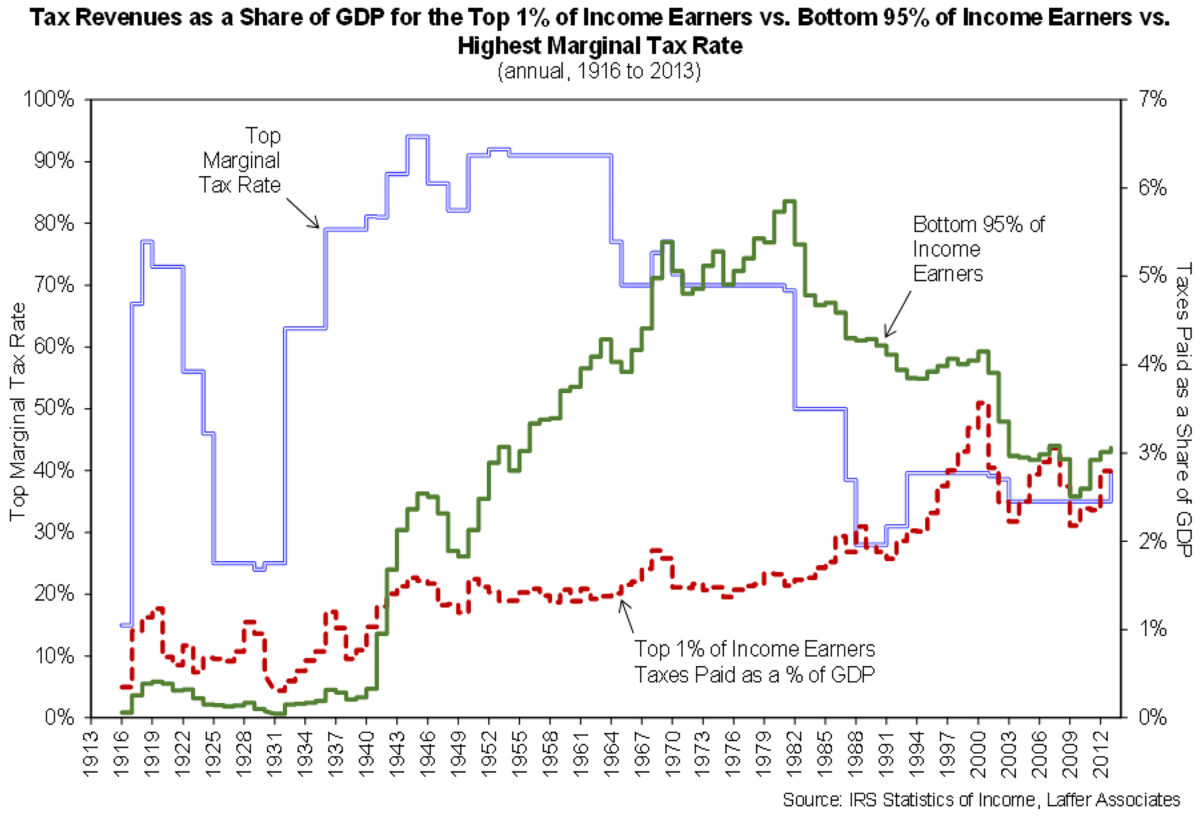
Why don't the rich pay more in taxes?

The graph shows that though the top marginal income tax rate has dramatically changed from 15% in 1913 to 37% today (marked by a blue line, left scale), but the share of taxes paid by the top 1% has not (red line, right scale). Here's why:
“Rich people are different than we are,” Laffer told The Epoch Times. “They can change the location of their income, they can change the volume of their income, they can change how many hours they work, they can change the composition of their income—how much of it is capital gains and how much of it is ordinary income. They can also change the timing of their income—things that normal people don’t think of, but rich people do.
UPDATE:  Loopholes are also available to the wealthy. Sec 1202 is used by wealthy to avoid tax up to $10 million. They put C Corp PE investments in multiple trust accounts to avoid $10 million multiple times. The carried interest is another unfair option. If the working class had the same tax rates as PE, they would have more money to invest in these funds. Shouldn’t everyone have the same opportunity to invest? We need lower tax rates for the working class so they have more opportunities to invest like the wealthy.
But these are pre-tax dollars.  After taxes and transfers, the share of the top 1% has not changed much, at least since 1960, plotted below (black line, from earlier post).

Saturday, April 1, 2023

California taxes almost eliminate he incentive to invest in education or training

MarginalRevolution reports on California's tax rates:
  • If a single parent of two in California earns $10k, the parent takes home $38k after taxes (an income subsidy or negative income tax).
  • If the same single parent were to earn $50k, the parent would take home $49k. 

Since "how much to work" is an extent decision, we use marginal analysis.  If the parent earns an extra $40K, the parent pays an extra $29K in taxes, a marginal tax rate of 73%=29/40.  In other words for every $1 earned between 10K and 50K, a single parent keeps only 27¢.  

  • ...And that's without childcare and housing subsidies!  (including them would further weaken the incentive to invest in human capital)

Bottom line: progressive taxes almost eliminate the incentive to invest in education or training.  

NOT AN APRIL FOOL'S JOKE.

Tuesday, March 21, 2023

How does ChatGPT characterize me?

Luke Froeb is an accomplished and highly experienced economist who has made significant contributions to the field of antitrust economics. He has held many important positions throughout his career, including Chief Economist at the Antitrust Division of the U.S. Department of Justice and Director of the Bureau of Economics at the Federal Trade Commission. Froeb is known for his extensive scholarship and research on competition policy, antitrust economics, and industrial organization. He has published numerous articles in top academic journals and has co-authored several highly regarded textbooks on the subject. Additionally, he has served as an expert witness in many high-profile antitrust cases. Froeb is also a respected educator, having taught at a number of universities, including Vanderbilt University where he currently serves as the William C. Oehmig Chair in Free Enterprise and Entrepreneurship. Through his teaching, research, and service, Luke Froeb has become a leading figure in the field of antitrust economics and has played a significant role in shaping antitrust policy in the United States.

Interestingly, it made up this part "co-authored several highly regarded textbooks on the subject."  That is a feature, not a bug, which is a byproduct of the "noise" it adds to its answer.  Without it, the writing seems seems sterile.  

Thursday, August 25, 2022

Collapse of Britain's Single Payer

from link:
Breast cancer sufferers had critical mammograms cancelled due to the pandemic. Nine out of ten NHS dental practices are not accepting new adult patients. GPs are quitting in droves. An unwell father of two waits 20 hours in A&E, refusing to leave until he gets a blood test, which ultimately reveals he is suffering from terminal leukaemia. A patient who, during lockdown, had his blood pressure managed remotely finally discovers his problem isn’t high blood pressure: he’s got a brain tumour.

HT:  marginalrevolution.com 

Tuesday, September 21, 2021

Good metaphor for tradeoffs associated with a bigger safety net

To communicate ideas, we need metaphors.  Greg Mankiw has a good one in this mornings NY Times, Can America Afford to Become a Major Welfare State?

Providing a social safety net is like using a leaky bucket to redistribute water among people with different amounts. While bringing water to the thirstiest may be noble, it is also costly as some water is lost in transit.

In the real world, this leakage occurs because higher taxes distort incentives and impede economic growth. And those taxes aren’t just the explicit ones that finance benefits such as public education or health care. They also include implicit taxes baked into the benefits themselves. If these benefits decline when your income rises, people are discouraged from working. This implicit tax distorts incentives just as explicit taxes do. That doesn’t mean there is no point in trying to help those in need, but it does require being mindful of the downsides of doing so. ...  

most European nations use that leaky bucket more than the United States does and experience greater leakage, resulting in lower incomes. By aiming for more compassionate economies, they have created less prosperous ones. Americans should be careful to avoid that fate.

Thursday, August 26, 2021

"Them Geezers is Bleedin' us Dry"

... or so claims a colleague of mine. He was referring specifically to their staunch defense of increased medicare spending. He might have been a bit untactful. I argued that it is likely appropriate to increase transfer payments for the medical care of senior citizens for at least two reasons. First, medical care has increasingly become effective. We have developed more treatments for more conditions and the pace of medical innovation is quite impressive. Or the marginal benefits of a dollar spent here has increased. Second, we are wealthier. We can better afford to subsidize others. Or the marginal cost has fallen. He grudgingly agreed but claimed this is not enough to account for the increase. When he told me expenditures per medicare enrollee increased tenfold, I was incredulous ... until I looked at the numbers. Sure enough, the number of enrollees increased somewhat, but expenditures per enrollee per year increased from ~$1,000 in 1980 to ~$10,000 in 2009. Folks, the automatic increases at this pace just aren't sustainable. I sure wish we could have an honest debate about it.

Wednesday, August 11, 2021

Economists vs. environmentalists

 Economics and environmentalism are belief systems that shape their adherent's way of thinking about the world.

                                                --Robert H. Nelson (link) 

When I earned my PhD, I started doing God's work (link to funny essay, "The Market as God") at the Justice Department, challenging anticompetitive mergers and putting price-fixers in prison.  My housemate was trying to do the same at the Environmental Protection Agency, using marginal analysis to design incentives to get polluters to face the consequences of their behavior.  If polluters produce up to the point where

    MR=MC

an output tax equal to the harm they cause, T=P, would bring pollution down to the point where the benefits of producing more are equal to its costs, including the costs of pollution.

    MR=MC+T.

There is legitimate debate about the magnitude of P but the principle seems obvious.  But not to [some/many?] environmentalists at the EPA.  They worship another God, and view all pollution as heresy.

In 2009, this debate made it up to the Supreme Court, where the economists prevailed, 6-3:
...the Supreme Court overturned [Sotomayor's earlier appellate decision that straightforward benefit-cost analysis was illegal] in a 6-3 ruling...

For the time being, benefit-cost analysis is OK.  

Sunday, August 1, 2021

What my daughter is learning in Rome

We have blogged about the labor market problems in Italy before:

This is why Southern Europe is a mess
Look ahead and reason back:  Italy
If you can measure absenteeism, you can control it

But I never realized how bad it was until I received this e mail from my daughter who is studying in Rome this summer:
Today, in my global practicum class we had a speaker who owns several McDonald's franchises in Rome and he enlightened us on the troubles of being an employer in Italy
 

First of all, he said, all employees who are hired, are hired for life.
They are allotted 6 weeks of paid vacation per year-- even working at Mcdonald's!!!
 

Each employer must pay a 100 percent tax of what he pays to the employee to the government.
 

Each employee has a 6 month paid sick leave per year that they can take with a valid doctors note. (which many tend to pull off with ease)
 

Employees are not allowed to be fired for poor behavior or work ethic, only if they steal or destroy company property.
If the employee is fired and sues the employer, the case is taken to civil court.  Most of these cases can take up to 3 years to be processed, 90% of the time the judge rules in favor of the employee and then the employer must pay 15 months salary for firing them, pay the salary they would have earned during the three years it took the case to be processed, and then must rehire the employee.

So basically no one wants to own or start a business in Italy, but everyone wants a freaking job.

Feel free to forward this to father, I am sure he would be interested, and I thought America was corrupt.
Her semester abroad seems like money well spent. 

Sunday, January 24, 2021

What do randomized control trials tell us about the minimum wage?

from MarginalRevolution.com

... almost all of the effects of the minimum wage came from substitution of higher productivity for lower productivity ones, which wouldn’t show up in headcounts, and reduction in hours worked, which is not measured in most conventional data sets.

Tuesday, January 19, 2021

Can money buy happiness?

Contrary to what I was taught in Sunday School, self-reported happiness rises with income, but at a declining rate:

each dollar (of income )starts to matter less the more a person earns. "We would expect two people earning $25,000 and $50,000, respectively, to have the same difference in well-being as two people earning $100,000 and $200,000, respectively. In other words, proportional differences in income matter the same to everyone."


Sunday, December 1, 2019

Sales "bunching" and high-powered commission rates

Ian Larkin studies the use of "high powered" quarterly sales commissions, used by virtually every firm that sells software. A typical incentive compensation scheme (as a function of sales) is highly convex: a sales person earns 2% if she sells $100,000 worth of software; 5% if $500,000; 8% if $1,000,000, ..., up to 25% if $8,000,000.

Ian finds that these high-powered (convex) compensation schedules give sales people an incentive to "bunch" sales into the same quarter. Just as convex production costs can be reduced by "smoothing", i.e., holding inventories to buffer sales shocks, so too can convex commissions be increased by "bunching" sales into the same quarter, the opposite of "smoothing."

Using proprietary data from a large vendor he finds that 75% of sales are occur on the last day of the quarter; and 5% of sales occur on the first day of the quarter, as sales people give discounts to customers to accelerate or delay purchases. These discounts cost the firm about 7% of revenue, which is about the same amount that it pays out in sales commissions.

The 7% revenue loss suggests that there is a way to make both firm and its salespeople better off: adopt linear commission schemes to eliminate the incentive to "bunch," and split the 7% savings between the firm and its sales people in the form of higher commission rates.

When asked why they use these costly incentive compensation schemes, managers say only that they need them to retain their "superstar" sales people. But surely there is a better way to retain superstars, isn't there? As always, I would like to hear from readers on whether they think this would work.