None, the market will do it; unless the Mississippi State Attorney General gets in the way.
Monday, August 31, 2015

Auctions versus Posted Price
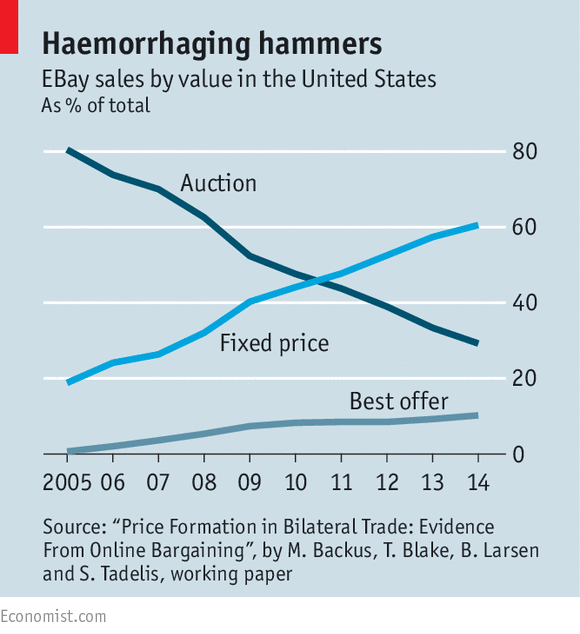
The Economist is reporting that auctions are no longer the main way items are sold on Ebay. Current research indicates that only a fraction of this decline can be explained by a product mix moving toward more mass-produced items or to more professional sellers. The conjecture is that the higher hassle costs, including sniping, are driving buyers to fixed price offers.

Thursday, August 27, 2015
China liquidates US treasuries to support yuan
Running a trade surplus makes your currency stronger, and in the graph below, we see the yuan appreciating relative to the dollar, from rom over 8 to the dollar, to only 6.5. It would have appreciated faster, but the Chinese government has been buying buying treasuries to slow appreciation, which makes their exports cheaper than they would have been, which helps Chinese companies and employment (but hurts Chinese consumers).

A few weeks ago, the Chinese government's decided on a sudden depreciation the yuan (back down to 6.5 to the dollar) to stimulate their domestic economy. You can see this in the small spike at the far right of the graph. But now the Chinese government has decided that the currency fell too far, and has been selling treasuries to support the yuan.
If the Chinese sell treasuries (borrowing by the US government), this puts downward pressure on treasury prices, and upward pressure on yields. If US treasury yields rise, the cost of borrowing increases, and the government (and private borrowers) will face a higher cost of capital. The dollar will also appreciate. All of these effects will hurt US companies (and employment).
The interactions between markets (foreign exchange, domestic unemployment, domestic interest rates) is the hallmark of macroeconomics. Microeconomics typically focusses on only one market at a time.

A few weeks ago, the Chinese government's decided on a sudden depreciation the yuan (back down to 6.5 to the dollar) to stimulate their domestic economy. You can see this in the small spike at the far right of the graph. But now the Chinese government has decided that the currency fell too far, and has been selling treasuries to support the yuan.
The clear takeaway is that there's a substantial amount of upward pressure building for UST (US Treasury) yields and that is a decisively undesirable situation for the Fed [Federal Reserve] to find itself in going into September.
If the Chinese sell treasuries (borrowing by the US government), this puts downward pressure on treasury prices, and upward pressure on yields. If US treasury yields rise, the cost of borrowing increases, and the government (and private borrowers) will face a higher cost of capital. The dollar will also appreciate. All of these effects will hurt US companies (and employment).
The interactions between markets (foreign exchange, domestic unemployment, domestic interest rates) is the hallmark of macroeconomics. Microeconomics typically focusses on only one market at a time.
Thursday, August 20, 2015
PUZZLE: Graduate students are only 14% of total; but account for 40% of debt
WSJ has the answer: moral hazard
But why don't we see this at the undergraduate level?
HT: MH
Propelling the surge in grad-school debt is a welter of federal programs that make it easy for students to borrow large amounts, then to have substantial chunks of those debts eventually forgiven. Critics of the system say it makes it easier for graduate schools to raise tuition, and for some high-earning graduates such as doctors to escape debts they can afford to repay.
But why don't we see this at the undergraduate level?
Federal programs allow grad students to borrow essentially unlimited amounts—whatever their schools charge—while requiring only a scant credit check and no assessment of their ability to repay. Other government loan programs, such as those for undergraduate students and home buyers, set loan limits to prevent borrowers from getting too deep into debt. Undergraduates are capped at $57,500 total in federal loans.
HT: MH
Tuesday, August 18, 2015
PUZZLE: why do unions want the flexibility to opt out of minimum wage laws?
The answer comes straight out of strategy:
This flexibility gives unions an advantage over non-unionized competitors, who must be hired at the minimum wage.
MAXIM: Make the rules or your rivals will.
...unions could advise companies that if they agree to labor representation, they can avoid paying the minimum wage, spending less on wages overall. The strategy could let unions bolster their ranks at a time when union membership is falling, ...
This flexibility gives unions an advantage over non-unionized competitors, who must be hired at the minimum wage.
MAXIM: Make the rules or your rivals will.
Tuesday, August 11, 2015
CEO of Wendy's weighs in on Nashville mayoral race...
...albeit indirectly. On last week’s call with securities analysts, Wendy’s CEO Emil Brolick was asked how he will respond to minimum wage hikes, like that proposed by Megan Barry, one of the two Nashville Mayoral Candidates in a runoff:
BLOGGING DISCLOSURE: I am supporting the other candidate, David Fox, and his wife is a former student.
“our franchisees will likely look at the opportunity to reduce overall staff, look at the opportunity to certainly reduce hours and any other cost reduction opportunities, not just price. You know there are some people out there who naively say that these wages can simply be passed along in terms of price increases. I don’t think that the average franchisee believes that.”
Mr. Brolick elaborated that “we believe that some of these increases will clearly end up hurting the people that they are intended to help."
BLOGGING DISCLOSURE: I am supporting the other candidate, David Fox, and his wife is a former student.
Opening shot fired in currency war?

China's unexpected devaluation of its currency lead to a decline in world wide stocks, global commodity prices, and and increase in US bond prices. This could be the opening salvo in a long and expensive currency war:
One reason is that it raises fears of a more intense and destabilising currency war — the trend for countries to use a weaker exchange rate rather than supply-side efficiencies — to bolster exports. ...
Tuesday’s PBoC move followed the release of weak trade data over the weekend that showed exports tumbled 8.3 per cent in July from a year earlier.
Sunday, August 9, 2015
Film premiere: India awakes
We have blogged about the renaissance in India, driven by the institutions of capitalism: markets, free trade, private property, and de-regulation. Now the good people at CATO have a documentary about it.
|
Documentary Preview and Discussion
Friday, August 14, 2015
12:00 – 1:30PM
Featuring Johan Norberg, Film host and Senior Fellow, Cato Institute. Moderated by Ian Vasquez, Director, Center for Global Liberty and Prosperity, Cato Institute.
For many centuries, only the politically connected and elite prospered in India, while the rest of the population lived in poverty. Since 1991, however, 250 million people have been lifted out of poverty and are finding new ways of unlocking their potential. India Awakes explores an inherited British bureaucracy, which created layers of rules and regulations, and it shows how globalization and economic liberalization are leading to social change. Join us to see a segment of the documentary from the Free to Choose Network. Film host Johan Norberg will discuss how individuals from different parts of India are breaking down the centuries-old caste system through new opportunities, entrepreneurship, and by obtaining property and other legal rights.
|
Friday, August 7, 2015
What will happen if Nashville introduces a $15 minimum wage?
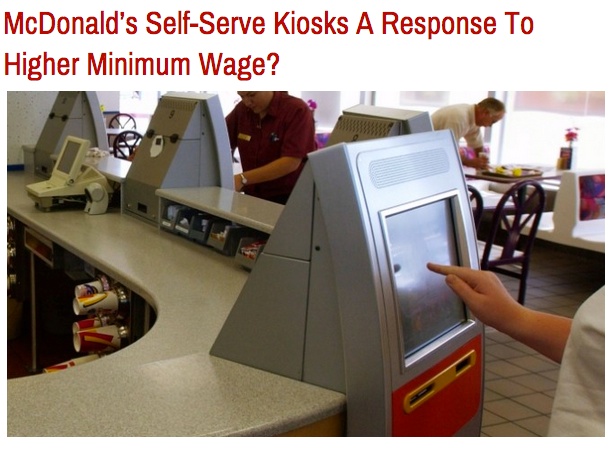
Fast food chains are exploring new ways for customers to order their meals without having to interact with a cashier. Labor costs are rising and consumers are demanding ever faster, more convenient service. At McDonald’s, self-service kiosks are popping up in restaurants in the U.S. after the burger chain saw some success with the machines overseas.
Megan Barry, one of Nashville's mayoral candidates, has called for an increase in the Nashville minimum wage. If fast food restaurants respond to the incentives created by the higher labor costs, we can expect to see fewer entry level jobs, as firms replace more costly labor with cheaper alternatives. Even Democrat Warren Buffet thinks that a $15 minimum wage would crush employment.
Thursday, August 6, 2015
Repost: Avoid Bureaucratese
Repost: avoid bureaucratese
There is a temptation, especially when you have nothing substantive to say, to write in the passive voice, using big words, and ponderous prose. If you notice these tendencies in yourself, you are probably OK. But if you don't, you may be speaking in what Alfred Kahn calls "bureaucratese."
Although Kahn is most remembered for deregulating the airlines industry, Vanderbilt students know him through his essay,My War Against Bureaucratese," the gobbledygook written by government bureaucrats designed to hide what they are really doing. Here are a few of his most salient points:
Former colleague Mike Shor's MBA Writer puts phrases from student memos together to generate sentences that sound all too familiar.
- “Every time you’re tempted to use ‘herein’ or ‘hereinabout’ or ‘hereinunder’ or, similarly, ‘therein,’ thereinabove’ or ‘thereinunder,” and the corresponding variants, try ‘here’ or ‘there’ or ‘above’ or ‘below,’ and see if it doesn’t make just as much sense.”
- “The passive voice is wildly overused in government writing. Typically its purpose is to conceal information. One is less likely to be jailed if one says, ‘He was hit by a stone,’ than if he says, ‘I hit him with a stone.’ The active voice is far more forthright, direct, humane.”
- The use of ‘presently’ to mean ‘now’ is another pomposity. If you mean ‘now,’ why don’t you say ‘now’?
- “Why use ‘regarding’ or ‘concerning’ or ‘with regard to’ when the simple word ‘about’ would do just as well? Unless you’re trying to impress somebody. But are you sure you want to impress anybody who would be impressed by such circumlocutions?
- “Outreach makes me upchuck.” Sometimes the demands of pomposity and dynamism converge—as in using “input” as a verb, “specifics” for “details” and constantly “implementing” things and “addressing issues.”
Former colleague Mike Shor's MBA Writer puts phrases from student memos together to generate sentences that sound all too familiar.
To proactively manage profit, our key initiative objective pushes the envelope toward systematized reciprocal capability.
Enabling continuity, enterprise optimization accelerates the movement towards third-generation contingencies.
Subscribe to:
Posts (Atom)